
BPA Computer Security Practice Test
$69.00
- Buy to unlock unlimited access to all Quiz questions and Answers in this Quiz.
- After purchase you can print a PDF of the whole quiz at any point. The PDF will contain the questions and the correct answers.
About this Exam
The BPA Computer Security exam is a prestigious component of the Business Professionals of America (BPA) Competitive Events program. It is designed for ambitious high school and post-secondary students who are passionate about cybersecurity, information technology, and network defense. This certification proves a student’s ability to understand, analyze, and implement fundamental security management tasks. It serves as a strong indicator to colleges and future employers that the student possesses the foundational hard skills required for the rapidly growing cybersecurity workforce.
Ready to test your knowledge?
Buy Now to Access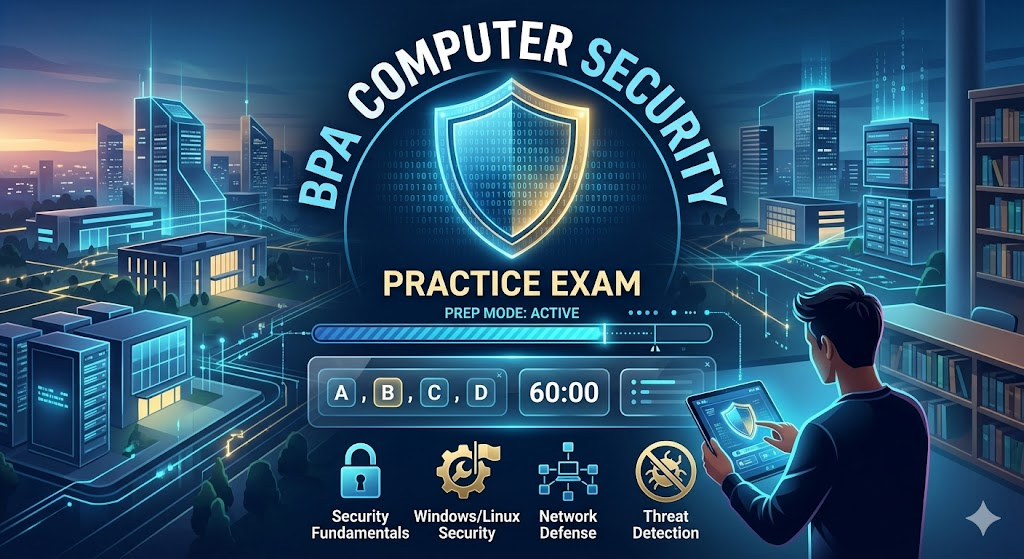
Additional Information
What the Course Entails and Exam Details
This examination does not stem from a singular course but rather represents a comprehensive standard of knowledge in the IT security domain. The core syllabus focuses on managing security within both Windows and Linux networking environments. Students must develop competencies in several key areas. These include fundamental security principles (the CIA triad: confidentiality, integrity, availability), identifying common security threats such as malware, phishing, and social engineering, and understanding the legal and ethical responsibilities of security professionals. Technical skills are required in securing network infrastructure, using cryptographic tools, and configuring security settings within diverse operating systems to harden them against attack.
What to Expect in the Final Exam
At the preliminary levels (Regional and State), students should expect a primarily objective examination consisting of multiple-choice questions. This portion tests theoretical knowledge and problem-solving scenarios. Students face a strictly enforced time limit, typically 60 minutes for the objective test. There isn't a single universal passing score; rather, high scores determine ranking, and top students advance to the next level of competition. A critical rule is that reference materials are generally prohibited during the preliminary objective tests, and all electronic devices like phones are monitored and restricted according to official BPA standards. Success at the top tier (National) may introduce practical, hands-on application components for the highest-ranking finalists.
How to Study and Exam Centers
Actionable study strategies must combine theory with practice. First, students should utilize BPA-specific practice tests to become familiar with the style and phrasing of standard questions. Second, hands-on lab work is essential; students should set up virtual machines to practice securing both Windows and Linux operating systems firsthand. Third, study the official BPA Competitive Events guidelines for the current year to ensure they are prioritizing the correct competencies. Regarding logistics, the BPA Computer Security exam is unique because you cannot register for it at a standard commercial testing center like Pearson VUE. The examination is administered exclusively through your school’s official BPA chapter advisor. The testing takes place locally at authorized Regional Leadership Conferences and subsequently at State Leadership Conferences, often hosted by specific high schools or colleges. Only qualifying students advance to take the final level of competition at the National Leadership Conference.
Job Opportunities from the Course
Earning a top ranking in this BPA event validates the technical skills needed for an entry-level career in cybersecurity and IT. It acts as a powerful discriminator on a resume, demonstrating initiative and proven competence to recruiters.
While this is a student competition rather than a professional licensure, it unlocks the following career paths and specific entry-level job titles:
Junior Cybersecurity Analyst: A role focused on monitoring networks for security breaches and responding to initial alerts.
Information Security Specialist: An entry-level position responsible for implementing and maintaining security controls.
Junior Network Security Engineer: A technical role that supports the design and maintenance of secure network architecture.
IT Support Technician (Security Focus): A desk-side or remote support role where specialized security knowledge helps resolve secure user access and malware issues.
System Administrator Apprentice: A training path leading to managing servers with a strong emphasis on security hardening and user permissions.
Security Auditor Trainee: An introductory path where individuals learn to review organization systems against established security standards.
Frequently Asked Questions
Reviews
5.0
Based on 0 reviews
Leave a Review
No reviews yet. Be the first to review!