
BPA Health Administration Procedures Practice Test
$69.00
- Buy to unlock unlimited access to all Quiz questions and Answers in this Quiz.
- After purchase you can print a PDF of the whole quiz at any point. The PDF will contain the questions and the correct answers.
About this Exam
The BPA Health Administration Procedures exam is a cornerstone of the Business Professionals of America (BPA) Workplace Skills Assessment Program.
It is specifically designed for secondary and post-secondary students who aspire to careers in the dynamic field of healthcare administration.
This certification serves as a powerful validation of a student’s fundamental knowledge and practical skills required to manage the administrative operations of a medical facility.
By preparing for and passing this exam, students demonstrate their readiness for entry-level roles that keep modern healthcare organizations running smoothly.
This event is an exceptional opportunity to translate classroom learning into a tangible professional credential.
Ready to test your knowledge?
Buy Now to Access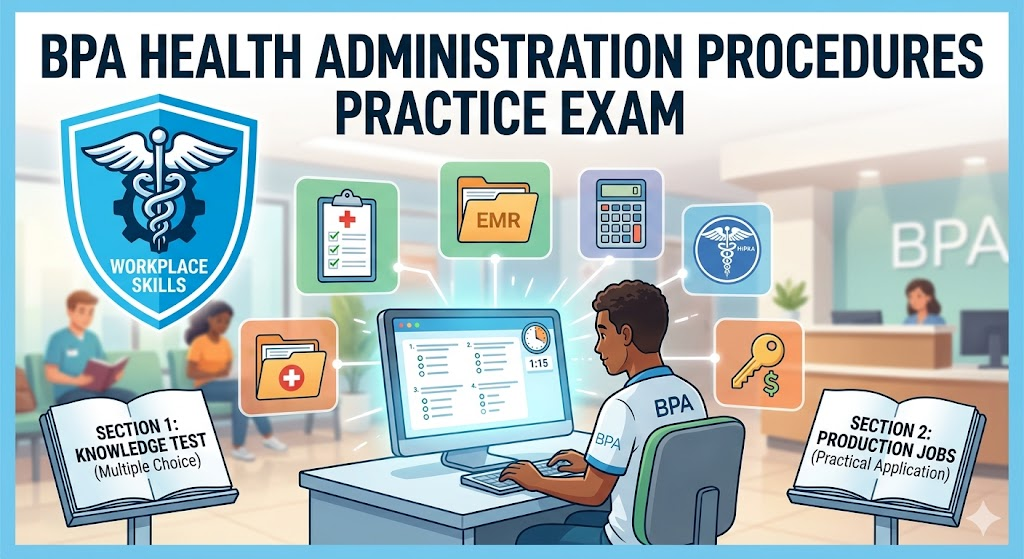
Additional Information
What the Course Entails and Exam Details
The core curriculum leading to this exam, often aligned with a Health Administration course, covers a robust syllabus essential for clerical excellence in a medical setting.
Students gain proficiency in medical terminology, understanding the language of healthcare to facilitate clear communication.
The syllabus emphasizes administrative medical office procedures, including efficient scheduling, effective patient communication, and meticulous medical records management.
A significant portion of the course detail focuses on health insurance and medical billing, teaching participants how to navigate claims, coding, and basic reimbursement processes.
Beyond administrative tasks, the exam evaluates an understanding of healthcare regulations, ethics, and the critical maintenance of patient confidentiality as mandated by laws like HIPAA.
What to Expect in the Final Exam
The final BPA Health Administration Procedures exam is a rigorous assessment comprising two distinct components designed to test both objective knowledge and practical application.
The first component is an objective test, which usually consists of multiple-choice and true/false questions that evaluate a candidate’s understanding of the theoretical concepts, regulations, and terminology.
The second part is a production-based application event, where students must use computers and software to complete realistic administrative tasks.
These tasks might include generating professional medical correspondence, managing schedules, or processing sample insurance data, all while adhering to the formatting standards detailed in the official BPA Style & Reference Manual.
While exact points can vary by competition year, the standard event structure allots 60 minutes for the testing portion, with additional time for orientation and wrap-up.
How to Study and Exam Centers
The key to success in this exam is a balanced approach that combines structured review with hands-on practice.
A primary strategy should involve a deep dive into the official study materials, which include the specific event guidelines published in the BPA Workplace Skills Assessment Program (WSAP) guidelines and the BPA Style & Reference Manual.
Utilizing a comprehensive study guide is vital, and students should prioritize taking a realistic health administration procedures practice test.
These practice exams replicate the objective question format and provide simulations of the production tasks, allowing you to refine your technical skills and manage your time effectively.
The exam itself is typically administered during regional, state, and national BPA conferences, often utilizing dedicated, authorized computer centers at authorized schools or official testing sites.
For specific information on online portals or physical exam centers, you must consult your local or state BPA chapter, as scheduling and location logistics are managed hierarchically.
Job Opportunities from the Course
Earning the BPA Health Administration Procedures credential unlocks a variety of promising career paths within the expanding healthcare industry.
By completing this course of study, you are qualified to pursue entry-level positions across different settings, including hospitals, multi-specialty clinics, dental practices, and rehabilitation centers.
These roles are often critical operational nodes, ensuring patient data is accurate, appointments are managed, and communication channels are open.
Successful candidates can transition directly into roles that provide essential infrastructure support to medical teams.
Common job titles and career paths available with this certification include:
Medical Receptionist
Medical Secretary
Patient Coordinator
Health Unit Coordinator
Medical Billing Assistant
Medical Records Clerk
Admissions Clerk
Medical Office Assistant
Administrative Assistant in Healthcare
Frequently Asked Questions
Reviews
5.0
Based on 0 reviews
Leave a Review
No reviews yet. Be the first to review!