
BPA Payroll Accounting Practice Test
$69.00
- Buy to unlock unlimited access to all Quiz questions and Answers in this Quiz.
- After purchase you can print a PDF of the whole quiz at any point. The PDF will contain the questions and the correct answers.
About this Exam
The BPA Payroll Accounting competitive event is a cornerstone of the Finance category within the Workplace Skills Assessment Program (WSAP). Designed primarily for middle level, secondary (high school), and post-secondary students who are members of the Business Professionals of America (BPA), this exam measures comprehensive knowledge of payroll procedures and the surrounding regulatory framework. It is ideal for students aiming to demonstrate technical proficiency in accounting, mathematical acumen, and an understanding of the intricate laws that govern employee compensation in the United States. Preparing for this exam helps student members validate the entry-level skills required by employers across all industries.
Ready to test your knowledge?
Buy Now to Access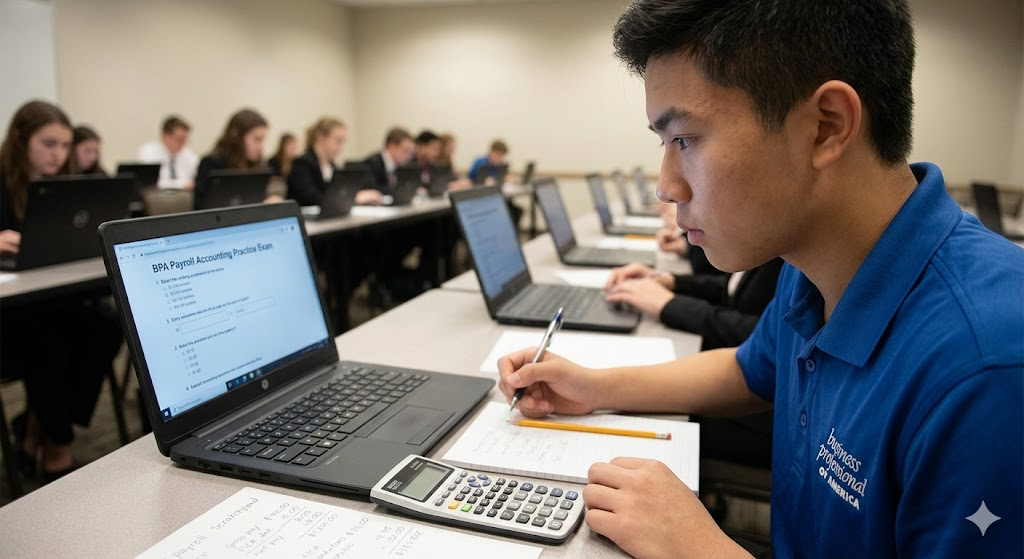
Additional Information
What the Course Entails and Exam Details
While not a formalized "course" with a fixed curriculum outside of the BPA WSAP guidelines, preparation for this exam encompasses a robust syllabus of essential payroll concepts. Candidates must master both manual calculation methods and the fundamental laws that underpin the process.
The core competencies tested include:
Federal Legislation: Mastery of the Fair Labor Standards Act (FLSA), including minimum wage, overtime regulations for exempt and non-exempt employees, and child labor laws.
Tax Documentation: An understanding of required employee and employer forms, such as Form W-4, Form W-2, Form 941 (Employer's Quarterly Federal Tax Return), and Form 940 (FUTA).
Payroll Calculations: The ability to calculate gross pay based on various methods (hourly, salary, piece-rate, commission) and compute all necessary deductions. This includes statutory deductions (Social Security, Medicare, federal and state income tax withholding) and voluntary deductions (retirement, health insurance).
Employer Taxes: Accurate computation of the employer’s share of FICA taxes, as well as Federal Unemployment Tax (FUTA) and State Unemployment Tax (SUTA).
Accounting Entries: The skill to journalize payroll transactions, including recording payroll expense, recording employee and employer liabilities, and the subsequent payment of those liabilities.
Recordkeeping: Knowledge of required record retention periods and best practices for maintaining master file integrity.
What to Expect in the Final Exam
The final examination for BPA Payroll Accounting is a rigorous assessment typically delivered in a computerized format at regional, state, and national leadership conferences. It consists of two distinct parts that evaluate both theoretical knowledge and practical application.
Part One: Objective Knowledge This section features multiple-choice and true/false questions. These questions test a candidate's recall of definitions, regulatory deadlines, legal requirements of the FLSA, tax form purposes, and basic accounting principles related to payroll.
Part Two: Problem Solving and Application The second part is a practical application section that requires candidates to perform calculations and prepare documents. Students might be required to complete a payroll register, compute net pay for employees with complex scenarios (such as overtime or tax levy deductions), prepare specific tax forms, or create the necessary journal entries to record a complete payroll cycle.
The exam has a strict time limit, usually ranging from 60 to 90 minutes depending on the competition level (Secondary vs. Post-Secondary). While specific passing scores vary by year and are determined relative to the applicant pool at each level of competition, candidates generally need to achieve high scores to place and advance. Students are typically permitted to use a non-programmable calculator.
How to Study and Exam Centers
Effective preparation for the BPA Payroll Accounting exam requires a blend of studying theoretical material and active practice.
Study Strategies:
Utilize Official BPA Resources: Start with the official Workplace Skills Assessment Program (WSAP) Guidelines provided to BPA members. This document outlines the exact competencies tested. Use the designated BPA Style & Reference Manual for consistency in journal entries and calculations.
Practice with Past Exams: The most effective way to prepare is to practice using previous years’ BPA competitive event exams. These give an accurate feel for the question style, formatting, and time pressure.
Focus on FLSA and Circular E: Master the core requirements of the Fair Labor Standards Act. Additionally, become very familiar with IRS Publication 15 (Circular E), the Employer’s Tax Guide, which is the foundational document for federal tax calculations and forms.
Simulate Real-World Scenarios: Create hypothetical payroll scenarios and manually calculate gross-to-net pay. practice journalizing these scenarios from the perspective of the employer.
Exam Centers and Registration:
As a competitive event, the BPA Payroll Accounting exam is taken exclusively by registered BPA members. The exams are administered at designated sites during scheduled BPA conferences. These sites are not open to the general public.
Regional Leadership Conferences (RLC): The initial level of competition. Exams are held at local schools, colleges, or community centers authorized by the local BPA region.
State Leadership Conferences (SLC): Qualified students advance to the state level, where exams are administered at larger, centralized physical testing centers, often convention centers or major hotels hosting the state conference.
National Leadership Conference (NLC): The final level of competition, held in a different major U.S. city each year. Only top-tier state qualifiers compete here.
Candidates must work with their local BPA Chapter Advisor to register for these conferences and events.
Job Opportunities from the Course
Mastering the competencies tested in the BPA Payroll Accounting event validates that a student possesses specialized knowledge in high demand across the business sector. While not a standalone licensure, placing well in this competitive event is a significant achievement to highlight on a resume.
This certification helps unlock the following job opportunities and career paths:
Payroll Clerk / Assistant: entry-level positions responsible for data entry, basic timekeeping, and simple payroll calculations.
Payroll Specialist: A more advanced role focused on managing the end-to-end payroll process, including complex taxation and benefits compliance.
Accounting Clerk: A generalist role in which payroll is one of many responsibilities, alongside accounts payable and receivable.
Payroll Coordinator: A mid-level administrative role involving supervision of data submission and reconciliation of payroll records.
Payroll Manager: A leadership position responsible for overseeing the entire payroll department, ensuring regulatory compliance, and managing vendor relationships.
Compensation and Benefits Analyst: A human resources career path focused on analyzing pay structures, competitiveness, and employee benefits programs.
Tax Accountant (Payroll Specialization): Focusing on the complex tax filing and compliance landscape for corporate payroll.
Frequently Asked Questions
Reviews
5.0
Based on 0 reviews
Leave a Review
No reviews yet. Be the first to review!