
BPI Building Analyst Practice Test
$69.00
- Buy to unlock unlimited access to all Quiz questions and Answers in this Quiz.
- After purchase you can print a PDF of the whole quiz at any point. The PDF will contain the questions and the correct answers.
About this Exam
The Building Performance Institute (BPI) Building Analyst (BA-P) certification is a prestigious, nationally recognized credential designed for professionals in the home energy auditing and home performance fields. This certification proves that an individual understands the complex relationship between various systems within a home—such as building tightness, ventilation, insulation, and the performance of combustion appliances. The core mission of this certification is to ensure homes are energy-efficient, safe, and durable.
The BPI Building Analyst is typically designed for HVAC technicians, energy auditors, insulations professionals, home inspectors, green building consultants, and facility managers looking to transition into residential energy efficiency work. This certification validates your expertise in identifying energy-saving opportunities and ensuring that improvements, often referred to as 'retrofits,' do not compromise the safety of the residents.
Ready to test your knowledge?
Buy Now to Access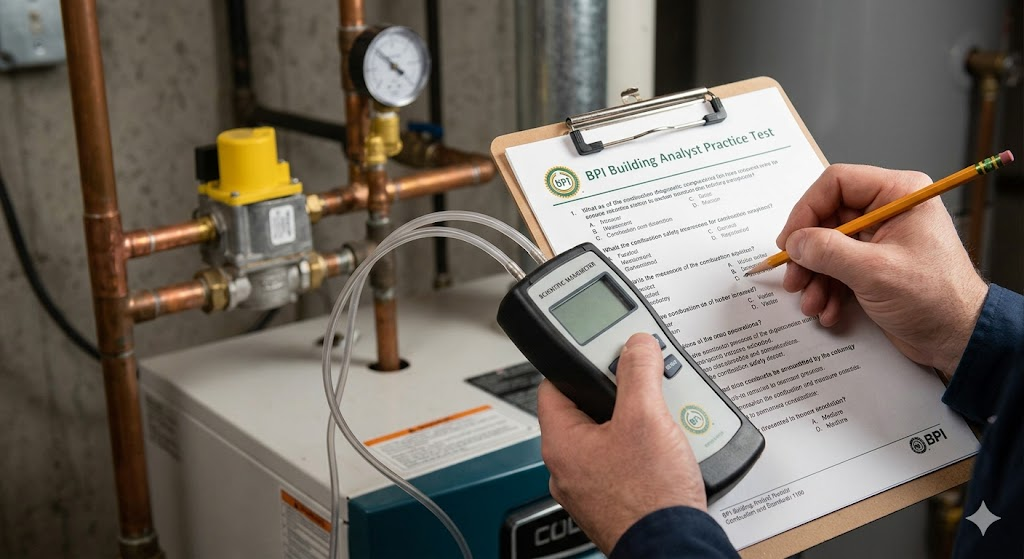
Additional Information
What the Course Entails and Exam Details
The path to becoming a certified BPI Building Analyst combines theoretical knowledge with applied field assessment skills. The training courses leading to the exam are comprehensive and highly structured. They cover the essential "whole-house" science that views the home as a set of interconnected systems rather than a series of individual appliances.
The core modules of a typical training course and the key domains covered by the certification include:
Building Science Principles: Fundamentals of heat transfer, air migration, moisture transport, and the laws of thermodynamics in buildings.
The Whole-House Concept: Understanding how building tightness, insulation, ventilation, and mechanical systems interact to affect home performance and durability.
Combustion Safety Testing: Crucial safety protocols, including testing all combustion appliances (furnaces, boilers, water heaters, gas fireplaces) for carbon monoxide production, proper draft (ventilation), and gas leaks. This is perhaps the most vital component, as energy work must not create carbon monoxide hazards.
Building Envelope Assessment: Evaluating the quality, placement, and effectiveness of insulation, air barriers, and identifying significant thermal defects.
Testing and Diagnosis: Mastery of dynamic testing equipment, particularly the blower door (for measuring overall air leakage) and duct blasting systems (for measuring ductwork leakage).
Data Collection and Reporting: How to perform a comprehensive energy audit, document findings, interpret data, and generate actionable reports for homeowners, including prioritizing recommended energy efficiency improvements.
What to Expect in the Final Exam
The certification process involves passing both a theoretical knowledge exam and a rigorous practical field examination, though many initial study guides and 'practice tests' are targeted toward the written knowledge assessment.
The BPI Building Analyst (BA-P) exam components are:
The Written Exam (Knowledge Component)
Format: This is a standardized, multiple-choice exam administered via a computer at a secure testing location.
Duration: Candidates generally have two (2) hours to complete the written portion.
Questions: The exam consists of approximately 100 multiple-choice questions covering all theoretical aspects of building science, combustion safety, and diagnostic procedures.
Passing Score: The passing score is 70%.
The Practical Exam (Field Assessment Component)
Format: This is a hands-on, one-on-one evaluation conducted in a real "test house" by a certified BPI Proctors.
Duration: Candidates are typically given approximately two (2) hours to complete the field assessment.
Requirements: Candidates must demonstrate proficiency in setting up and operating the diagnostic equipment (such as the blower door and manometer), performing every combustion safety protocol flawlessly, identifying structural and insulation issues, and explaining their findings in real-time to the proctor.
Passing Score: Candidates must score at least 70% overall, but must pass all "mandatory" safety steps, particularly those relating to combustion safety, with 100%.
How to Study and Exam Centers
Effective preparation for the BPI Building Analyst certification requires a dual approach that targets both theoretical comprehension and hands-on skill.
For the Written Exam, a combination of dedicated study and practice questions is key:
Study the "Redline" (BPI Standards): Obtain and study the current BPI standards documents, which contain the specific criteria by which performance is measured.
Practice Tests are Essential: Utilize realistic practice exams and question banks. These help you become familiar with the phrasing of questions and identify your weak subject areas (e.g., combustion physics or insulation types).
Flashcards: Create flashcards for critical definitions, diagnostic formulas (like CFM50 calculation), and exact BPI protocols, especially for combustion safety levels and air changes per hour (ACH).
For the Practical Exam, there is no substitute for supervised, hands-on field experience:
Enroll in a BPI-Approved Training Course: This is highly recommended and often a requirement. Most authorized training providers offer intensive, multi-day, or week-long programs that include theoretical classroom time followed by extensive, supervised practical training in a designated test lab or real-world house.
Shadow Experienced Auditors: If possible, apprentice under an existing certified auditor to watch real audits and gain experience handling the equipment.
Simulate the Test: Practice performing a full audit, starting with the client interview and moving through to combustion safety, with a stopwatch. Ensure you can perform every safety test, like the draft test on a natural draft water heater, precisely as written in the protocols.
Where and how to take the exam: The BPI exams are administered through BPI Test Centers. These test centers are generally authorized colleges, vocational schools, green building organizations, or private training providers that have the required diagnostic labs for the practical exam and the computer labs for the written component. To take the exam, you must register through one of these authorized organizations rather than a generalized center like Pearson VUE. BPI provides a searchable map of authorized test centers on their official website.
Job Opportunities from the Course
A BPI Building Analyst certification is a critical, often requisite, credential in the expanding field of green construction and home performance. It signals to employers that you have the skills to handle sensitive diagnostic equipment and the professional integrity to ensure that energy improvements are safe.
This certification directly unlocks or enhances career opportunities in these roles:
Home Energy Auditor: The quintessential job for a Building Analyst. Performing independent energy audits on existing homes for utility companies, municipalities, or private audit firms.
Energy Efficiency Contractor: For professionals who install insulation, air seal, or install windows, this credential proves they understand how their work affects the whole building.
HVAC Lead Technician or Service Manager: Crucial for certifying that new heating and cooling systems are integrated safely into an increasingly tight home envelope.
Program Manager/Auditor for Utility Companies: Many utilities offer energy rebate programs that require an initial and post-improvement BPI certified audit.
Building Inspector/Code Enforcement Officer: Increasingly, municipalities are referencing BPI standards or whole-home science for new building codes and performance standards.
Facility Manager (Residential): Managing larger residential developments or multi-family complexes, focusing on maintenance, tenant safety, and energy costs.
Green Building Consultant: Working with builders during the design phase or performing diagnostic testing to achieve certifications like LEED for Homes or Energy Star.
BPI Proctor or Trainer: With experience, you can move into roles educating the next generation of building performance professionals.
Frequently Asked Questions
Reviews
5.0
Based on 0 reviews
Leave a Review
No reviews yet. Be the first to review!