
BPI Building Analyst Technician Practice Test
$69.00
- Buy to unlock unlimited access to all Quiz questions and Answers in this Quiz.
- After purchase you can print a PDF of the whole quiz at any point. The PDF will contain the questions and the correct answers.
About this Exam
The Building Performance Institute (BPI) Building Analyst Technician (BA-T) certification is a vital, industry-recognized credential for professionals in the home energy performance sector. This certification represents a practical, hands-on counterpart to the foundational knowledge required by the prerequisite BPI Building Science Principles (BSP) certificate. It is designed specifically for early-career workers, HVAC technicians, weatherization specialists, and any home performance professionals who need to demonstrate mastery of essential diagnostic testing, data gathering, and safety inspection techniques. This credential verifies that you possess the practical skills necessary to accurately assess a residential building's energy efficiency, comfort, health, and safety, paving the way for advanced auditing roles.
Ready to test your knowledge?
Buy Now to Access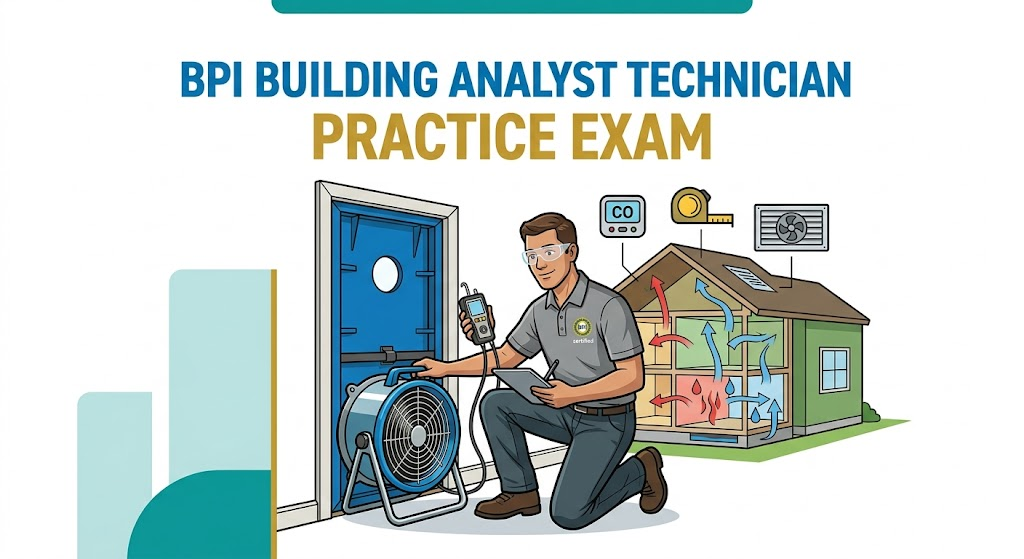
Additional Information
What the Course Entails and Exam Details
This training course is practical and focuses heavily on applying building science theory in the field. Candidates learn to use diagnostic equipment, conduct inspections, and collect critical data to inform energy conservation strategies.
The core domains covered include:
House-as-a-System Approach: Understanding how different components of a home interact and affect performance, durability, and occupant health.
Heat, Air, and Moisture Transport: Analyzing how these three elements move through a building envelope and their impact on energy loss and structure.
Health and Safety Inspections: Recognizing and assessing moisture problems, mold conditions, lead hazards, asbestos, and mechanical ventilation issues.
Diagnostic Testing Procedures: Hands-on mastery of dynamic testing equipment, particularly the Blower Door for measuring building air leakage and the Manometer for differential pressure testing.
Combustion Safety and Carbon Monoxide (CO) Testing: Critically important skills for evaluating the safety of fuel-fired appliances within the home, including fuel leak testing and spillage testing under worst-case depressurization.
HVAC Systems Evaluation: Identifying system types, examining ductwork, and measuring system performance parameters.
Standardized Data Gathering: Techniques for consistently and accurately collecting interior and exterior dimensions, equipment nameplate data, and building component details.
What to Expect in the Final Exam
It is important to understand that the BPI Building Analyst Technician exam is exclusively a Field Certification Exam. There is no traditional multiple-choice written component for this specific technician-level certification.
Candidates can expect the following during the final assessment:
Practical Demonstration: You must physically demonstrate your ability to set up equipment, conduct diagnostic tests (like a Blower Door test and Combustion Appliance Zone testing), and gather accurate field data within a real or simulated residential home environment.
Oral Questioning: While you perform the practical tasks, a proctor will ask oral questions to assess your understanding of the diagnostic procedures, the standard protocols you are following (such as ANSI/BPI-1200), and how to interpret the results.
Time Limit: The field exam typically has a strict four-hour time limit.
Passing Score Requirements: To earn the BA-T certification, you must achieve a score of 70% or higher on the field exam.
Gated Safety Items: There are specific safety protocols, such as ambient CO monitoring within the Combustion Appliance Zone, that are "gated" items. Failure to successfully complete any gated safety item results in an automatic failure of the entire exam, regardless of your scores on other components.
How to Study and Exam Centers
Preparation for the BA-T Field Exam must focus on combining theory with repetitive physical practice. You cannot pass this exam solely through reading.
Here are actionable study strategies:
Review Foundations: Ensure you fully understand the concepts from your prerequisite Building Science Principles (BSP) training.
Study Key Standards: Familiarize yourself with the industry standards that govern the procedures you will be tested on, specifically the ANSI/BPI-1100 Home Energy Auditing Standard and ANSI/BPI-1200 Standard Practice for Basic Analysis of Buildings.
Get Hands-On Practice: Spend significant time using the actual equipment (Blower Doors, digital manometers, CO detectors, and fuel leak detectors). Familiarize yourself with their setup, calibration, and troubleshooting until the procedures feel automatic.
Simulate the Field Audit: Practice conducting a full diagnostic audit on a house from beginning to end under timed conditions. Narrate your actions as you work to practice answering oral questions.
Utilize Authorized Test Centers: You must take your field exam through an authorized BPI Test Center. These organizations have approved testing facilities (or approved simulated environments) and proctors. Many Test Centers, such as Everblue, EnergyScore, and local training schools, offer integrated "blended" learning courses that include the field training, equipment rental, and the proctored exam in one package. You can find a nearby center using the locator tool on the official BPI website.
Job Opportunities from the Course
Earning the nationally recognized BPI Building Analyst Technician certification validates your practical technical expertise. This is a crucial credential for advancing into numerous career paths dedicated to home performance, energy efficiency, and building sustainability.
The BA-T certification unlocks a clear list of specific job titles and career paths, including:
Residential Energy Auditor: Conducting comprehensive energy assessments of existing homes and developing standardized scopes of work for efficiency improvements.
Building Performance Technician: Performing diagnostic testing, collecting data, and supporting the implementation of energy conservation measures.
Weatherization Specialist: Identifying energy-saving opportunities, particularly related to air sealing and insulation, and verifying the efficacy of these improvements.
Home Performance Consultant: Advising homeowners on strategies to reduce energy consumption, improve indoor air quality, and increase comfort.
HVAC Service Technician (Auditor Track): Integrating diagnostic testing and safety checks into standard HVAC service calls to offer comprehensive system-level performance assessments.
Quality Control Inspector (QCI) Trainee: Utilizing technician skills as the first step toward the advanced QCI certification required for state weatherization assistance programs.
Frequently Asked Questions
Reviews
5.0
Based on 0 reviews
Leave a Review
No reviews yet. Be the first to review!