
BPI Home Energy Professional (HEP) Quality Control Inspector (QCI)Training Practice Exam
$69.00
- Buy to unlock unlimited access to all Quiz questions and Answers in this Quiz.
- After purchase you can print a PDF of the whole quiz at any point. The PDF will contain the questions and the correct answers.
About this Exam
The BPI Home Energy Professional (HEP) Quality Control Inspector (QCI) certification is a premier credential for professionals in the home energy performance industry. This advanced certification validates your expertise in verifying the quality of energy efficiency retrofits and ensuring they align with established standards and specifications. The QCI designation is designed for experienced home energy auditors, quality assurance personnel, and program managers who oversee weatherization and energy efficiency programs. It signifies a high level of competency in inspecting, testing, and confirming the effectiveness of energy-saving measures. Earning this certification demonstrates your commitment to quality workmanship, occupant safety, and data accuracy within the building performance sector. This practice exam is a critical tool to assess your readiness and build confidence for the official BPI HEP QCI certification exam.
Ready to test your knowledge?
Buy Now to Access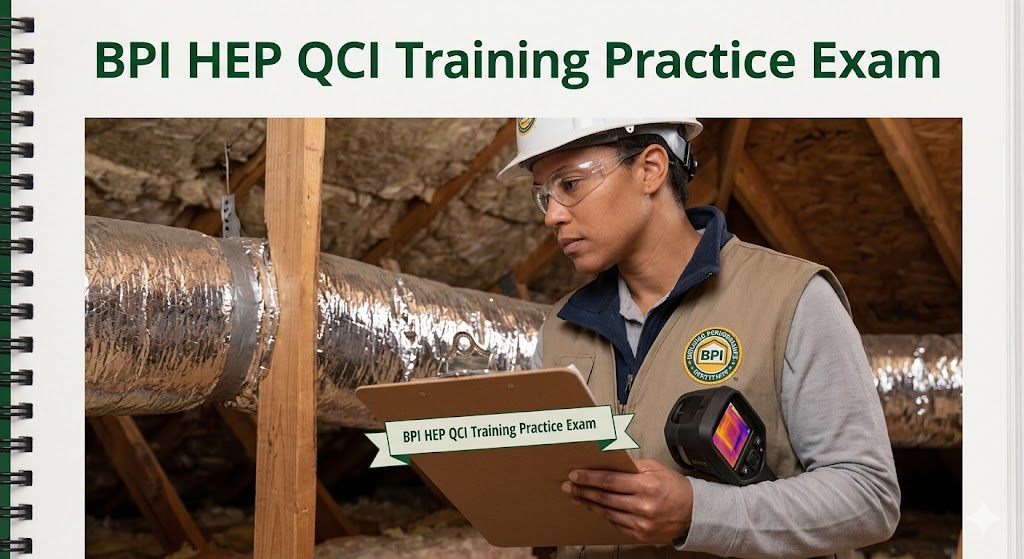
Additional Information
What the Course Entails and Exam Details
The BPI HEP QCI training course and exam cover a robust set of core topics and essential skills required for quality control work. The curriculum is meticulously aligned with the BPI Home Energy Professional Quality Control Inspector Job Task Analysis. Participants will dive deep into a diverse range of areas, including in-depth building science principles, thorough health and safety inspections, diagnostic testing procedures (such as blower door and duct leakage testing), and rigorous quality assurance and inspection protocols.
The official BPI QCI certification process actually requires passing two separate exams: a comprehensive, 100-question multiple-choice online exam and a challenging, field-based practical inspection exam. The practice material focus should be on preparing for the types of scenarios and knowledge areas present in both. For the multiple-choice portion, candidates have a total time of 2 hours and must achieve a passing score of at least 70%. The practical exam involves demonstrating real-world inspection techniques and diagnostic proficiency on an actual home, and it requires a separate passing score.
What to Expect in the Final Exam
When you arrive for the final BPI HEP QCI online exam, be prepared for a comprehensive test of your knowledge and decision-making skills in quality control. The 100-question multiple-choice exam is designed to simulate scenarios you might encounter as a QCI. It covers a range of complex topics, and you will have to draw on your understanding of building science and inspection procedures to select the best answer. The practical field exam is an entirely different experience, where you will perform actual inspection and diagnostic testing on a property under the observation of a registered BPI proctor. You must demonstrate your ability to correctly use diagnostic tools, identify install defects, and maintain safety protocols. Candidates must achieve a minimum passing score on both the online and practical exams to earn the QCI credential. It’s important to familiarize yourself with the BPI Testing Center guidelines and arrive well-rested and prepared for both parts of the process.
How to Study and Exam Centers
Effective preparation for the BPI HEP QCI exam demands a strategic and multi-faceted study approach. Begin by thoroughly reviewing the BPI HEP QCI Job Task Analysis, which serves as the ultimate blueprint for the exam's content and domains. To prepare for the multiple-choice online exam, utilize structured BPI HEP QCI training courses offered by BPI-accredited training providers. Engage in focused review sessions, and take numerous practice exams (like this one) to identify your knowledge gaps and refine your understanding of core concepts. For the practical field exam, hands-on practice is absolutely essential. Seek opportunities to perform actual blower door and duct leakage tests under expert guidance, conduct mock field inspections, and meticulously practice identifying typical workmanship issues. Your ability to correctly set up equipment, follow specific diagnostic procedures, and accurately interpret readings will be heavily scrutinized.
The online multiple-choice exam can be taken at BPI-authorized testing centers or via remote proctoring, allowing for flexible test scheduling. The practical field exam must be completed in-person at a designated BPI Test Center equipped for field assessments. To locate an authorized testing center or schedule an exam session, visit the BPI website or contact a BPI-accredited training organization in your region.
Job Opportunities from the Course
Earning the BPI HEP QCI certification significantly enhances your professional credibility and unlocks diverse career opportunities in the expanding field of energy efficiency and building performance. This advanced credential makes you a highly sought-after candidate for specialized positions focused on quality assurance, program integrity, and energy-saving verification.
Holders of the QCI certification are well-qualified for various key roles, including:
Home Energy Professional (HEP) Quality Control Inspector
Energy Efficiency Program Manager
Quality Assurance Auditor
Energy Auditor Supervisor
Weatherization Field Supervisor
Building Performance Consultant
Independent Energy Efficiency Inspector
Many state and local weatherization programs, utility companies, and energy efficiency contractors specifically require or prioritize the BPI HEP QCI certification when hiring inspectors and managers. As a certified QCI, you play a crucial role in ensuring that residential energy retrofits deliver the expected performance, meet high-quality standards, and contribute to significant energy savings. This designation not only opens doors to advanced roles but also provides a distinct competitive edge in the job market, potentially leading to increased earning potential and career advancement within the dynamic home performance sector.
Frequently Asked Questions
Reviews
5.0
Based on 0 reviews
Leave a Review
No reviews yet. Be the first to review!