
BPI Multifamily Building Analyst Practice Exam
$69.00
- Buy to unlock unlimited access to all Quiz questions and Answers in this Quiz.
- After purchase you can print a PDF of the whole quiz at any point. The PDF will contain the questions and the correct answers.
About this Exam
The BPI Multifamily Building Analyst certification is a premier, advanced credential for energy professionals who specialize in the unique challenges of large-scale residential structures.
While single-family audits focus on isolated systems, this certification validates your ability to analyze whole-building performance in complexes like apartments, condominiums, and townhouses.
Designed for experienced energy auditors, building operators, architects, and engineers, this designation proves you possess the expertise to evaluate building systems as a single, unified structure.
Earning this credential differentiates you as a leader in the expanding green building sector, certifying that you can produce prioritized recommendations that improve tenant comfort, enhance occupant health and safety, and significantly reduce energy consumption.
Ready to test your knowledge?
Buy Now to Access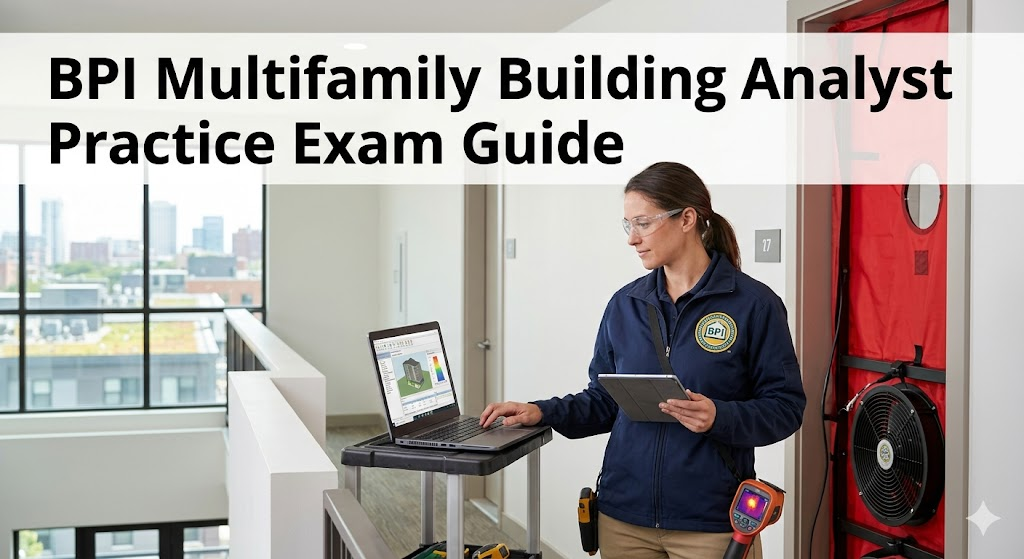
Additional Information
What the Course Entails and Exam Details
To prepare for the exam, candidates must master a comprehensive body of knowledge that applies advanced building science to multifamily contexts.
The core curriculum and exam blueprint cover several critical diagnostic and analytical disciplines.
You will delve deeply into building envelope analysis, focusing on air leakage, insulation effectiveness, and advanced thermal boundary evaluation using techniques like multi-fan blower door testing.
A major focus is placed on complex mechanical systems, including central heating and cooling plants, domestic hot water loops, ventilation systems, and ensuring combustion safety within shared utility spaces.
Candidates are also trained in accurate energy modeling, utilizing specialized software to simulate a building’s energy use and quantify the impact of proposed energy efficiency measures.
Finally, you must be skilled in financial analysis and work scope development, ensuring your recommendations are both technically sound and economically viable for building owners.
What to Expect in the Final Exam
The BPI Multifamily Building Analyst certification process is rigorous and typically involves two distinct components that test both your cognitive knowledge and your practical application skills.
The Online (Written) Component Candidates must first pass a 75-question, multiple-choice online exam.
This part tests your understanding of building science theory, diagnostic protocols, health and safety standards, and energy modeling concepts.
You are generally allocated two hours to complete this portion, and the passing score is typically 65% or higher.
The Practical (Field) Component The second phase is a practical field exam where you must demonstrate your hands-on mastery.
You will be expected to correctly set up and operate diagnostic equipment, such as blower doors and duct blasters, in a multi-unit setting.
Proctors will also assess your ability to conduct combustion safety testing, identify health risks, and accurately survey mechanical systems.
A separate passing score of 65% or higher is required for the practical component.
How to Study and Exam Centers
Effective preparation for the BPI Multifamily Building Analyst exam requires a blend of rigorous theoretical study and hands-on diagnostic experience.
Actionable Study Strategies Begin by downloading the current BPI Multifamily Building Analyst Technical Standards; this document is the foundation of the exam.
We highly recommend enrolling in a BPI-authorized training course, which offers essential access to diagnostic equipment and expert instruction tailored to the test blueprint.
Utilize practice exams extensively to familiarize yourself with the multiple-choice format and identify knowledge gaps in building science theory.
For the practical, spend time mentoring with an experienced analyst or practicing in a real-world multifamily environment to ensure you can operate equipment quickly and accurately.
Exam Centers The BPI exams are administered through BPI-authorized Test Centers located across the country.
You can take the written component online through BPI’s secure portal, but it must still be proctored at an authorized location.
The practical field exam must be taken at a physical Test Center that has the necessary facility setup and diagnostic equipment.
Job Opportunities from the Course
Earning the BPI Multifamily Building Analyst credential significantly expands your career horizons in the energy efficiency, sustainability, and facility management sectors.
Unlocking this advanced certification makes you a highly desirable candidate for numerous specialized roles within the green building economy.
The most prominent job opportunities and career paths unlocked by this certification include:
Multifamily Energy Auditor
Building Performance Consultant
Sustainability Coordinator
Resource Conservation Manager
Quality Control Inspector (Multifamily Retrofits)
Green Building Project Manager
Facility Manager (Large Residential Complexes)
Energy Modeler
Utility Program Manager
Frequently Asked Questions
Reviews
5.0
Based on 0 reviews
Leave a Review
No reviews yet. Be the first to review!