
BPOC Canine Encounters Practice Test
$69.00
- Buy to unlock unlimited access to all Quiz questions and Answers in this Quiz.
- After purchase you can print a PDF of the whole quiz at any point. The PDF will contain the questions and the correct answers.
About this Exam
Welcome to your comprehensive study guide for the BPOC Canine Encounters Certification Exam.
This specialized certification is designed exclusively for law enforcement officers, specifically those completing or who have completed their Basic Peace Officer Course (BPOC). It provides critical training for safely and effectively managing interactions with domestic dogs encountered in the line of duty.
The course is not about training dogs; rather, it empowers officers with the knowledge to read canine behavior, assess threats accurately, and utilize non-lethal, humane strategies to de-escalate potential conflicts. By prioritizing both officer safety and the welfare of animals, this certification plays a vital role in reducing injuries to personnel and avoiding unnecessary use of force against beloved family pets.
For agencies and communities, this training fosters positive public relations by demonstrating a commitment to compassionate and professional policing in diverse field situations.
Ready to test your knowledge?
Buy Now to Access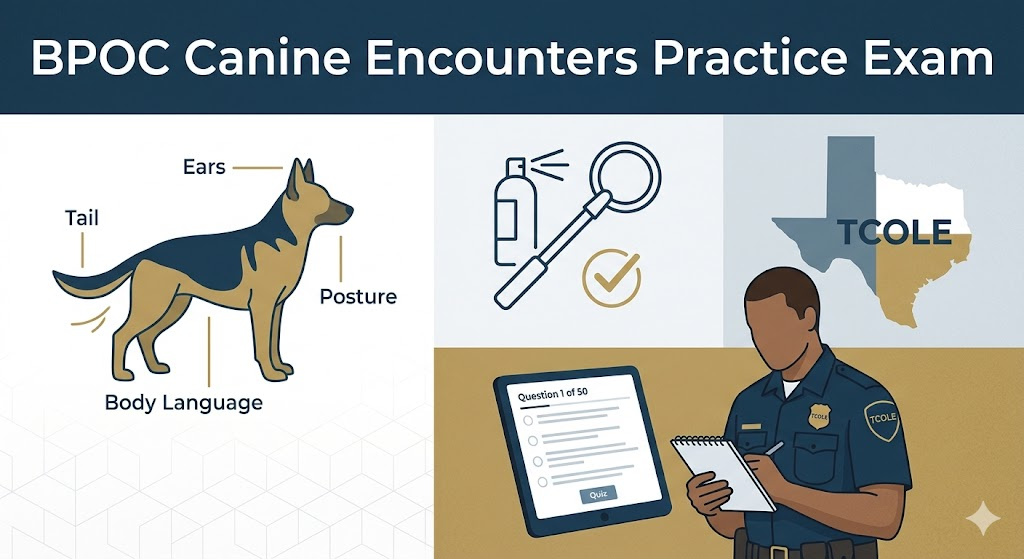
Additional Information
What the Course Entails and Exam Details
This rigorous course dives deep into the psychology and physiology of canine encounters from a law enforcement perspective.
The primary objective is to equip officers with a versatile "toolkit" that prioritizes safety through understanding. The core curriculum typically covers:
Understanding Canine Behavior: Learning to interpret subtle cues such as body language, facial expressions, tail carriage, and vocalizations to distinguish between a relaxed, playful, fearful, protective, or genuinely aggressive dog.
Conflict De-escalation Strategies: Mastering safe movement patterns, non-threatening posture, verbal commands tailored to animals, and situational awareness (e.g., checking a fenced yard safely before entry).
Non-Lethal Force Options: Appropriate use and tactical application of tools like OC (Oleoresin Capsicum) spray, batons (as a barrier), electronic control devices (e.g., Taser spark test vs. deployment), and improvised humane barriers.
Legal and Administrative Requirements: Understanding relevant state laws regarding animal cruelty, use of force, and best practices for accurate, objective report writing following any canine encounter, regardless of the outcome.
What to Expect in the Final Exam
The final BPOC Canine Encounters Exam is designed to validate your command of the procedural knowledge and situational judgment required in the field.
The exam format is almost exclusively Multiple Choice, testing your recall of facts, definition of terms, and ability to apply safety principles to scenario-based questions. For example, you may be shown a description or image of a dog's posture and asked to identify its likely emotional state and the appropriate officer response.
A passing score is typically required to be 70% or higher (e.g., achieving 70 out of 100 questions correct). The time limit is reasonable, often allowing 1 to 2 minutes per question. The exam is usually closed-book, reflecting the need for officers to possess this knowledge intuitively during real-world, dynamic encounters.
Always verify the exact number of questions, time limit, and passing score with your specific testing authority, such as your state’s commission on law enforcement (e.g., TCOLE in Texas).
How to Study and Exam Centers
Preparation is key to success on this high-stakes exam.
Start by thoroughly reviewing all material provided during your instruction. Pay special attention to charts detailing dog body language and safety distance principles. When taking practice tests, analyze not only the questions you got wrong but also those where you had to guess; this identifies critical knowledge gaps. Structure your study by simulating exam conditions: take timed practice tests in a quiet room to build your pacing and confidence. We encourage you to discuss hypothetical scenarios with your classmates or training officers; vocalizing your decision-making process is an excellent way to reinforce your learning.
Regarding Exam Centers: For active-duty personnel, this exam is frequently administered within your Police Academy or via your agency's official, secure online training portal (such as TCOLE's online system). In some regions, the final certification exam must be taken at a state-authorized physical testing center or designated regional training facility. Refer to your course coordinator or training sergeant to confirm the specific location and login procedures required for your official test.
Job Opportunities from the Course
Earning your BPOC Canine Encounters Certification adds a valuable layer of specialization to your law enforcement resume. While it is rarely a standalone requirement for a new career, it strongly signals to command staff that you are proactive, safety-conscious, and prepared for complex field duties. This certification unlocks several specific professional advantages and career paths:
Peace Officer / Patrol Officer: This is the most direct application. Certified officers are seen as more versatile and desirable for patrol duties, particularly in residential areas where animal encounters are frequent.
School Resource Officer (SRO): Specialized knowledge in managing animal encounters is highly valued in school settings, ensuring the safety of students and staff during any canine-related incidents on campus.
Community Policing Specialist: Certification demonstrates a commitment to humane and modern policing techniques, making candidates ideal for roles focused on building trust within the community.
K-9 Handler (Supplementary Skill): While becoming a K-9 handler requires distinct, intensive training, having this foundational canine encounters certification makes an officer a more knowledgeable and attractive candidate for a future K-9 unit vacancy.
Civilian Police Employee (Animal Services Liaison): In larger departments, this training benefits civilian roles that coordinate between the police agency and local animal control or shelter services.
Frequently Asked Questions
Reviews
5.0
Based on 0 reviews
Leave a Review
No reviews yet. Be the first to review!