
BPOC Force Options Practice Test
$69.00
- Buy to unlock unlimited access to all Quiz questions and Answers in this Quiz.
- After purchase you can print a PDF of the whole quiz at any point. The PDF will contain the questions and the correct answers.
About this Exam
The Basic Peace Officer Course (BPOC) Force Options certification is a critical milestone for aspiring law enforcement professionals.
This specialized training is designed to equip cadets and new officers with the essential knowledge and judgment required to make split-second decisions regarding the application of force.
It focuses heavily on legal standards, ethical considerations, and the physical skills necessary to manage a wide array of field encounters safely and effectively.
If you are a student in a police academy or a licensed officer seeking to refresh your proficiency, mastering the Force Options component is non-negotiable for a successful and safe career in public service.
Ready to test your knowledge?
Buy Now to Access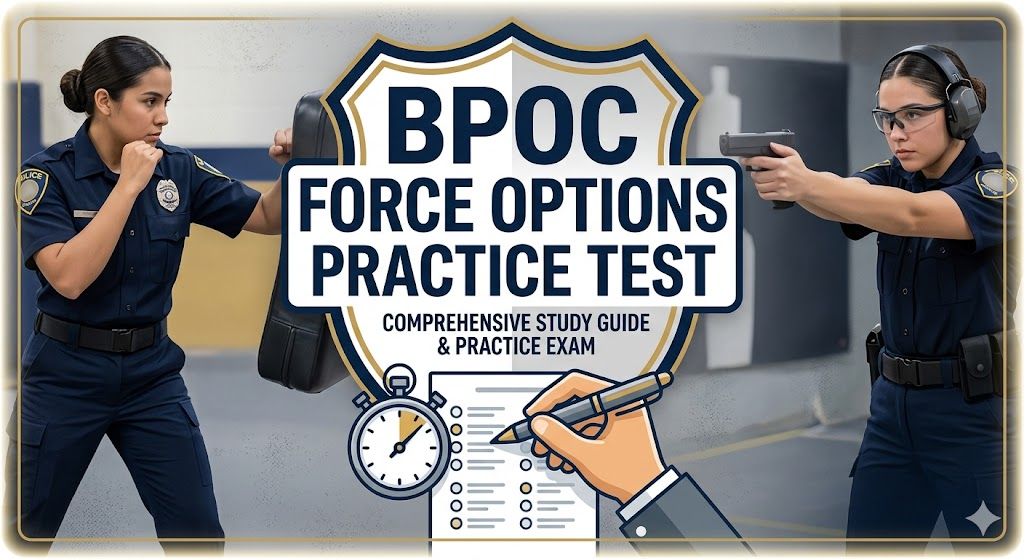
Additional Information
What the Course Entails and Exam Details
The BPOC Force Options course provides a comprehensive framework for understanding when and how much force is objectively reasonable under the law.
The curriculum combines classroom theory with hands-on practical application. Core areas of focus typically include:
Federal and State Law: Detailed study of constitutional amendments, relevant statutes, and landmark court cases (such as Graham v. Connor) defining the legal boundaries of the use of force.
Use of Force Mechanics and Continuum: Understanding the progression of force options, from officer presence and verbal communication to intermediate weapons and deadly force.
De-escalation Techniques: Learning verbal and non-verbal communication strategies to defuse volatile situations and reduce the need for physical force.
Officer Safety and Crisis Decision-Making: Developing situational awareness and the ability to assess threats under high stress.
Defensive Tactics and Intermediate Weapons: Practical training in subject control, handcuffing, and the proper use of tools like OC spray, batons, and Conducted Energy Weapons (CEWs).
Firearms Proficiency: Comprehensive training on firearm safety, maintenance, and combat shooting accuracy.
What to Expect in the Final Exam
The final certification for BPOC Force Options usually consists of a two-part assessment: a written knowledge exam and a practical skills demonstration.
The Written Exam: This is typically a multiple-choice, comprehensive test designed to verify your understanding of legal concepts, policy, and decision-making scenarios. You can expect questions that require you to apply legal standards to hypothetical situations to determine the appropriate level of force. The passing score is set by your specific state’s commissioning body (e.g., TCOLE in Texas, POST in California) or your academy, often requiring a minimum of 70% to 80%. Time limits vary but are generally sufficient to complete the test if you are well-prepared.
The Practical Skills Exam: This portion requires you to demonstrate proficiency in dynamic, scenario-based environments. You will be evaluated on your ability to use de-escalation tactics, properly apply subject control techniques, use intermediate weapons, and exhibit safe and accurate firearms handling. These assessments are often pass/fail, and failure to meet safety standards or critical task requirements can result in failing the entire certification.
How to Study and Exam Centers
Preparation for the Force Options exam must be both mental and physical.
Study Strategies:
Utilize Practice Exams: Regularly taking a BPOC Force Options Practice Test is one of the most effective ways to build confidence. Focus on the rationales provided for correct answers, especially for scenario-based questions.
Review Core Legal Concepts: Create flashcards for key court cases and legal definitions related to the use of force. Ensure you understand the concept of "objective reasonableness."
Physical Repetition: Practice defensive tactics and handcuffing techniques outside of class until they become muscle memory.
Visualize Scenarios: Run through potential field encounters in your mind, deciding on the appropriate de-escalation and force options for each.
Exam Centers:
The final licensing or certification exam is typically administered at standardized testing locations authorized by your state’s law enforcement commissioning agency or at the police academy where you completed your training. Practice tests are often available through online educational portals, specific law enforcement training websites, or learning management systems provided by your academy.
Job Opportunities from the Course
Successfully completing the Basic Peace Officer Course and the Force Options certification is the primary requirement for a variety of critical public safety roles.
This certification unlocks the following career paths:
Police Officer
Sheriff’s Deputy
State Trooper / Highway Patrol Officer
Constable
Municipal Court Bailiff
Park Ranger (Law Enforcement Track)
Campus Police Officer
Transit Police Officer
Frequently Asked Questions
Reviews
5.0
Based on 0 reviews
Leave a Review
No reviews yet. Be the first to review!