
BPOC Penal Code Practice Test
$69.00
- Buy to unlock unlimited access to all Quiz questions and Answers in this Quiz.
- After purchase you can print a PDF of the whole quiz at any point. The PDF will contain the questions and the correct answers.
About this Exam
The BPOC Penal Code Practice Test is an essential preparatory tool designed for aspiring law enforcement officers enrolled in the Basic Peace Officer Course.
Passing this comprehensive evaluation is a critical step towards earning TCOLE certification in the state of Texas.
It is specifically tailored for individuals who need to demonstrate a deep understanding of statutory law to proceed in their academy training or state licensing.
This practice test ensures that candidates can accurately identify offense classifications and apply the law in real-world scenarios.
Ready to test your knowledge?
Buy Now to Access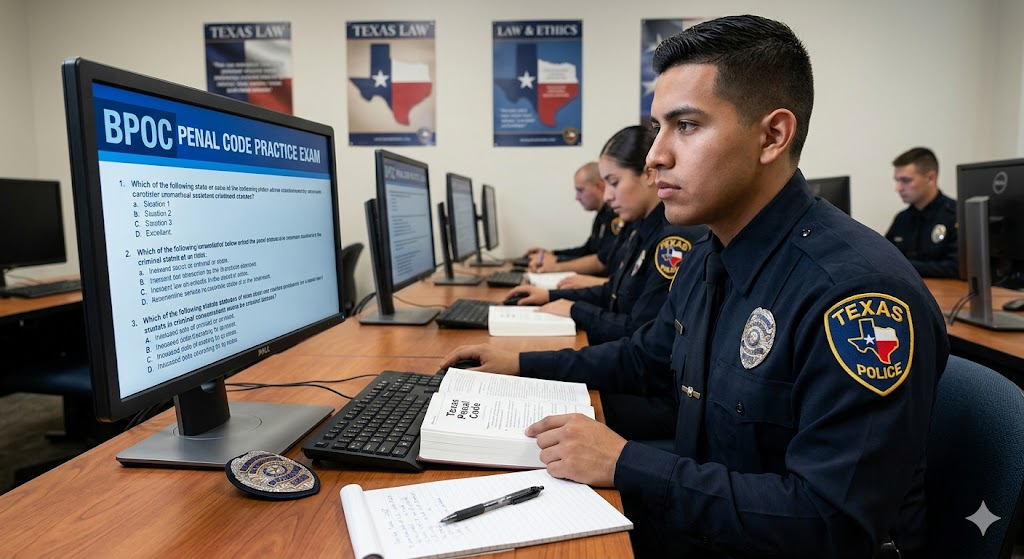
Additional Information
What the Course Entails and Exam Details
The larger Basic Peace Officer Course covers hundreds of learning objectives, but the Penal Code section specifically drills down into the complex legal statutes that dictate police authority.
The coursework leading to this exam focuses on the Texas Penal Code, forcing candidates to study the precise definitions, classifications, and elements of criminal offenses.
Topics covered in depth include general provisions, principles of criminal responsibility, and justification excluding responsibility (defenses).
Furthermore, significant focus is placed on Offenses Against the Person (such as criminal homicide, kidnapping, and sexual assault) and Offenses Against Property (including arson, robbery, and burglary).
You must also master public administration offenses, such as perjury and obstruction, to pass the final evaluation.
What to Expect in the Final Exam
The final BPOC Penal Code examination consists entirely of multiple-choice questions designed to test both rote memorization and situational application of the law.
You will be presented with scenarios and asked to determine if a specific crime occurred and which statutory elements define that offense.
A passing score of 70% is typically required within police academies, although many aim higher to ensure state readiness.
The exam is timed, replicating the pressure of the final state licensing exam, so time management is crucial for success.
Candidates should expect rigorous testing on penal classifications, ranging from Class C misdemeanors to Capital Felonies.
How to Study and Exam Centers
Effective preparation requires a multi-faceted approach combining active study with practical application using dynamic test questions.
Utilize practice tests extensively to identify knowledge gaps and get comfortable with the phrasing of TCOLE-style questions.
Focus on creating flashcards specifically for the essential elements of each major offense to ensure rapid recall during the exam.
Study in scenarios; do not just memorize the statute; rather, understand how the statute applies to a chaotic situation on the street.
The initial academy-level exams are typically administered in-person at authorized training academies across Texas, while the final TCOLE state licensing exam is taken at designated official testing sites, which may include regional councils of government or Pearson VUE locations.
Opportunities from the Course
Earning certification by passing the BPOC modules and eventually the TCOLE state exam unlocks a variety of career paths within Texas law enforcement.
Completing this course and certification allows you to pursue the following roles:
Police Officer (Municipal Departments)
Sheriff’s Deputy
Texas State Trooper (Department of Public Safety)
Constable Deputy
University Police Officer
Independent School District (ISD) Police Officer
State Park Ranger
Investigator for State Agencies (such as the Office of the Attorney General)
Frequently Asked Questions
Reviews
5.0
Based on 0 reviews
Leave a Review
No reviews yet. Be the first to review!