
BPOC Professional Policing Practice Test
$69.00
- Buy to unlock unlimited access to all Quiz questions and Answers in this Quiz.
- After purchase you can print a PDF of the whole quiz at any point. The PDF will contain the questions and the correct answers.
About this Exam
The BPOC, short for the Basic Peace Officer Course, is the essential foundational training for individuals aspiring to a career in law enforcement within jurisdictions that utilize this specific curriculum. This extensive course is designed to equip candidates with the core knowledge, critical thinking, and practical skills necessary to serve as licensed peace officers. This specialized BPOC Professional Policing Practice Test is an indispensable study tool created for students enrolled in or preparing for a BPOC academy. It allows them to assess their readiness for the challenging state licensing examination that marks the culmination of their training. By taking this practice test, future officers can gain confidence, identify weak areas, and ensure they are fully prepared for the crucial high-stakes assessment that bridges the gap between academy student and licensed professional.
Ready to test your knowledge?
Buy Now to Access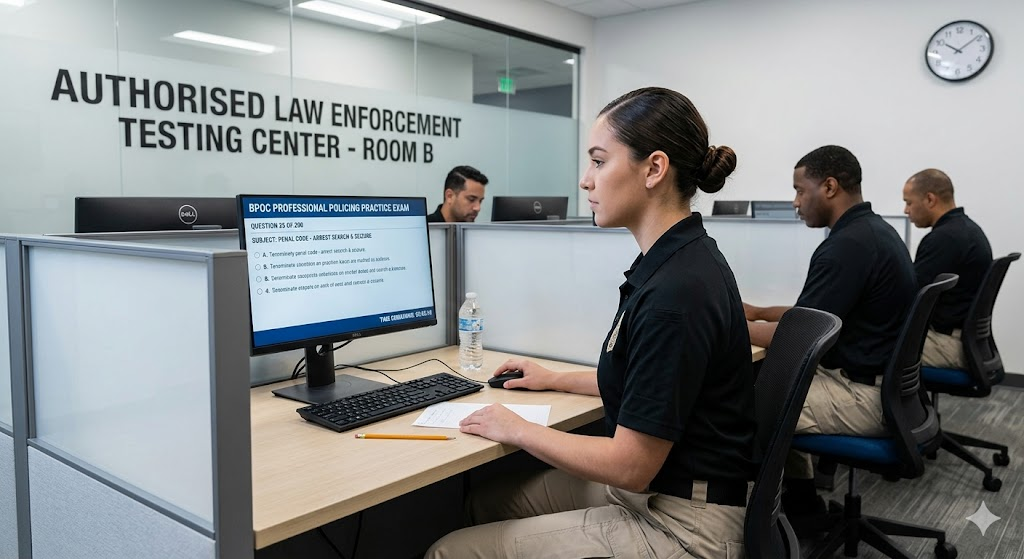
Additional Information
What the Course Entails and Exam Details
A standard Basic Peace Officer Course (BPOC) encompasses hundreds of hours of instruction, covering a wide array of policing subjects. Students dive deep into core topics such as:
Texas Penal Code and Code of Criminal Procedure: Mastering the legal framework they will enforce.
Traffic Law and Accident Investigation: Learning safe road operations and crash analysis.
Patrol Procedures and Special Populations: Understanding day-to-day operations and community engagement.
Use of Force and Defensive Tactics: Training in legal justification and physical skills.
Firearms Proficiency: Developing safe and accurate weapon handling.
Criminal Investigation: Mastering evidence collection and crime scene management.
Professionalism and Ethics: Cultivating a strong moral foundation and public trust.
First Aid and CPR: Acquiring life-saving medical skills.
The final state exam is a comprehensive assessment that tests knowledge across all these critical areas. While specific question counts can vary slightly by jurisdiction, it typically consists of approximately 250 multiple-choice questions, administered via a computerized format. Candidates are generally given a fixed time limit, often around 3 to 4 hours, to complete the exam.
What to Expect in the Final Exam
As students approach the final state licensing exam, they should anticipate a rigorous evaluation. The primary format is computerized multiple-choice questions designed to simulate the real-world decision-making process an officer encounters. Questions often use scenarios to test the application of law, policy, and procedure, rather than simple rote memorization. Candidates should be prepared for a substantial mental endurance test, given the comprehensive nature of the content and the multi-hour duration. The required passing score is typically set at 70%, emphasizing the need for a strong command of all course materials. Strict testing rules are enforced at official centers, including prohibitions on outside materials, mobile devices, and collaboration. The final exam results determine eligibility for state licensure, making preparation key to unlocking a future in law enforcement.
How to Study and Exam Centers
Effective preparation for the BPOC final exam demands structured, actionable study strategies.
Active Recall and Spaced Repetition: Instead of passive reading, students should use flashcards for complex topics like the Penal Code and Code of Criminal Procedure, reviewing them at increasing intervals.
Take Multiple Practice Tests: Consistently utilizing tools like this BPOC Professional Policing Practice Test helps students familiarize themselves with the question format, manage their time, and build stamina.
Create Study Groups: Collaborative learning with academy classmates can reinforce understanding and expose different perspectives on complex legal scenarios.
Simulation and Scenario Practice: Apply academic knowledge to practical, hands-on scenarios, especially for use of force, defensive tactics, and patrol procedures.
Utilize Instructor and Academy Resources: Leverage the expertise of academy instructors, who often provide targeted review sessions and valuable study materials.
The final licensing exam is not taken at the individual academy. Instead, it is administered at specialized state-authorized testing centers. Candidates are typically directed to these locations by their state's licensing agency or academy leadership. For instance, in Texas, this process involves registering through the TCOLE (Texas Commission on Law Enforcement) portal and scheduling an exam at a Pearson VUE testing center or an authorized regional testing site.
Job Opportunities from the Course
Successfully passing the BPOC and the state licensing exam is the gateway to diverse and rewarding careers in law enforcement. Completion of this course unlocks job opportunities, allowing professionals to embark on several career paths within municipal, county, and state agencies. These include roles such as:
Police Officer (Municipal/City Departments)
Sheriff's Deputy (County Sheriff's Offices)
State Trooper (State Departments of Public Safety)
Constable (County Precincts)
Airport Police Officer
School Resource Officer (SRO)
University Police Officer
Park Ranger (Law Enforcement Division)
Criminal Investigator / Detective (following additional experience)
By dedicating oneself to rigorous study and thorough preparation with this comprehensive guide and our targeted practice tests, candidates are investing directly in a bright and impactful career dedicated to serving and protecting their communities.
Frequently Asked Questions
Reviews
5.0
Based on 0 reviews
Leave a Review
No reviews yet. Be the first to review!