
BPOC Standardized Field Sobriety Tests (SFST) Practice Test
$69.00
- Buy to unlock unlimited access to all Quiz questions and Answers in this Quiz.
- After purchase you can print a PDF of the whole quiz at any point. The PDF will contain the questions and the correct answers.
About this Exam
The Standardized Field Sobriety Tests (SFST) certification is a critical milestone within the Basic Peace Officer Course (BPOC). This comprehensive training is specifically designed for aspiring law enforcement officers and cadets undergoing foundational academy training. Mastery of this component proves your ability to accurately detect impaired drivers, establish probable cause for arrest, and improve road safety through rigorous, scientifically validated methods. A comprehensive BPOC SFST Practice Test serves as an essential diagnostic tool, helping you gauge your understanding of the National Highway Traffic Safety Administration (NHTSA) standards before taking the official, high-stakes final evaluation.
Ready to test your knowledge?
Buy Now to Access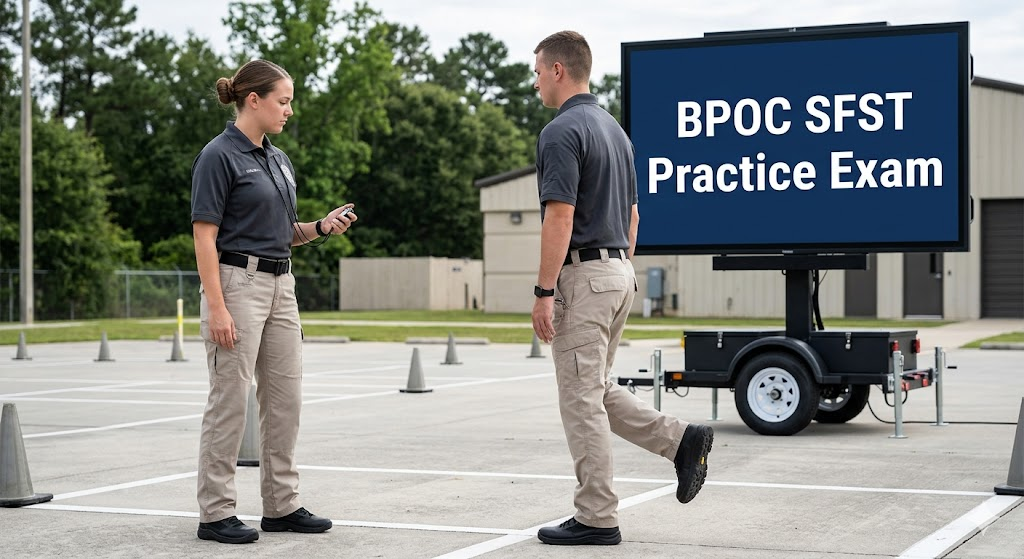
Additional Information
What the Course Entails and Exam Details
The core SFST curriculum focuses heavily on the scientifically validated battery of three tests used by law enforcement agencies across the nation. Candidates must learn the precise administration protocols, precise instruction delivery, and specific clue-scoring metrics for each test. The curriculum breaks down as follows:
Horizontal Gaze Nystagmus (HGN): Understanding the physiological basis and recognizing the specific "clues" indicative of impairment by checking the eyes for involuntary jerking.
Walk-and-Turn (WAT): Mastery of a complex, divided attention task that requires the subject to listen to instructions while maintaining physical balance.
One-Leg Stand (OLS): Assessing a subject's capability to balance and count over a sustained 30-second period.
In addition to the practical administration of these tests, the course covers the critical groundwork surrounding DWI enforcement, including:
The three phases of DWI Detection: Vehicle in Motion, Personal Contact, and Pre-Arrest Screening.
Legal requirements for establishing probable cause and documenting evidence.
The scientific validation studies supporting the SFST battery.
Report writing and techniques for effective judicial testimony regarding sobriety evaluations.
What to Expect in the Final Exam
The final SFST certification exam generally consists of two distinct, mandatory components that must both be passed. You cannot receive certification without mastering both the conceptual knowledge and the practical application.
The Written Examination: This segment typically involves a series of multiple-choice questions focusing on case law, terminology, the scientific basis of the tests, standardized clue definitions, and exact wording for instructions. Candidates must usually achieve a score of at least 80% to pass this section.
The Practical Proficiency Examination: This is a rigorous, hands-on evaluation where you must demonstrate perfect administration of the entire SFST battery (HGN, WAT, and OLS) on a simulated subject. You are graded strictly on your ability to deliver exact instructions, maintain correct officer positioning, and accurately identify the valid clues of impairment demonstrated by the subject. In most academies, any deviation from the NHTSA standard administration protocol is classified as a "fatal error," resulting in an automatic failure of the practical proficiency portion.
How to Study and Exam Centers
Effective preparation requires a blend of mental rote memorization and physical, repetitive practice. Because the standard is high, casual studying is rarely sufficient.
Recommended Study Strategies:
Master the NHTSA Student Manual: The official NHTSA manual is your primary source of truth; highlight every exact instructional phrase and commit clue definitions to memory.
Utilize Practice Tests: Take comprehensive BPOC SFST Practice Tests multiple times to identify critical gaps in your conceptual knowledge and terminology.
Conduct Consistent Mock Evaluations: Roleplay the administration of tests with a partner continuously. Deliver the instructions verbatim without relying on notes until the process is second nature.
Record Your Drills: Videotape your practical practice sessions to spot positioning errors, posture mistakes, or timing issues during the HGN stimulus movement.
Exam Centers:
The final SFST examination is almost always administered internally by your authorized police academy or law enforcement training facility as an integral part of your larger BPOC program. It is not an exam you typically schedule independently at a private testing center. For veteran officers needing recertification or refresher training, these are usually coordinated directly through your state’s commission on law enforcement standards (such as TCOLE in Texas) or hosted by certified regional training centers or community college law enforcement programs. Consult your academy instructor or agency training coordinator for specific scheduling and authorization.
Job Opportunities from the Course
Successfully completing this certification is a mandatory component of becoming a licensed peace officer. While it is rarely a stand-alone job title, expertise in SFST significantly enhances your capability as an officer and unlocks specialized career paths within law enforcement. Mastery of these skills applies directly to the following roles:
Police Officer (Municipal/City)
Deputy Sheriff
State Trooper / Highway Patrol Officer
DWI Specialization Unit Officer
Traffic Enforcement Specialist
Constable
Campus Police Officer
Impaired Driving Task Force Member
DWI Task Force Instructor (following advanced training and extensive field experience)
Frequently Asked Questions
Reviews
5.0
Based on 0 reviews
Leave a Review
No reviews yet. Be the first to review!