
Brake System Practice Test
$69.00
- Buy to unlock unlimited access to all Quiz questions and Answers in this Quiz.
- After purchase you can print a PDF of the whole quiz at any point. The PDF will contain the questions and the correct answers.
About this Exam
A brake system practice test is a vital educational tool designed to evaluate and enhance an individual’s understanding of automotive braking mechanisms. This practice exam serves as crucial preparation for students in automotive technology programs, aspiring mechanics seeking entry-level positions, and experienced technicians aiming for advanced certifications, such as the ASE (Automotive Service Excellence) A5 Brakes certification.
By simulating the environment and content of official certification exams, this practice test assesses your readiness to diagnose, service, and repair complete automotive braking systems. It is an essential resource for anyone looking to validate their technical skills and build a foundation for a successful career in automotive service and repair.
Ready to test your knowledge?
Buy Now to Access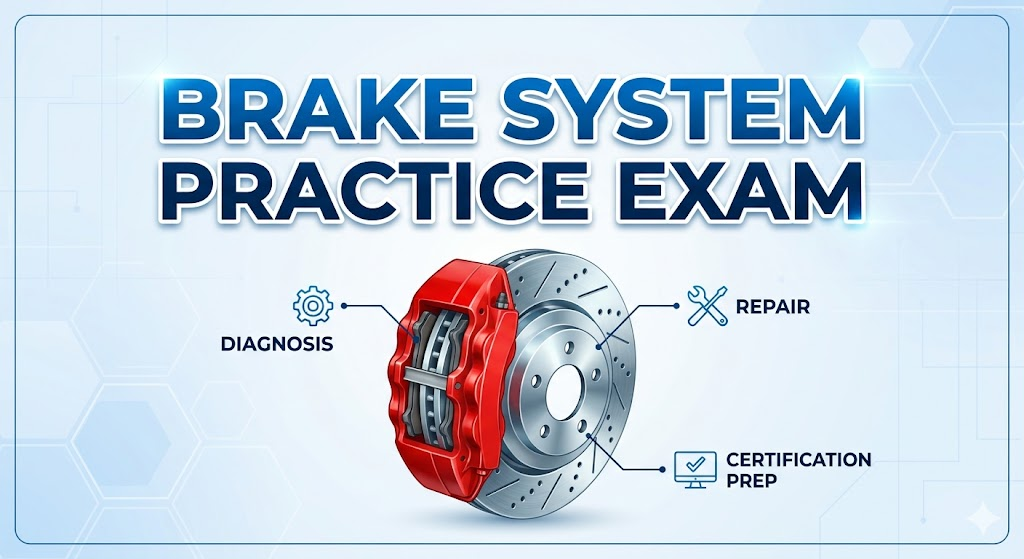
Additional Information
What the Course Entails and Exam Details
This comprehensive study guide and the accompanying practice exam cover the intricate details of both standard and advanced automotive braking systems. The core topics align with standard industry certification requirements, ensuring that successful testers possess the necessary theoretical knowledge and practical understanding required in a professional shop environment.
The key areas covered in this curriculum include:
Hydraulic System Theory and Service: Mastery of master cylinders, brake fluid types and handling, brake lines, hoses, and the principles of Pascal's Law as applied to braking force.
Drum Brake Diagnosis and Repair: Comprehensive understanding of wheel cylinders, brake shoes, drums, self-adjusting mechanisms, and parking brake linkages.
Disc Brake Diagnosis and Repair: Detailed knowledge of calipers (floating and fixed), brake pads, rotors, and mounting hardware.
Power Assist Units: Understanding the operation, diagnosis, and testing of vacuum boosters and hydro-boost systems.
Electronic Braking Systems: In-depth coverage of Anti-lock Braking Systems (ABS), Traction Control Systems (TCS), and Electronic Stability Control (ESC), including wheel speed sensors, hydraulic control units, and system diagnosis.
General System Diagnosis: The ability to interpret common symptoms such as brake noise, pulling, low pedal, and pulsation to accurately identify root causes.
What to Expect in the Final Exam
While specific formatting may vary slightly depending on the testing body (e.g., ASE vs. a state-level exam), candidates can generally expect a standardized, rigorous evaluation of their knowledge.
The final exam is typically delivered in a computer-based format consisting entirely of multiple-choice questions. These are not merely recall questions; they are often scenario-based, requiring the test-taker to apply diagnostic logic to solve specific vehicle performance issues. For example, a question might describe a specific brake pedal feel and ask for the most likely cause among four technical options.
Standard certification exams usually contain between 40 and 60 questions. The time limit is strictly enforced, generally allowing approximately one to one and a half minutes per question. A passing score is typically around 70% to 75%, though this varies by jurisdiction and specific certification level. Note that official testing centers maintain strict proctoring protocols, and no outside reference materials are allowed during the exam.
How to Study and Exam Centers
Preparation is the key to success on any technical certification exam. A passive review of materials is rarely sufficient. Instead, adopt an active study strategy.
Begin by thoroughly reviewing a comprehensive automotive textbook or factory service manuals, paying close attention to system diagrams and diagnostic flowcharts. Utilize this practice exam repeatedly. Do not just look for the correct answer; understand why the distractors (incorrect answers) are wrong. Create flashcards for critical specifications, brake fluid classifications, and diagnostic trouble codes (DTCs).
If you have access to a shop environment, combine your theoretical study with hands-on practice. Perform visual inspections, measure rotor discard thickness, and practice bleeding a hydraulic system according to manufacturer procedures. Physical muscle memory reinforces theoretical knowledge.
When you are ready to take the official certification exam, you will need to register through the appropriate organization (such as ASE). Examinations are rarely administered directly by the school. Instead, they are held at secure, authorized testing centers, such as Pearson VUE, which have locations globally. Some automotive programs or community colleges may serve as authorized testing sites, but registration and scheduling are still handled through the central certifying body.
Job Opportunities from the Course
Successfully mastering brake systems and passing the relevant certification exams opens several immediate and lucrative career paths within the automotive sector. This specialized knowledge is in high demand, as braking systems are critical for vehicle safety.
Completing this course of study prepares you for the following job opportunities:
Automotive Brake Technician
General Service Technician
Lube and Tire Technician (with brake service responsibilities)
Alignment and Suspension Specialist
Shop Foreman or Team Leader
Automotive Service Advisor
Mobile Repair Technician
Fleet Maintenance Technician
Frequently Asked Questions
Reviews
5.0
Based on 0 reviews
Leave a Review
No reviews yet. Be the first to review!