
Brannigan's Building Construction for the Fire Service Practice Test
$69.00
- Buy to unlock unlimited access to all Quiz questions and Answers in this Quiz.
- After purchase you can print a PDF of the whole quiz at any point. The PDF will contain the questions and the correct answers.
About this Exam
Welcome to the comprehensive study guide for the Brannigan's Building Construction for the Fire Service Practice Test.
For decades, Francis Brannigan’s seminal work has been the definitive text for understanding how buildings behave under fire conditions. This body of knowledge is absolutely critical for firefighter safety and effective command decisions on the fireground.
This practice test is specifically designed for fire service professionals, promotional candidates, fire science students, and fire inspectors who need to master the material found in the Brannigan's Building Construction for the Fire Service text.
By utilizing this resource, you are taking a proactive step toward ensuring you can recognize structural hazards before they lead to catastrophic failure. Mastering this content is not just about passing an exam; it is about making split-second decisions that save lives, including your own.
Ready to test your knowledge?
Buy Now to Access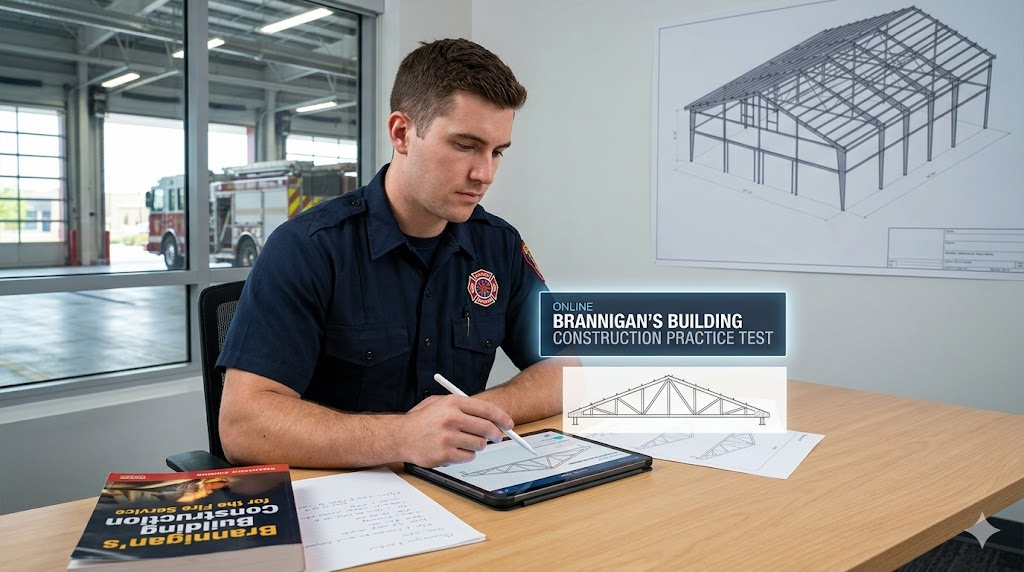
Additional Information
What the Course Entails and Exam Details
The Brannigan's Building Construction for the Fire Service Practice Test challenges your comprehensive understanding of the specialized knowledge required by modern fire services.
It goes beyond simple definitions to test your ability to apply construction principles to real-world fire scenarios.
The practice material covers a wide array of vital topics, including:
Firefighter Safety and Building Construction: Understanding why building construction knowledge is the foundation of effective risk management on the fireground.
The Alphabet of Building Construction: Master the core language of structural stability, forces, loads, and material reactions.
NFPA 220 Types of Construction: In-depth knowledge of the five fundamental types of building construction (Type I through Type V), their characteristics, and their specific fire risks.
Wood-Frame and Ordinary Construction: Understanding the unique hazards of balloon-frame, platform-frame, and legacy brick-and-joist buildings.
Heavy Timber and Mill Construction: Assessing the "fire cut" and the substantial fire load presented by massive wood elements.
Steel and Concrete Construction: Analyzing the behavior of steel under high heat (e.g., expansion and failure temperatures) and the critical difference between pre-cast and cast-in-place concrete.
Roof Systems and Trusses: Evaluating the high-risk nature of lightweight truss construction, engineered lumber, and the threat they pose to roof operations.
Smoke and Fire Spread: How building design, HVAC systems, and voids facilitate the movement of fire and toxic gases.
Buildings Under Construction or Demolition: Recognizing the heightened risks present during these vulnerable phases of a building’s life.
A rigorous course utilizing Brannigan's text prepares you to "read the building" efficiently, identifying collapse zones and predicting fire travel based on structural type.
What to Expect in the Final Exam
While specific exams (such as civil service promotional tests or college finals) may vary slightly, you can generally expect a standardized, high-stakes format for assessments based on this material.
Exam Format:
The final exam is typically delivered in a computer-based format.
The primary question type is multiple-choice, which often includes complex, scenario-based questions. These questions require you to analyze a given situation (e.g., "You are command at a Type III ordinary construction fire showing heavy smoke from the cockloft...") and select the safest, most effective tactical response based on Brannigan’s principles.
Some exams may also include "order of operations" questions or identification questions based on images of structural components.
Passing Score and Time Limits:
A competitive passing score is usually 70% or higher, particularly for promotional exams where higher rankings are necessary for advancement.
Time limits vary, but a common standard is 120 minutes for a 100-question exam. This is designed to simulate the need for rapid, accurate decision-making on the scene.
Proper preparation using practice tests is crucial for building the speed and confidence necessary to succeed.
How to Study and Exam Centers
Preparing for an exam based on Brannigan's Building Construction for the Fire Service requires dedication and a strategic approach. This is not a test you can cram for overnight.
Study Strategies:
Utilize the Primary Text: The Brannigan's Building Construction for the Fire Service text is your definitive source. Pay close attention to the specific chapters on the five types of construction and structural loads.
Use the "Fire Ground Notes": Each chapter in the latest edition includes critical "Fire Ground Notes." These highlight the direct tactical application of the construction principles discussed. Review these repeatedly.
Analyze Practice Questions: A core strategy is to use dynamic practice tests like this one. Review not only the correct answer but why the other answers are incorrect. This reinforces critical thinking.
Create Visual Aids: Building construction is a highly visual subject. Draw truss diagrams, label force vectors (compression, tension), and create flashcards distinguishing different types of construction.
Conduct "Windshield Surveys": When driving or on the apparatus, look at the buildings in your response area. Ask yourself: "What construction type is that? Where is the void space? What is the likely roof structure?" This brings the material to life.
Exam Centers:
Where you take the final exam depends entirely on the entity administering it.
Civil Service/Promotional Exams: These are usually proctored at city or county human resources facilities, local government centers, or dedicated assessment centers.
College/Fire Academy Exams: Finals for formal courses are taken in person on campus or at the state fire academy where the training is conducted.
Professional Certification Bodies: If you are taking this as part of a certification for a role like a Fire Inspector, it may be administered at Pearson VUE testing centers or a state fire marshal’s testing location.
Job Opportunities from the Course
Mastery of the principles found in the Brannigan's Building Construction for the Fire Service text is essential for career progression across the fire service.
It is a requirement for advanced operational leadership and specialized inspection roles.
This knowledge directly unlocks and supports advancement to the following career paths and job titles:
Fire Captain
Fire Lieutenant
Battalion Chief (Command Staff)
Fire Inspector
Arson/Fire Investigator
Fire Safety Officer
State Fire Service Instructor
Plan Reviewer (Fire Marshal's Office)
Frequently Asked Questions
Reviews
5.0
Based on 0 reviews
Leave a Review
No reviews yet. Be the first to review!