
Breeding and Genetics Exam 2 Practice
$69.00
- Buy to unlock unlimited access to all Quiz questions and Answers in this Quiz.
- After purchase you can print a PDF of the whole quiz at any point. The PDF will contain the questions and the correct answers.
About this Exam
The Breeding and Genetics Exam 2 is a crucial milestone for students pursuing degrees in Animal Science, Agronomy, Biology, or Biotechnology. This assessment is specifically designed for students who have mastered fundamental genetic principles and are now transitioning to the complex, practical applications of heredity in agricultural and laboratory settings.
It evaluates your ability to not only recall terms but also to apply mathematical models to predict outcomes in breeding programs. By passing this exam, students demonstrate a readiness to handle advanced topics in genomics and selection strategies, moving them one step closer to professional qualification in life science fields.
Ready to test your knowledge?
Buy Now to Access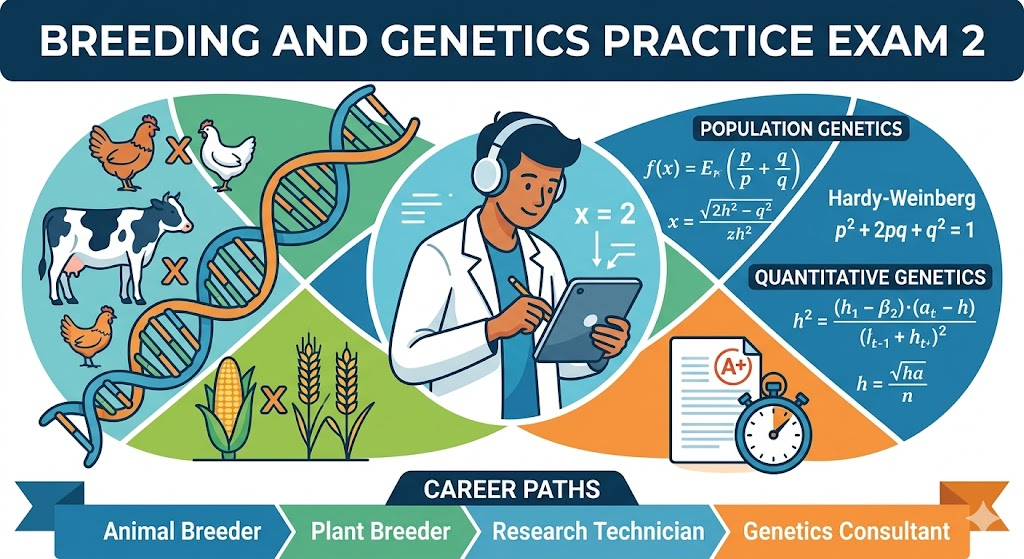
Additional Information
What the Course Entails and Exam Details
This stage of the Breeding and Genetics course moves beyond simple Mendelian squares to explore how traits behave within entire populations and how specific phenotypes are selected. The core syllabus covered by Exam 2 typically includes:
Population Genetics: Mastery of the Hardy-Weinberg Principle, including calculating allele and genotype frequencies and understanding the forces that change them (mutation, migration, drift, and selection).
Quantitative Genetics: Understanding polygenic traits, the concept of heritability ($h^2$ and $H^2$), and the difference between narrow-sense and broad-sense heritability.
Linkage and Mapping: Analyzing recombination frequencies to map gene locations on chromosomes and understanding how linkage disequilibrium affects breeding.
Gene Interactions: Identifying non-Mendelian inheritance patterns such as epistasis, pleiotropy, codominance, and incomplete dominance.
Breeding Systems: Evaluating the genetic consequences of inbreeding, linebreeding, crossbreeding, and the biological basis of heterosis (hybrid vigor).
What to Expect in the Final Exam
You should expect the official Exam 2 to be a rigorous testing event, usually conducted in a formal academic setting over a period of 60 to 90 minutes. The format is typically a combination of assessment styles, designed to test both comprehensive knowledge and practical calculation skills:
Multiple Choice & True/False: Covering definitions, conceptual understanding, and quick scenario analysis.
Problem-Solving & Calculations: These are the heart of Exam 2, requiring you to perform Hardy-Weinberg equilibrium calculations, determine heritability from data sets, and solve complex linkage mapping problems.
Short Answer/Diagram Interpretation: You may be asked to interpret breeding pedigrees or explain the genetic mechanism behind a specific physiological trait.
A passing score is typically 70%, though this varies by institution. It is critical to note that while some conceptual sections may be straightforward, you must allow significant time for the mathematical problems, which are heavily weighted.
How to Study and Exam Centers
Preparation for Exam 2 must emphasize active application over passive reading. Follow these strategies to maximize your score:
Prioritize Problem Sets: Genetics is a quantitative science. You must actively work through dozens of Hardy-Weinberg, heritability, and mapping problems until the process is instinctual.
Form Study Groups: Explaining population genetics concepts to others is one of the most effective ways to solidify your own understanding.
Use Practice Exams: Take timed practice tests that mimic the structure of the actual exam to improve your speed and identify weak areas.
Visualize the Concepts: Draw out chromosome mappings and create flowcharts for different types of epistasis.
Regarding exam centers, for university-based courses, the exam is typically administered in your designated classroom or a university testing hall. If this course is part of an online program, the exam will likely be proctored through a secure online portal (such as Honorlock or RPNow) or administered at authorized physical testing centers (like Pearson VUE) if specific external certification is tied to the course.
Job Opportunities from the Course
A strong performance in Breeding and Genetics unlocks several specialized career paths in both animal and plant sectors. Mastery of these concepts is essential for the following roles:
Animal Breeder: Managing selection programs for livestock, poultry, or companion animals to improve health and productivity.
Plant Breeder: Developing new crop varieties with enhanced yield, disease resistance, or drought tolerance.
Genetics Research Technician: Conducting laboratory experiments in universities, government agencies (like the USDA), or private biotech firms.
Livestock Production Manager: Utilizing genetic data to optimize herd or flock management decisions.
Quality Control Specialist (Seed/Semen Industry): Ensuring the genetic purity and viability of agricultural products.
Conservation Geneticist Aide: Assisting in managing the genetic diversity of endangered species in zoos or wildlife reserves.
Frequently Asked Questions
Reviews
5.0
Based on 0 reviews
Leave a Review
No reviews yet. Be the first to review!