
British Columbia Powerlifting Association Referee Practice Exam
$69.00
- Buy to unlock unlimited access to all Quiz questions and Answers in this Quiz.
- After purchase you can print a PDF of the whole quiz at any point. The PDF will contain the questions and the correct answers.
About this Exam
The British Columbia Powerlifting Association (BCPA) Referee Certification is the essential credential for individuals dedicated to upholding the integrity, safety, and standardization of drug-tested powerlifting within British Columbia. This program is specifically designed for passionate lifters, coaches, volunteers, and long-standing enthusiasts who wish to transition from the sidelines to the platform's officiating chairs. By becoming a certified referee, you join a critical team responsible for ensuring that every competition is conducted fairly, adheres strictly to the International Powerlifting Federation (IPF) technical rules, and provides a level playing field for all athletes across the province.
Ready to test your knowledge?
Buy Now to Access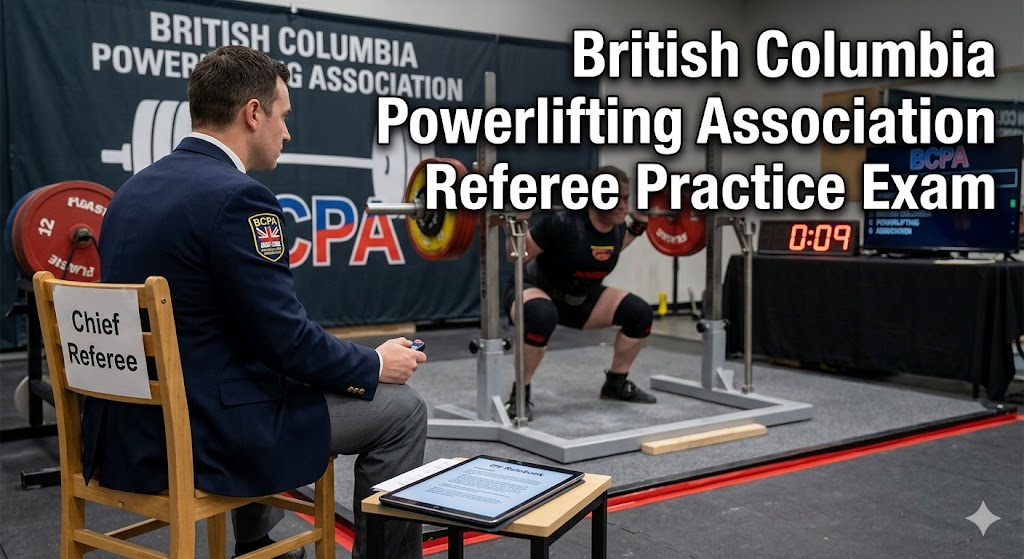
Additional Information
What the Course Entails and Exam Details
This certification program is not a traditional "course" with a fixed classroom schedule, but rather a comprehensive self-study and mentorship journey. The core technical syllabus is the current version of the IPF Technical Rules Book. Prospective referees must master a vast array of topics, beginning with the detailed technical standards for all three contested lifts: the Squat, the Bench Press, and the Deadlift. Beyond lift execution, the curriculum covers mandatory vs. disallowed athlete equipment (including specific rules on belts, singlets, and wraps); the exact referee signals and audible commands; weigh-in protocols; drug-testing support procedures; and general competition management. Candidates must demonstrate an ability to apply these rules impartially under pressure during actual competitions.
What to Expect in the Final Exam
The full referee certification process in British Columbia generally consists of two distinct components that must both be passed to achieve status.
The first component is the Written Examination. This is a comprehensive test designed to measure your theoretical understanding of the IPF Technical Rules Book, including niche rule scenarios and equipment specifications. You must achieve a high minimum score, usually 90%, to proceed. The written exam is often hosted through an online portal or administered by an authorized proctor.
The second component is the Practical Examination, often referred to as "shadowing." This occurs on-site at a sanctioned BCPA competition. You will sit alongside senior, ranked referees ( Provincial, National, or International level) during a full session of lifting, typically involving at least 20 lifters. You will make calls on every lift, and your decisions—including the reasons for "No Lift" calls—will be compared against the final consensus of the official referees. You must achieve a high percentage of agreement to pass the practical component. There is usually no strict time limit for the practical; you are graded on the accuracy of your decisions across the duration of the session.
How to Study and Exam Centers
The most critical study strategy is to internalize the IPF Technical Rules Book. You should treat this document as your primary textbook, reading it multiple times and focusing on the specific "Causes for Disqualification" for each lift. Supplemental study guides, official BCPA practice quizzes, or educational videos detailing common rule infractions are excellent secondary resources. Practice watching competition footage on mute and calling "Good Lift" or "No Lift" instantly, providing the correct reason code for failures. Attending referee clinics hosted by the BCPA is highly recommended for hands-on clarification.
There are no dedicated third-party testing centers like Pearson VUE for this exam. To initiate the process, you must contact the BCPA Officiating Chair directly. The Written Exam is generally administered virtually via an online testing portal. The Practical Exam can only be taken at a sanctioned BCPA powerlifting meet, which serves as the physical testing environment. You must coordinate with the BCPA to be scheduled as a shadowing referee at a suitable upcoming competition.
Job Opportunities from the Course
While many powerlifting referee positions are initially volunteer-based, becoming a certified official is the compulsory first step down a prestigious and structured career path within the sport. This certification unlocks the following progressive career paths:
BCPA Provincial Referee (The entry-level rank, allowing you to officiate all sanctioned local and provincial meets).
CPU National Referee (Requires a minimum tenure as a Provincial referee and successful officiating at National Championships).
IPF Category 2 International Referee (Allows you to officiate at international and World Championship events).
IPF Category 1 International Referee (The highest possible rank, which also qualifies you to serve on Jury panels at the highest level of the sport).
BCPA Meet Director (Many sanctioned meet directors are required to hold a referee credential).
Sport Administrator or Technical Committee Member within Provincial or National Federations.
Frequently Asked Questions
Reviews
5.0
Based on 0 reviews
Leave a Review
No reviews yet. Be the first to review!