
Broadband Digital Installer Practice Test
$69.00
- Buy to unlock unlimited access to all Quiz questions and Answers in this Quiz.
- After purchase you can print a PDF of the whole quiz at any point. The PDF will contain the questions and the correct answers.
About this Exam
The Broadband Digital Installer (BDI) certification is a crucial credential for professionals aiming to excel in the rapidly evolving telecommunications industry. This exam validates the fundamental skills and knowledge required to install, maintain, and troubleshoot modern high-speed internet services for residential and commercial customers. This certification is ideal for entry-level technicians looking to start their career, and it's also highly valuable for experienced technicians seeking to formalize and upgrade their skill set to match the demands of the latest broadband technologies.
Ready to test your knowledge?
Buy Now to Access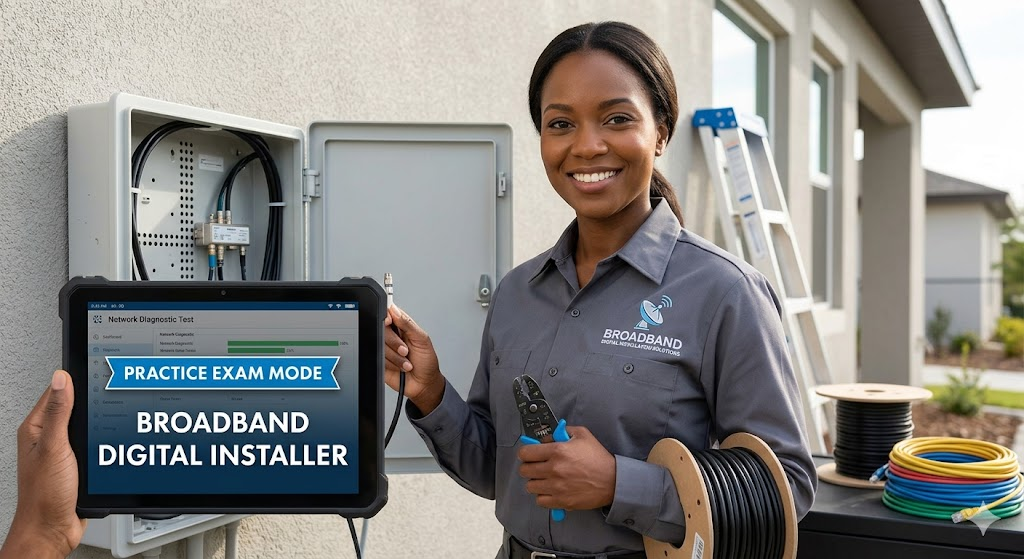
Additional Information
What the Course Entails and Exam Details
This comprehensive course provides in-depth training on the vital technical components of digital broadband installation. Students will delve into a wide range of topics, including the principles of RF (Radio Frequency) and how signal transmission works over various mediums.
The curriculum covers a detailed understanding of both coaxial cable (DOCSIS) and fiber optic systems (FTTH/FTTP). Key skills taught include proper physical installation techniques, from running cables and installing connectors to configuring and testing customer premises equipment (CPE) such as modems, routers, and Wi-Fi access points. Essential safety procedures and practical troubleshooting methods are emphasized throughout.
What to Expect in the Final Exam
The final certification exam typically consists of a multiple-choice format designed to assess a candidate's theoretical knowledge. However, depending on the specific program or issuing body, a practical, hands-on demonstration of installation and troubleshooting skills may also be required.
Candidates must typically achieve a passing score of at least 70–80% to earn the certification. For the multiple-choice section, there is often a time limit, usually ranging from 90 to 120 minutes. It's essential for candidates to be well-prepared for both the conceptual questions and, if applicable, the real-world scenarios in the practical evaluation.
How to Study and Exam Centers
Effective preparation for the Broadband Digital Installer exam is key to success. Utilize all available resources, starting with the official course materials and study guides provided by your training provider. To solidify your understanding of the multiple-choice section, taking a Broadband Digital Installer Practice Test is highly recommended. Practicing with sample questions familiarizes you with the exam format and identifies areas where you may need further study.
Furthermore, hands-on practice is indispensable. Spending time working with actual equipment—stripping cable, installing connectors, and configuring routers—is crucial for both the written exam and any potential practical assessment.
Testing centers vary by certification provider. The exam may be available through proctored online portals, at designated community colleges or vocational schools, or at authorized corporate training facilities. Candidates should check with their specific certifying body for a current list of approved testing locations and dynamic remote proctoring options.
Job Opportunities from the Course
Upon earning your Broadband Digital Installer certification, a wide array of career opportunities becomes available within the telecommunications sector. Potential job titles include:
Broadband Installation Technician
Field Service Technician
Telecommunications Installer
High-Speed Internet Technician
Network Support Specialist
Digital Home Service Installer
This credential acts as a solid foundation, paving the way for advanced certifications and specialized roles in network engineering and telecommunications management.
Frequently Asked Questions
Reviews
5.0
Based on 0 reviews
Leave a Review
No reviews yet. Be the first to review!