
BSA Compliance Practice exam
$69.00
- Buy to unlock unlimited access to all Quiz questions and Answers in this Quiz.
- After purchase you can print a PDF of the whole quiz at any point. The PDF will contain the questions and the correct answers.
About this Exam
Welcome to your comprehensive roadmap to mastering the Bank Secrecy Act (BSA) Compliance exam.
This pivotal practice exam is specifically created to support professionals aiming to demonstrate their expertise in combating financial crime within the US regulatory framework.
It is designed for a broad range of candidates, including bank compliance officers, BSA/AML analysts, risk managers, auditors, and law enforcement professionals transitioning into the financial sector.
By successfully navigating this practice test, you are not just preparing for a certification; you are proving your commitment to integrity within the global financial system.
This guide provides the structure, strategy, and confidence you need to take the final step toward becoming a certified BSA compliance expert.
Ready to test your knowledge?
Buy Now to Access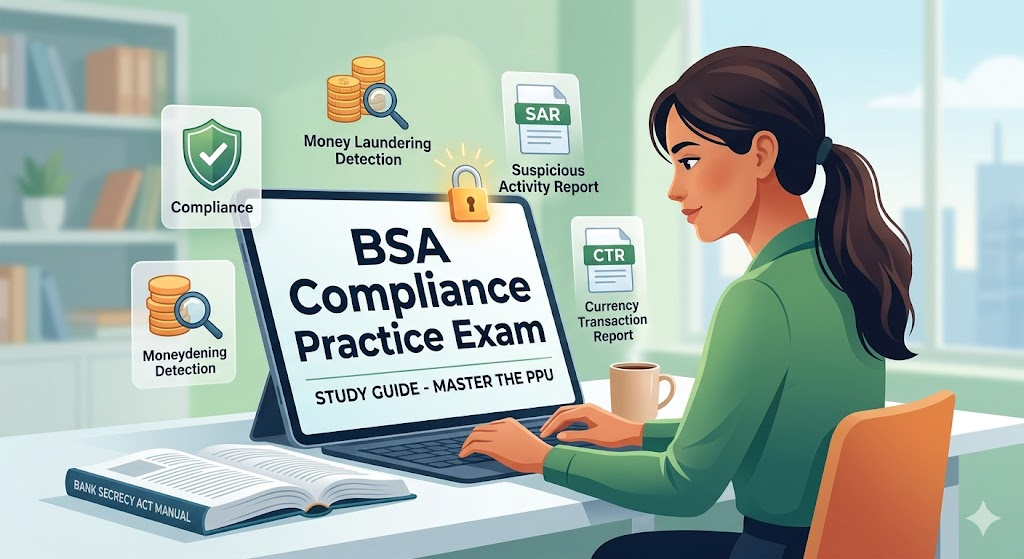
Additional Information
What the Course Entails and Exam Details
The BSA Compliance practice exam is designed to simulate the rigorous knowledge required by official regulatory bodies and certification providers.
The course curriculum focuses heavily on the five pillars of a robust BSA compliance program.
Candidates must demonstrate an in-depth understanding of Customer Due Diligence (CDD) and Beneficial Ownership requirements.
Significant emphasis is placed on identifying and reporting suspicious behavior through Suspicious Activity Reports (SARs) and Currency Transaction Reports (CTRs).
Furthermore, you will be tested on your ability to navigate Office of Foreign Assets Control (OFAC) sanctions and the implications of the USA PATRIOT Act.
The exam details ensure you are ready for the core competencies required to maintain a compliant financial institution.
What to Expect in the Final Exam
The final BSA Compliance certification exam is typically a proctored, comprehensive test of logic and regulatory knowledge.
Candidates should expect a multiple-choice format, often containing scenario-based questions that require you to apply regulations to real-world financial situations.
While specific question counts vary by certifying body, most final exams range from 80 to 120 questions.
The time limit is usually set between 2 and 3 hours, demanding both accuracy and efficient time management.
A passing score is generally required to be within the 75% to 80% range.
It is crucial to read every scenario carefully, as official exams often include complex details that differentiate a required CTR filing from a voluntary SAR filing.
How to Study and Exam Centers
Success on the BSA Compliance exam requires a blended approach of theoretical study and practical application.
Your primary study resource should be the FFIEC BSA/AML Examination Manual, which is the gold standard used by regulators themselves.
Create detailed flashcards for key acronyms, filing thresholds, and deadlines—memorizing CTR and SAR timeframes is non-negotiable.
The most effective study method is the repeated use of this practice exam; use it to identify your weak points and return to the manual for review.
Most official certification exams, such as those provided by the American Bankers Association (ABA) or the Independent Community Bankers of America (ICBA), are administered digitally.
You can usually take these exams through secure online portals or at authorized, proctored testing centers, including Pearson VUE facilities located nationwide.
Job Opportunities from the Course
Earning a certification in BSA Compliance immediately elevates your professional standing and unlocks multiple lucrative career paths within the financial services industry.
Many graduates advance into specialized regulatory roles.
Possible job titles include:
BSA/AML Compliance Officer
BSA Analyst or Senior Analyst
Compliance Specialist
Financial Intelligence Unit (FIU) Investigator
KYC (Know Your Customer) Analyst
Risk Management Officer
Internal Auditor for Financial Institutions
Regulatory Consultant
Anti-Money Laundering (AML) Director
Fraud Investigator
Frequently Asked Questions
Reviews
5.0
Based on 0 reviews
Leave a Review
No reviews yet. Be the first to review!