
BSMS Work Experience Practice Test
$69.00
- Buy to unlock unlimited access to all Quiz questions and Answers in this Quiz.
- After purchase you can print a PDF of the whole quiz at any point. The PDF will contain the questions and the correct answers.
About this Exam
The BSMS Work Experience Practice Test is an invaluable preparatory tool designed for students planning to apply to medical school, specifically those who are completing or have completed the Brighton and Sussex Medical School (BSMS) Virtual Work Experience programme. This innovative programme aims to provide aspiring doctors, regardless of their background or social capital, with a comprehensive insight into the medical profession. The practice test serves as a critical checkpoint, allowing students to consolidate the knowledge, values, and clinical understanding they have gained throughout the virtual placement. It is specifically tailored to simulate the reflection and assessment stages that follow real-world medical work experience, ensuring that students can effectively communicate their learning to admissions tutors and interview panels.
Ready to test your knowledge?
Buy Now to Access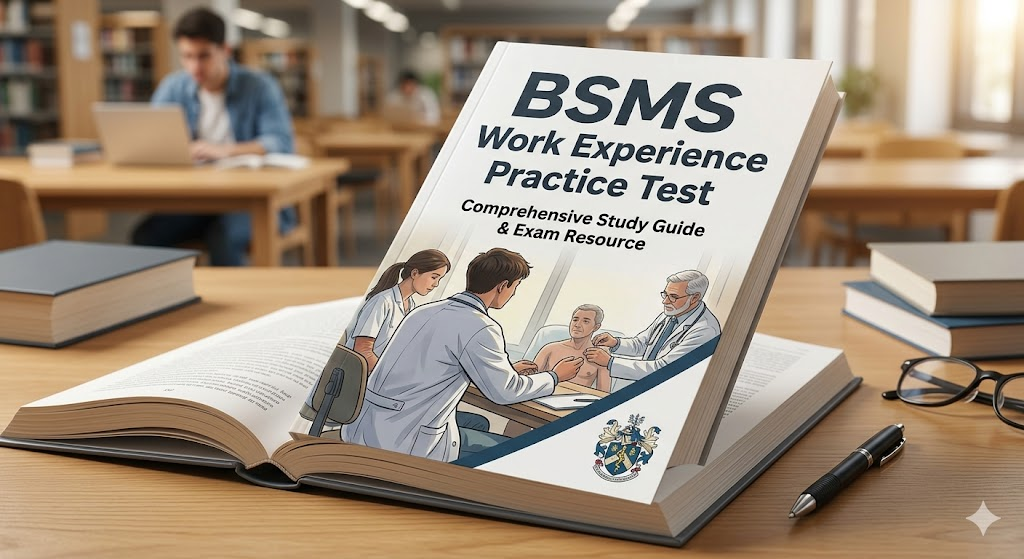
Additional Information
What the Course Entails and Exam Details
This practice test is intrinsically linked to the comprehensive syllabus covered in the BSMS Virtual Work Experience course. The course takes students on a detailed journey through six diverse areas of medicine, exploring the roles, daily responsibilities, skills required, and specific challenges faced by healthcare professionals in specialities such as primary care (GP), anatomy, and various hospital-based departments.
The practice test primarily covers a syllabus of reflection and scenario-based understanding, evaluating a student's grasp of:
The fundamental principles and core values of the NHS (e.g., patient-centered care, compassion, integrity).
The essential skill sets, attributes, and professional roles of different medical specialists.
The communication techniques and ethical decision-making processes required in various clinical settings.
Current and wider issues affecting healthcare delivery in the UK.
The importance of teamwork and professionalism within a multidisciplinary healthcare team.
In terms of exam details, the assessment is structured to reflect the reflective and decision-making nature of modern medical assessment, such as the Multiple Mini Interviews (MMI). The final examination consists entirely of multiple-choice questions, which evaluate both declarative knowledge of the NHS and procedural knowledge of how doctors respond to typical ethical and clinical scenarios. There are no practical stations or long-form essays in this particular practice test. Students must demonstrate a high level of comprehension to pass, with the passing score requirement generally set at 70%. The test is strictly time-limited to 60 minutes, emphasizing the need for efficient processing and decision-making under pressure.
What to Expect in the Final Exam
When sitting for the BSMS Work Experience Practice Test, students should anticipate a focused, efficient, and entirely virtual assessment.
Format: The exam is composed of approximately 50 to 60 multiple-choice questions (MCQs). These are designed to be scenario-based, presenting you with a short ethical, communication, or clinical problem and asking you to select the most or least appropriate response based on the principles taught in the course.
Time Limit: You will have exactly one hour (60 minutes) to complete the examination. This means you must manage your time effectively, allocating roughly one minute per question, including reading and decision time.
Passing Score: To pass and demonstrate satisfactory completion, students must achieve a score of 70% or higher.
Specific Rules: As this is an online, unproctored assessment taken via the course portal, there are few environmental constraints. However, students must ensure they have a stable internet connection and must complete the entire test in a single sitting. Once the 60-minute timer starts, it cannot be paused.
Question Type Example: You may be asked: "A patient's family member insists on knowing the patient's diagnosis against the patient's stated wishes. Based on the NHS core value of confidentiality, what is the most appropriate action?" and then be given four multi-step choices to select from.
How to Study and Exam Centers
Studying for the BSMS Work Experience Practice Test requires a dynamic and active learning approach focused on reflection rather than passive memorization.
Actionable Study Strategies:
Active Review of Course Content: Go back through your notes from all six modules of the BSMS Virtual Work Experience. Don't just re-read; actively summarize the key challenges and resolutions presented in each speciality.
Internalize NHS Values: Ensure you can define and discuss the core values of the NHS Constitution. Questions often test how these values apply in practical scenarios (e.g., 'Respect and Dignity' during a difficult consultation).
Practice with Ethical Scenarios: Seek out resources that provide medical ethics and MMI practice scenarios (e.g., scenarios focusing on autonomy, beneficence, non-maleficence, and justice). Apply the "Four Pillars of Medical Ethics" to every scenario you encounter.
Simulate Exam Conditions: In the final days of preparation, take a full 60 minutes to practice answering scenario-based MCQs without interruption.
Exam Centers: Because this is a fully virtual assessment, there are no physical testing centers (like Pearson VUE). The BSMS Work Experience Practice Test is taken exclusively online. It is accessed through the authorized BSMS Virtual Work Experience platform (often hosted on Thinkific or an equivalent portal linked through Brighton and Sussex Medical School's website or partners like Barclays LifeSkills). You can complete the test from any location with a secure and stable internet connection.
Job Opportunities from the Course
While the successful completion of the BSMS Work Experience Practice Test and the broader programme is not a formal qualification that directly grants entry into a new job title, it is a significant asset on any application within the healthcare sector. The reflected learning and certification are highly regarded by admissions tutors and employers alike, unlocking critical competitive advantages for the following career paths:
Medical Doctor: By far the most common path. This certification is crucial for strengthening a medical school application (e.g., to BSMS or any other UK medical school), helping you secure an interview and eventually leading to roles as a Junior Doctor, and later, a General Practitioner or Consultant.
Clinical Researcher / Research Assistant: The structured insight into medical specialities, ethical decision-making, and the NHS framework provides a strong foundation for entry-level roles in clinical trials or health research.
Healthcare Assistant (HCA) / Support Worker: The understanding of clinical professionalism, teamwork, and patient safety is immediately transferable to supportive patient-care roles within the NHS or private sector.
Healthcare Policy or Administration Analyst: Understanding NHS values, structures, and challenges equips you for initial roles in healthcare management or policy development.
Physician Associate (via further graduate study): For those interested in the 'medical model' of care but a shorter training pathway, this background provides the competitive edge needed for admission to Physician Associate postgraduate programmes.
Medical Scribe / Transcriptionist: Familiarity with the language and procedural logic used in medical scenarios helps transition into clinical documentation roles.
Frequently Asked Questions
Reviews
5.0
Based on 0 reviews
Leave a Review
No reviews yet. Be the first to review!