
BTEC Applied Psychology Social Practice Exam
$69.00
- Buy to unlock unlimited access to all Quiz questions and Answers in this Quiz.
- After purchase you can print a PDF of the whole quiz at any point. The PDF will contain the questions and the correct answers.
About this Exam
Welcome to your comprehensive study guide for the BTEC Applied Psychology Social Practice Exam.
This specialized practice tool is designed specifically for students preparing for the Pearson BTEC Level 3 National qualifications in Applied Psychology.
It provides targeted revision and assessment on the intricate relationship between individuals and society, focusing on how social situations influence human mind and behavior.
This certification is designed for learners wishing to progress to higher education or seek entry-level roles in social care, healthcare, or community support by demonstrating their ability to apply psychological theories to real-world social scenarios.
Ready to test your knowledge?
Buy Now to Access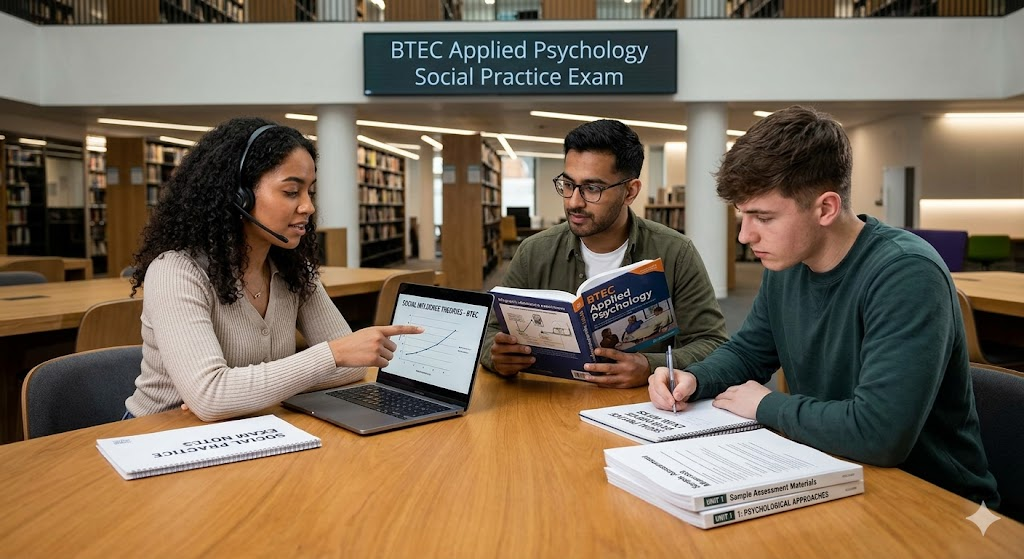
Additional Information
What the Course Entails and Exam Details
This examination focuses heavily on the social approach within the broader BTEC Applied Psychology curriculum.
You will need a robust understanding of key theoretical frameworks, foundational studies, and their practical applications.
The core syllabus covered within this practice exam includes:
Social Influence: Detailed knowledge of conformity, obedience to authority, and minority influence.
Key Studies: Analysis and evaluation of landmark research, such as Milgram's obedience experiments and Asch's conformity studies.
Factors Affecting Social Behavior: Understanding dispositional factors (personality traits) versus situational factors (environmental context).
Social Identity Theory: Exploring in-groups, out-groups, social categorization, and comparison.
Prejudice and Discrimination: Examining the psychological origins of prejudice and strategies to reduce it in society.
Aggression: Psychological explanations of aggressive behavior from a social perspective.
The underlying details of the final formal assessment typically include a 90-minute external examination, carrying a total of 72 marks.
What to Expect in the Final Exam
When sitting the formal BTEC Applied Psychology examination, you will face a rigorous test comprising varied question types.
The paper is externally set and marked by Pearson, ensuring a standardized assessment of your knowledge.
You should expect the following format:
Total Time: 1 Hour and 30 Minutes.
Total Marks: 72 marks.
Question Types: A mix of multiple-choice questions (testing definitions and recall), scenario-based short answers (testing application skills), and extended open-response questions (testing analysis and evaluation).
Passing Requirement: There is no single "passing score" for one exam; rather, your score contributes to your overall grade profile (Pass, Merit, Distinction, or Distinction*) for the full qualification. You must demonstrate knowledge across all assessment outcomes to secure a Pass.
Specific rules include the strict prohibition of calculators, mobile devices, or any revision materials within the examination room.
How to Study and Exam Centers
Effective preparation for this exam requires a balance of active recall, application practice, and time management.
Here are actionable study strategies:
Master Key Terms: Use digital or physical flashcards to memorize definitions of concepts like normative social influence, informational social influence, deindividuation, and agentic state.
Analyze Past Papers: Obtain Sample Assessment Materials (SAMs) from Pearson. Complete them under timed conditions to build exam stamina and familiarize yourself with the question wording.
Evaluate Studies: Do not just memorize studies; learn to evaluate them using GRAVE (Generalizability, Reliability, Application, Validity, Ethics). Extended response questions will require this level of analysis.
Apply Theories to Scenarios: Practice linking theories to real-life situations. For example, use Social Identity Theory to explain a conflict between rival sports fans.
Regarding Exam Centers, the BTEC Applied Psychology exams are vocational qualifications primarily delivered through authorized schools, further education colleges, or approved training centers.
Unlike some professional certifications taken at generic testing centers (like Pearson VUE), your final written exam will almost always be arranged and invigilated by the educational institution where you are registered for the BTEC course.
Check with your course tutor or exams officer to confirm the specific dates and location for your scheduled exam session.
Job Opportunities from the Course
Successfully completing the BTEC Applied Psychology course demonstrates valuable skills in critical thinking, data analysis, and an understanding of human behavior that are highly sought after by employers.
This qualification can unlock various career paths, particularly in social sectors:
Social Support Worker: Providing assistance to vulnerable individuals within community settings.
Youth Worker: Supporting the personal, social, and educational development of young people.
Teaching Assistant: Assisting teachers in classrooms, particularly supporting students with behavioral needs.
Mental Health Support Worker: Working alongside professionals to care for individuals with mental health conditions.
Human Resources Assistant: Utilizing an understanding of social dynamics for recruitment and employee relations.
Marketing/Advertising Assistant: Applying concepts of social influence to consumer behavior and campaigns.
Community Outreach Officer: Developing programs to support and engage local community groups.
Frequently Asked Questions
Reviews
5.0
Based on 0 reviews
Leave a Review
No reviews yet. Be the first to review!