
BTEC Music Practice Exam
$69.00
- Buy to unlock unlimited access to all Quiz questions and Answers in this Quiz.
- After purchase you can print a PDF of the whole quiz at any point. The PDF will contain the questions and the correct answers.
About this Exam
The BTEC Level 1/2 Tech Award in Music Practice is an exciting, practical qualification designed for students aged 14 to 16, or anyone aiming to develop core skills within the modern music industry.
This course is for those who are passionate about music, whether your interest is performing, composing, or the technical aspects of production and sound engineering.
It provides a hands-on introduction to the musical world, giving you the practical experience that employers and colleges value, all while you study in a structured academic environment.
By focusing on real-world projects, this qualification bridges the gap between creative ambition and professional skill-building.
Ready to test your knowledge?
Buy Now to Access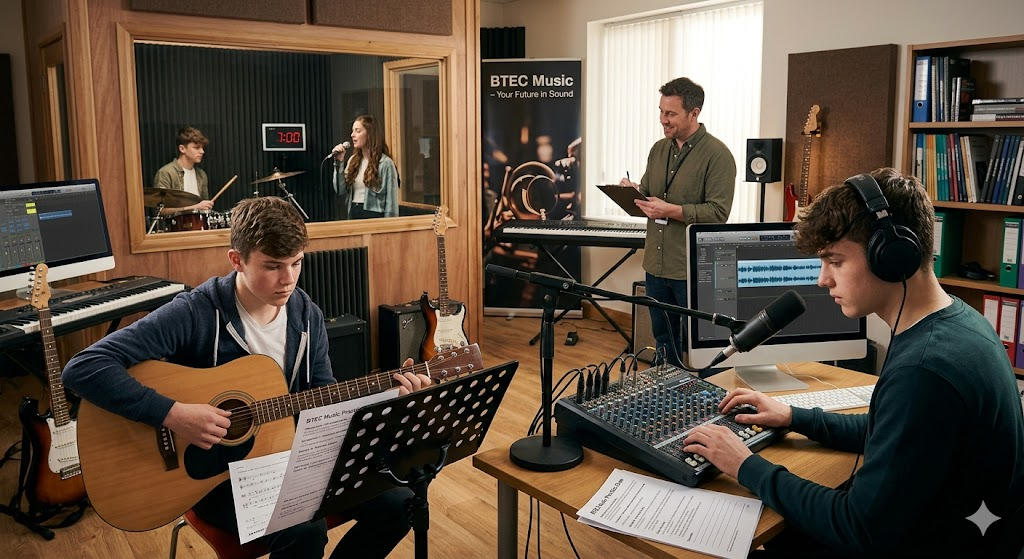
Additional Information
What the Course Entails and Exam Details
The core structure of the BTEC Music Practice qualification is built around practical, skill-based assessment rather than a traditional, single exam paper.
You will complete three vocational components, which allow you to apply your knowledge to realistic industry scenarios.
The curriculum covers exploring musical styles and techniques, creating your own original work, and responding to a specific music industry brief.
Your assessment is largely through an Internal Assessment (60%) where your performance in coursework is graded by your tutor, and one key Synoptic External Assessment (40%) where your final practical skills are tested by Pearson.
The course develops your understanding of music theory, composition, production techniques using Digital Audio Workstations (DAWs), and the fundamental professionalism required for the music business.
What to Expect in the Final Exam
The term 'exam' in this context refers to the Synoptic External Assessment (Component 3: Responding to a Commercial Music Brief).
Unlike a written, multiple-choice paper, this assessment is a major practical assignment that tests everything you have learned in your course.
You will be given a specific industry brief, and you must apply your musical and technical skills to create, produce, and review a musical project.
This brief could require you to perform, compose, or produce music that meets a commercial client’s needs, such as music for advertising, film, or gaming.
This assignment has a set time limit—typically around 20 hours—spread over several sessions under controlled conditions.
Your submission will be externally moderated by Pearson, the awarding body, and will contribute significantly to your final Level 1 or Level 2 Distinction, Merit, or Pass grade.
There is no traditional 'passing score' but rather a cumulative point score across all components, culminating in your final award grade.
How to Study and Exam Centers
Studying for BTEC Music Practice requires you to focus on developing technical proficiency, creating high-quality coursework, and preparing specifically for the final external assessment.
Key Study Strategies Include:
Practice Your Core Skill: Whether you are a musician or a producer, dedicate regular time to improving your technical expertise, so your final project is polished.
Understand Commercial Music Briefs: Practice deconstructing various briefs from previous years (which are often available from Pearson). Practice identifying the target audience, the aesthetic requirements, and the technical constraints.
Create Your Own Projects: Build up a portfolio. Work on different projects to build a diverse range of creative skills, which will help you adapt to the specific challenge of the final brief.
Master Music Software: For production students, ensure you are deeply familiar with one leading DAW. Practice creating arrangements, mixing, and mastering efficiently under time pressure.
Maintain Your Coursework: Keep meticulous records of your work. Ensure all documentation, from early rough ideas to your final review, is accurate and well-organized for internal assessment.
Exam Centers and Where to Take the Exam:
As the BTEC Music Practice qualification is integrated into your school or college’s curriculum, you will complete both your coursework (internal assessments) and your external assessment (Component 3 brief) at your registered school or an approved educational center.
These assessments are overseen by your teachers and exam coordinators, following Pearson's strict guidelines.
You will typically not go to an external Pearson VUE test center for this specific exam; your own school’s facilities—including recording studios or computer suites—are where you will complete your practical assignments.
Job Opportunities from the Course
The BTEC Level 1/2 in Music Practice is a recognized qualification that prepares you for progression. Many students move on to Level 3 BTECs, T-Levels, or entry-level positions in the industry. The skills you develop unlock diverse career paths, including:
Studio Assistant: Start on the technical side, supporting lead sound engineers in professional recording studios.
Junior Music Producer: Use your production and DAW skills to create electronic music, tracks, and soundscapes.
Sound Designer for Games: Create the immersive sound effects and audio environments for video games.
Live Sound Technician Trainee: Gain experience managing the sound equipment for live music performances and events.
Session Musician: Build your performance portfolio to work as a freelance musician for live performances and studio recordings.
Music Marketer/Content Creator: Utilize your understanding of the music industry brief and promotion for roles in music management and digital media.
Music Journalist/Critic: Combine your deep knowledge of music styles and theory with strong writing and analytical skills.
Arts Administrator: Apply organizational and industry knowledge to roles within arts councils, performance venues, and music charities.
Frequently Asked Questions
Reviews
5.0
Based on 0 reviews
Leave a Review
No reviews yet. Be the first to review!