
Building Automations 1 Practice Test
$69.00
- Buy to unlock unlimited access to all Quiz questions and Answers in this Quiz.
- After purchase you can print a PDF of the whole quiz at any point. The PDF will contain the questions and the correct answers.
About this Exam
The Building Automations 1 certification and its associated practice test are designed for aspiring technicians, engineers, and facility managers looking to establish a foundational understanding of modern building management systems (BMS).
This entry-level exam validates that an individual possesses the core knowledge required to install, operate, and maintain simple automated controls that regulate a building’s HVAC (Heating, Ventilation, and Air Conditioning), lighting, and electrical systems.
It is ideal for recent graduates of technical programs, electricians transitioning into smart technology, or current maintenance staff seeking to specialize and improve efficiency. This is the essential first step in a career focused on green energy, intelligent infrastructure, and smart city technology.
Ready to test your knowledge?
Buy Now to Access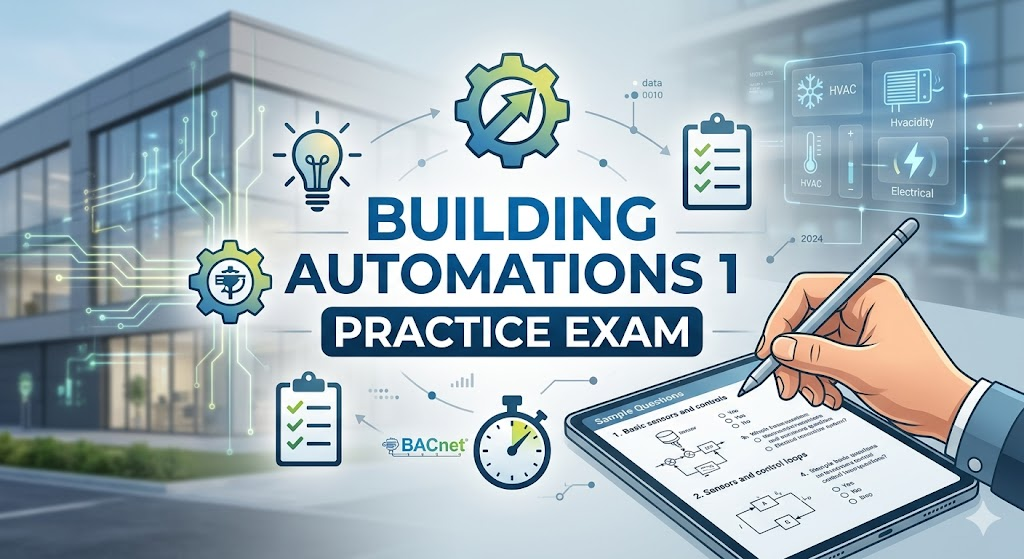
Additional Information
What the Course Entails and Exam Details
This examination assesses a comprehensive range of competencies fundamental to successful building automation deployment. A candidate must demonstrate practical understanding across a wide syllabus, starting with the core principles of control loops and fundamental electronics.
Key topics covered include detailed identification and operation of input and output devices, including various sensors (temperature, humidity, pressure, occupancy) and actuators for dampers and valves. The exam also heavily covers standard communication protocols, specifically the fundamentals of how devices interact using networks like BACnet, LonWorks, or Modbus.
Furthermore, students are expected to show familiarity with the sequence of operations (SOO) for basic HVAC equipment, common networking hardware (routers, switches, controllers), and the reading of schematic diagrams that outline these intricate system relationships.
What to Expect in the Final Exam
The actual certification exam following the Building Automations 1 course is typically structured as a comprehensive multiple-choice test designed to measure theoretical knowledge and scenario-based problem-solving.
Candidates are usually allotted 90 to 120 minutes to complete approximately 50 to 75 questions, depending on the specific testing provider (e.g., HVAC Excellence, specific manufacturer training programs like Siemens or Johnson Controls).
A passing score is generally between 70% and 80%, indicating a strong conceptual grasp of all key domains. The exam is often closed-book, though some online proctored versions may permit a small blank notepad. Calculator usage, if allowed, is typically limited to a basic, non-programmable model provided within the testing interface.
How to Study and Exam Centers
Effective preparation for the Building Automations 1 exam requires a hybrid approach, combining focused study with hand-on practice.
First, focus deeply on the course materials, textbooks, and any official study guides provided by the testing entity. Many successful students utilize flashcards (physical or digital via apps like Anki) to master communication protocols, terminology, and sensor types. However, theory alone is insufficient. Candidates are strongly encouraged to seek out simulation software (many BMS vendors offer student versions) or virtual labs to practice identifying hardware and programming basic sequences. Regularly taking a reputable practice test (like this one) is critical to gauge your readiness, manage time effectively, and identify specific weak areas.
Regarding the location, this foundational exam is frequently available online via live-proctored portals, offering candidates flexibility to test from their home or office. Physical testing is also commonly facilitated through authorized community colleges, dedicated trade schools, and authorized Pearson VUE or Prometric testing centers. Check the specific provider's website to schedule an appointment at your preferred location.
Job Opportunities from the Course
Successfully completing the Building Automations 1 course and passing the certification exam is a powerful step that unlocks numerous entry-level career opportunities. Employers in commercial real estate, data centers, hospitals, and energy management firms are actively seeking these skills.
Potential job titles include:
Building Automation Systems (BAS) Technician I
BMS Controls Installer
Entry-Level HVAC Controls Technician
Facility Automation Specialist
BMS Support Representative
Energy Management Systems Operator
Maintenance Tech II (with specialized focus)
Frequently Asked Questions
Reviews
5.0
Based on 0 reviews
Leave a Review
No reviews yet. Be the first to review!