
Building Maintenance Practice Exam
$69.00
- Buy to unlock unlimited access to all Quiz questions and Answers in this Quiz.
- After purchase you can print a PDF of the whole quiz at any point. The PDF will contain the questions and the correct answers.
About this Exam
The Building Maintenance certification is a vital credential designed to validate the essential technical skills and knowledge required to keep commercial and residential properties safe, efficient, and well-maintained. This certification serves as a professional standard for entry-level to semi-skilled maintenance personnel. It is specifically tailored for individuals working as building technicians, facility maintenance workers, property caretakers, and apartment maintenance staff. By obtaining this certification, professionals demonstrate their proficiency in handling the diverse range of systems and repairs that keep modern infrastructure operational.
Ready to test your knowledge?
Buy Now to Access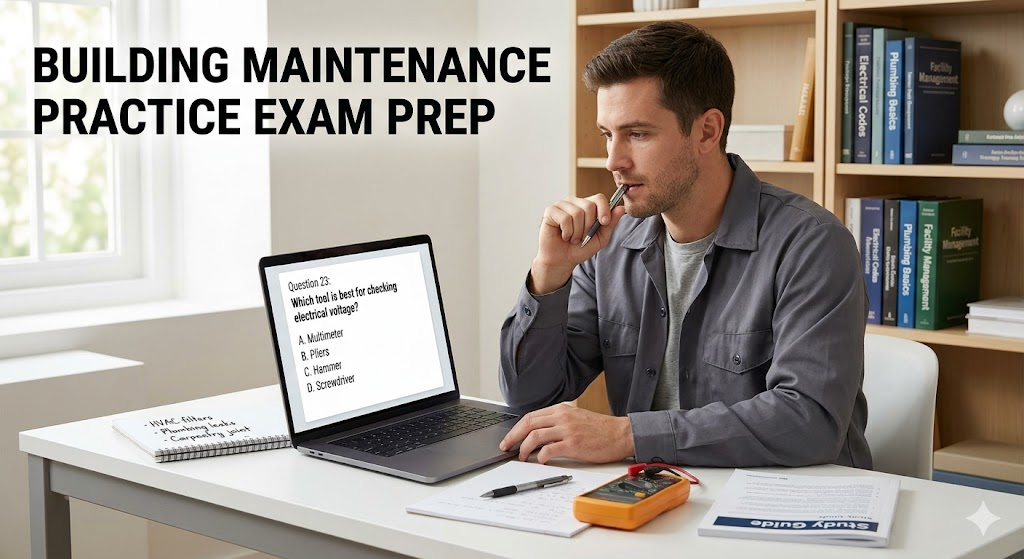
Additional Information
What the Course Entails and Exam Details
This comprehensive training course and subsequent examination cover a broad spectrum of core maintenance disciplines. Students will explore foundational skills across several key trades to ensure a well-rounded skill set. The primary domains covered include Carpentry, focusing on constructing frames, minor structural repairs, and interpreting blueprints. The course also delves deeply into Plumbing principles, such as sweating piping, diagnosing leaks, and maintaining drainage systems. Electrical training is another critical component, encompassing rough wiring, installing switching devices, and mastering both finish wiring and safety codes.
Furthermore, candidates will study HVA Systems (Heating, Ventilation, and Air Conditioning) to perform routine checks, troubleshoot basic mechanical issues, and understand refrigerant regulations like the EPA 608. General maintenance topics include Drywall installation and finishing, appliance repair, and preventative maintenance strategies like condition-based and predictive monitoring. Safety is integrated into every module, covering OSHA standards, tool safety, and hazard identification.
What to Expect in the Final Exam
The final exam structure varies depending on the specific certifying body or testing vendor you choose. However, most assessments follow one of two main formats: a computer-based cognitive exam or a performance-based practical assessment.
The cognitive exam typically consists of multiple-choice questions ranging from 75 to 100 items. Candidates are generally allotted two to three hours to complete this section. Questions are designed to measure factual and theoretical knowledge of mechanical principles, tool application, reading written comprehension, and math relevant to the trade. A common passing score is 70% or higher.
The practical or performance assessment allows individuals to demonstrate their acquired skills by completing actual jobs using authentic tools, materials, and equipment. You may be asked to frame a small structure, rough-wire a junction box, sweat a plumbing joint, and test for defects within a specific time frame. Proper safety procedures are strictly evaluated during these hands-on tasks. Some comprehensive programs require candidates to pass both the written and practical components to earn their certification.
How to Study and Exam Centers
Effective preparation for the Building Maintenance exam requires a dedicated combination of practical experience and structured study. The most actionable strategy is to engage in hands-on work in the field. Volunteer for diverse repair tasks or observe experienced mentors, asking questions about their problem-solving processes. Utilize dedicated study materials, including textbooks specifically designed for the Building Trades or the systems maintenance designations. Online training platforms and local community colleges offer excellent foundational courses. Most importantly, leverage practice exams, focusing on the explanations for correct answers to identify and strengthen your weak areas. Create flashcards for critical safety codes, tool identification, and technical terms.
The location for taking your final exam depends on the certification provider. Written exams are commonly administered via major online testing portals such as Pearson VUE or PSI, which offer convenient physical testing centers worldwide. Many vocational-technical schools and community colleges are also authorized testing facilities for both written and performance assessments. Organizations like BOMI International or NOCTI will provide specific scheduling information upon enrollment in their programs.
Job Opportunities from the Course
A Building Maintenance certification unlocks a dynamic range of career paths across various industries, including real estate management, hospitality, healthcare, government, and education. Licensed and certified maintenance workers are consistently in high demand.
Building Maintenance Technician
Facility Maintenance Worker
Apartment Maintenance Technician
Property Maintenance Worker
Systems Maintenance Technician (SMT)
Building Operator
Groundskeeper/Janitorial Maintenance Leader
Maintenance Manager
HVAC Apprentice
Maintenance Planner
Frequently Asked Questions
Reviews
5.0
Based on 0 reviews
Leave a Review
No reviews yet. Be the first to review!