
Building Utilities Practice Exam
$69.00
- Buy to unlock unlimited access to all Quiz questions and Answers in this Quiz.
- After purchase you can print a PDF of the whole quiz at any point. The PDF will contain the questions and the correct answers.
About this Exam
The Building Utilities Practice Exam is designed for professionals and students aspiring to specialize in the essential systems that keep modern buildings functional. Whether you are an engineer, an architect in training, or a facility management professional, mastering these utilities is critical. This practice exam is specifically crafted to help you prepare for the comprehensive assessments required for certifications or licenses in building systems. It serves as an excellent resource for anyone aiming to validate their knowledge and readiness to manage, design, and maintain the complex utility networks within commercial, residential, and industrial structures. By taking this practice exam, you will identify areas where you excel and where you need further review, ensuring you are thoroughly prepared for the official test.
Ready to test your knowledge?
Buy Now to Access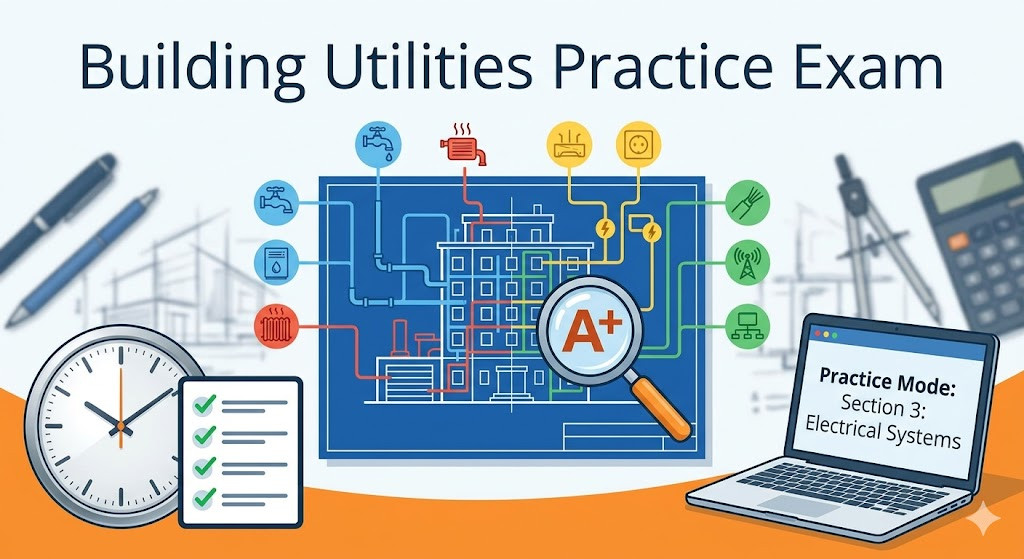
Additional Information
What the Course Entails and Exam Details
The course and subsequent exams on building utilities cover a broad spectrum of integrated systems crucial for a building's operation. You will be tested on your understanding of the design, installation, maintenance, and regulation of these systems. Key areas include:
HVAC (Heating, Ventilation, and Air Conditioning): Focus on thermal comfort, indoor air quality, energy efficiency, system types, and control strategies.
Plumbing and Sanitary Systems: Covers water supply, drainage, waste disposal, and venting, ensuring public health and system efficiency.
Electrical Systems: Examines power distribution, lighting design, circuit sizing, safety codes, and emergency power systems.
Fire Protection and Life Safety: Critical knowledge on sprinkler systems, fire alarms, detection devices, and code compliance for occupant safety.
Specialty Systems: This may include communication networks, building automation systems, and renewable energy integration.
The core syllabus emphasizes not just theoretical knowledge but practical application and problem-solving, aligning with industry standards and safety regulations.
What to Expect in the Final Exam
The final Building Utilities exam is a standardized test, often administered online or at designated testing centers. While formats can vary depending on the specific certifying body, it typically consists of multiple-choice questions designed to assess your comprehension of the key concepts across all the modules. You should expect a rigorous examination, with 50 to 100 questions, and a time limit ranging from two to four hours. The questions often use real-world scenarios, requiring you to apply regulations, formulas, and best practices to solve complex engineering and operational problems. To pass, you generally need to achieve a score in the 70% to 80% range, making thorough preparation essential. There are usually strict testing protocols, such as prohibitions on reference materials or communication devices.
How to Study and Exam Centers
Effective preparation for the Building Utilities exam requires a structured study plan. Start by reviewing official study guides and reference textbooks that cover the syllabus in detail. We highly recommend leveraging multiple-choice practice questions and full-length practice exams, like the one this guide supports. These will help you get accustomed to the question format and the pressure of the timed environment. Form a study group with peers to discuss challenging topics and share insights. Review your mistakes thoroughly to understand the correct reasoning. The actual exams are usually taken through established testing platforms like Pearson VUE or directly through the authorized professional organization’s online portal. Some examinations might also be offered at specialized testing centers or physical schools associated with the certifying body.
Job Opportunities from the Course
Mastering the knowledge required for the Building Utilities certification opens up numerous career paths in the construction, engineering, and facility management sectors. The demand for qualified professionals is robust, with critical roles across many industries. This certification can significantly enhance your career opportunities and earning potential. Here are some of the job titles and roles you will be qualified for upon completion of the course and passing the exam:
Building Utilities Engineer
Mechanical (HVAC) Engineer
Plumbing Systems Designer
Electrical Systems Engineer
Facilities Manager
HVAC Technician (with additional practical certifications)
Construction Project Manager
Code Enforcement Officer (Building Inspector)
Building Services Manager
Sustainability Coordinator (Focusing on Building Efficiency)
Property Manager
This credential demonstrates your expertise and commitment to the industry, making you a highly desirable candidate for employers looking for specialized skills in building systems.
Frequently Asked Questions
Reviews
5.0
Based on 0 reviews
Leave a Review
No reviews yet. Be the first to review!