
Bulk Fuel Tactical Fuel Systems Practice Exam
$69.00
- Buy to unlock unlimited access to all Quiz questions and Answers in this Quiz.
- After purchase you can print a PDF of the whole quiz at any point. The PDF will contain the questions and the correct answers.
About this Exam
The Bulk Fuel Tactical Fuel Systems qualification is a critical certification designed for military personnel and specialized contractors responsible for the large-scale distribution of petroleum products in austere and forward-operating environments. This course trains individuals to establish, operate, and maintain temporary and semi-permanent fuel storage and distribution systems—often referred to as 'fuel farms'—using flexible bladders, tactical pumps, and filtration systems. This certification validates the proficiency required to support sustained mechanized and aviation operations, ensuring that the necessary energy reaches the front lines safely and efficiently.
Ready to test your knowledge?
Buy Now to Access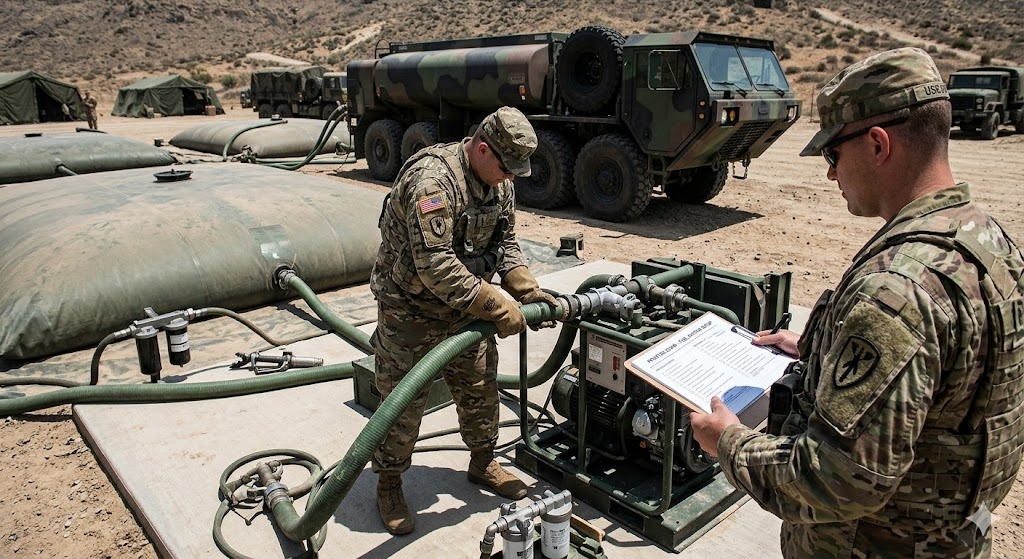
Additional Information
What the Course Entails and Exam Details
The training program encompasses both theoretical knowledge and intensive practical application. Students will master the logistics of moving bulk fuel, the physics of fluid flow, and the rigorous safety protocols required when handling hazardous materials.
Key topics covered include:
Layout and construction of tactical fuel storage locations (fuel farms).
Installation, operation, and maintenance of centrifugal pumps, filtration separators, and sampling equipment.
Safety procedures, including fire suppression, grounding, bonding, and spill containment.
Fuel quality surveillance, testing, and contamination prevention.
Accountability procedures and documentation for bulk fuel received, stored, and issued.
Operation of tactical fueling vehicles and associated equipment.
What to Expect in the Final Exam
The final evaluation is typically split into two primary components: a comprehensive written exam and a hands-on practical evaluation.
Written Exam: Candidates must complete a multiple-choice examination covering the technical aspects of fuel logistics, safety regulations, environmental compliance, and equipment capabilities. This section has a strict time limit (usually 60–90 minutes). A passing score of 75% or higher is generally required to proceed.
Practical Evaluation: This critical component requires the candidate to physically demonstrate proficiency in the field. Under the supervision of certified evaluators, you must successfully perform tasks such as setting up a fuel manifold, deploying a 50,000-gallon bladder, performing a fuel quality test (e.g., Aqua-Glo or Millipore), and operating a pump system without safety violations or technical failures. This section is often graded on a GO/NO-GO basis, requiring perfect execution of safety protocols.
How to Study and Exam Centers
Success in this exam depends on a blend of technical study and physical repetition.
Study Strategies:
Master the Technical Manuals (TMs): The foundation of the exam lies in the official military publications and technical manuals relevant to bulk fuel equipment. Study these meticulously.
Practice Equipment Layouts: Utilize diagrams and mock schematics to practice designing fuel farm layouts, focusing on efficient flow and containment.
Form Study Groups: Collaborate with peers to review procedures and quiz each other on safety protocols and fuel accountability calculations.
Leverage Practice Exams: Utilize available practice question sets to familiarize yourself with the phrasing of the written test and identify knowledge gaps.
Exam Centers: As a military-specific qualification, this exam is not administered at public testing sites like Pearson VUE. The examination and practical evaluation are conducted exclusively at authorized military training installations and logistics schools (e.g., the U.S. Army Quartermaster School) or by certified Mobile Training Teams (MTTs) dispatched to specific units. Candidates must be sponsored by their command to attend the course and sit for the exam.
Job Opportunities from the Course
The skills validated by this certification are highly specialized and essential, unlocking distinct career paths within military logistics and the defense contracting sector.
Job Opportunities include:
Petroleum Supply Specialist (Military)
Fuel Farm Manager (Defense Contractor)
Tactical Refueling Operator
Bulk Fuel Logistics Coordinator
Quality Surveillance Technician (POL)
Expeditionary Logistics Officer
Frequently Asked Questions
Reviews
5.0
Based on 0 reviews
Leave a Review
No reviews yet. Be the first to review!