
C-17 Pilot Initial Qualification (PIQ) End Of Course Practice Test
$69.00
- Buy to unlock unlimited access to all Quiz questions and Answers in this Quiz.
- After purchase you can print a PDF of the whole quiz at any point. The PDF will contain the questions and the correct answers.
About this Exam
The C-17 Pilot Initial Qualification (PIQ) is the fundamental gateway for newly minted or transitioning military pilots to master the formidable C-17 Globemaster III strategic transport aircraft.
This initial course transforms qualified pilots into fully capable C-17 copilots, providing them with the foundational knowledge and basic airmanship required to operate this complex weapon system in global airlift missions.
It is designed primarily for US Air Force, Air Force Reserve, and Air National Guard pilots, as well as select allied nation pilots who have been assigned to fly the C-17.
A thorough C-17 PIQ End of Course Practice Test is critical for consolidating knowledge and preparing for the ultimate evaluation that marks the beginning of their operational C-17 career.
Ready to test your knowledge?
Buy Now to Access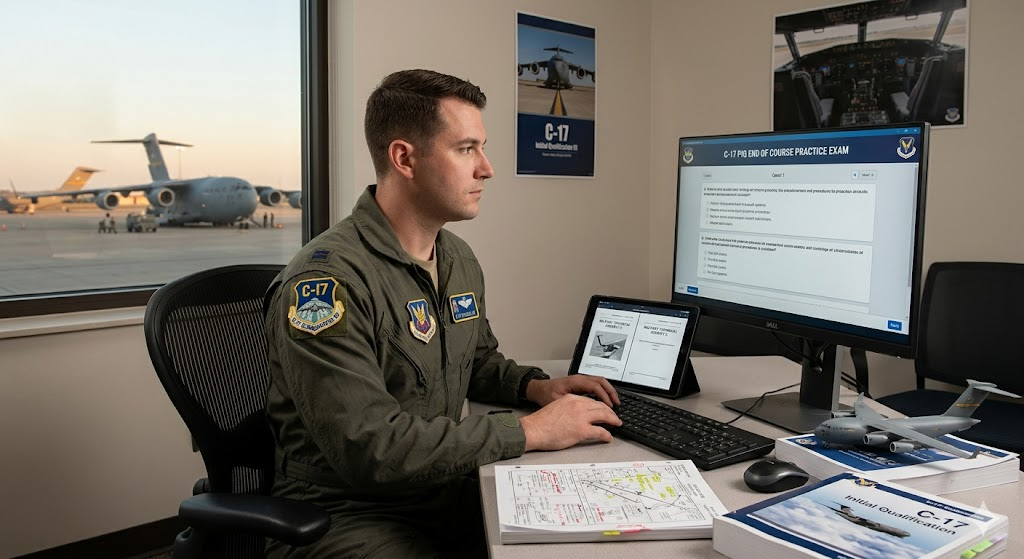
Additional Information
What the Course Entails and Exam Details
The comprehensive PIQ course involves a demanding blend of academics, ground training, and high-fidelity simulator sessions, culminating in actual aircraft flight operations.
Pilots dive deep into aircraft systems, including propulsion, hydraulics, electrical, avionics, flight controls, and cargo handling systems, moving beyond a simple operating knowledge to a deep understanding required for emergency procedures and advanced employment.
The syllabus covers a wide range of mission sets, from basic instrument flight and formation to advanced concepts like strategic airlift, tactical airland, aerial refueling, and operations in hostile environments.
This extensive training prepares students not just for routine flight, but for the complex decision-making and crew resource management (CRM) vital to C-17 global operations.
The practice test reflects this breadth, ensuring mastery across all key learning objectives.
What to Expect in the Final Exam
The actual end-of-course evaluation is not just a single exam, but a multi-part process known as a "checkride," which consists of both comprehensive written tests and a practical evaluation in the simulator and/or aircraft.
Pilots must first pass standardized written examinations covering areas like aircraft systems, instrument flight rules, and operations.
These exams typically require high passing scores, often around 80% or higher, reflecting the criticality of the knowledge.
Following successful completion of the written phase, the pilot undergoes the checkride, where a highly experienced examiner evaluates their ability to plan, brief, and execute a complex mission scenario.
They must demonstrate proficiency in standard operations, instrument procedures, emergency handling, and mission-specific tasks, showing they can safely and effectively operate the aircraft as a copilot in a variety of conditions.
There are limited retake opportunities, making a rigorous practice test indispensable for first-time success.
How to Study and Exam Centers
Studying for the C-17 PIQ requires a dedicated, multifaceted approach that goes far beyond simple rote memorization.
The official, core study materials are the Technical Orders (TOs), specifically the TO 1C-17A-1 Flight Manual (known as the "Dash-1"), the TO 1C-17A-1-1 Basic Performance Data, and the TO 1C-17A-1-2 Non-nuclear Weapons Delivery manual.
Candidates should devote substantial time to mastering these documents, focusing on systems, operating limits, and emergency procedures until they become second nature.
Utilizing C-17 PIQ End of Course Practice Tests and official question banks is paramount for assessing knowledge, identifying weak areas, and practicing with the types of questions used in official exams.
Furthermore, pilots benefit enormously from studying together, conducting simulator "chair flying" (mentally rehearsing flights), and practicing CRM and communication.
C-17 PIQ training is centralized at military installations, primarily the US Air Force's 97th Air Mobility Wing at Altus Air Force Base in Oklahoma.
The final written and practical examinations are conducted on-site by authorized military examiners within the specific training squadron.
This is not a civilian certification available through public testing vendors like Pearson VUE; it is an internal military qualification process.
Job Opportunities from the Course
Upon successful completion of the C-17 PIQ and the associated end-of-course evaluations, a newly qualified C-17 pilot has unlocked numerous rewarding career paths, primarily centered on military service, including:
C-17 Globemaster III Copilot (active duty, reserve, or guard)
Aviation Leadership Roles within an operational C-17 squadron
Opportunity to advance to Aircraft Commander after gaining required experience
Potential to become a C-17 Instructor Pilot (IP) or Evaluator Pilot (EP)
Preparation for subsequent transition to commercial or cargo airline pilot careers later in life due to extensive large, multi-engine jet experience
Mastering the C-17 PIQ practice exam is the first crucial step toward achieving these professional milestones and serving in a vital global airlift capacity.
Frequently Asked Questions
Reviews
5.0
Based on 0 reviews
Leave a Review
No reviews yet. Be the first to review!