
C Certified Entry-Level (CLE) Programmer Certification Practice Test
$69.00
- Buy to unlock unlimited access to all Quiz questions and Answers in this Quiz.
- After purchase you can print a PDF of the whole quiz at any point. The PDF will contain the questions and the correct answers.
About this Exam
The CLE – C Certified Entry-Level Programmer certification is a prestigious foundational credential designed for aspiring software developers, computer programming students, and anyone looking to start a career in low-level or middle-level programming.
It is issued by the C++ Institute and serves as an important first step toward achieving the more advanced CLA (Associate) and CLP (Professional) certifications.
This certification validates that a candidate possesses a strong command of universal computer programming concepts and the fundamental syntax and semantics of the C programming language.
Ready to test your knowledge?
Buy Now to Access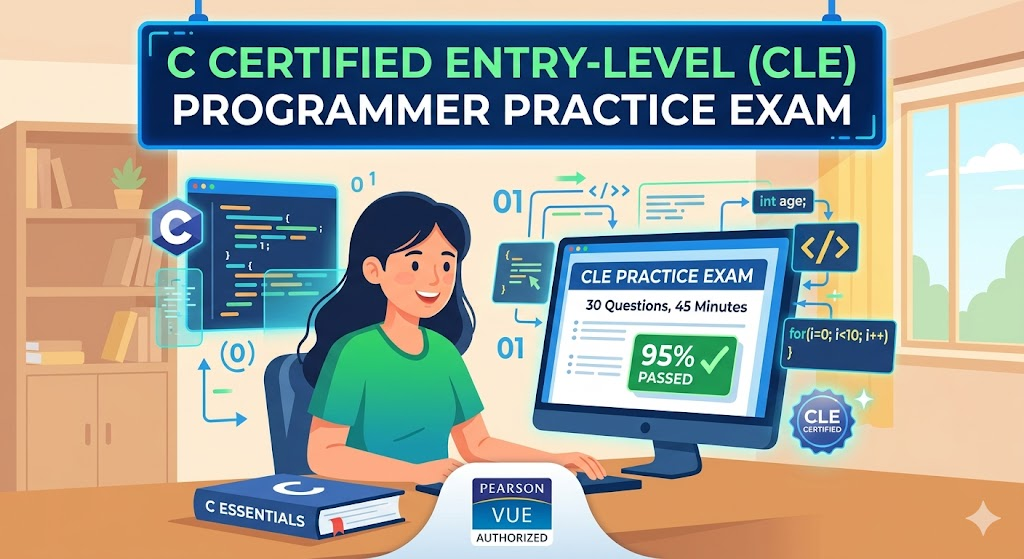
Additional Information
What the Course Entails and Exam Details
To prepare for the CLE exam, you must become proficient in the core building blocks of the C language.
The certification syllabus covers five key areas of programming theory and practice:
Universal Programming Concepts: Understanding the compilation process, the main() function, runtime environments, and fundamental algorithm thinking.
Data Types and Operations: Mastery of basic data types (int, float, char), literals, variables, typecasting, and arithmetic, relational, and logical operators.
Flow Control: Implementing program logic using conditional execution (if-else, switch) and loops (while, for, do-while).
Data Structures: Working efficiently with arrays, multidimensional arrays, and basic memory organization.
Functions and Pointers: Declaring and invoking functions, understanding parameter passing, and the basics of pointers, which are crucial for low-level language efficiency.
What to Expect in the Final Exam
The CLE final exam is a comprehensive online assessment designed to test both your theoretical knowledge and your ability to analyze code snippets.
The current exam format includes:
Exam Name: CLE – C Certified Entry-Level Programmer
Number of Questions: 30 questions
Question Types: Single-choice, multiple-choice, gap-fill, and drag-and-drop items focused on code analysis.
Time Limit: Approximately 45 minutes for the exam, plus 5 minutes for the Non-Disclosure Agreement (NDA) and tutorial.
Passing Score: The passing score is 70%.
Languages: The exam is administered in English.
How to Study and Exam Centers
Preparation requires a balance of studying programming theory and hands-on coding practice.
Study Strategies
Take an Official Course: The C++ Institute often provides free access to their official CLE course on their Edube Interactive platform, which is aligned directly with the exam objectives.
Read Fundamental Textbooks: Supplementary textbooks on C programming, such as "The C Programming Language" by Kernighan and Ritchie, provide timeless knowledge of the language’s core principles.
Practical Coding: Do not just read about code—write it. Re-write example programs from memory, modify them, and use a debugger to understand how variables change within loops and functions.
Practice with Code Snippets: Focus on tracing code logic. Many exam questions will ask you to determine the exact output of a tricky code fragment.
Exam Centers and Delivery
The CLE exam is a strictly proctored test delivered via the C++ Institute's official TestNow™ platform.
Online Proctoring: Candidates can take the exam from their own home or office using the OpenEDG Online Proctoring Service, which requires a stable internet connection, a webcam, and a desktop or laptop computer (mobile devices are not supported).
Authorized Schools: Many high schools, colleges, universities, and training organizations are authorized OpenEDG Testing Service Partners and can administer the exam on-site.
Job Opportunities from the Course
Earning the CLE certification validates your baseline proficiency to potential employers, proving you have the necessary "grit" and foundational skill to succeed in a technology-focused role.
This certification is a significant resume builder that unlocks various entry-level career paths, including:
Junior C Programmer
Trainee Software Developer
Junior Embedded Systems Programmer
Quality Assurance (QA) Tester (White Box Testing)
Application Support Analyst
Programmer Analyst I
Achieving this certification is not just about passing a test; it is about building the robust programming background required to advance into more complex, specialized, and higher-paying domains of software engineering.
Frequently Asked Questions
Reviews
5.0
Based on 0 reviews
Leave a Review
No reviews yet. Be the first to review!