
CAFS Individuals & Groups Practice Test
$69.00
- Buy to unlock unlimited access to all Quiz questions and Answers in this Quiz.
- After purchase you can print a PDF of the whole quiz at any point. The PDF will contain the questions and the correct answers.
About this Exam
The CAFS Individuals & Groups module is a foundational component of the Community and Family Studies Preliminary course in New South Wales (NSW). This crucial area of study is designed for senior high school students seeking to understand the complex dynamics between individuals and the various groups they form or join.
The focus is on how interactions within these groups impact personal identity, well-being, and social harmony. Students examine different types of groups, the roles individuals adopt within them, patterns of communication, leadership styles, and conflict management strategies. This module provides essential critical thinking and research skills that are foundational for success in the final HSC CAFS course.
Ready to test your knowledge?
Buy Now to Access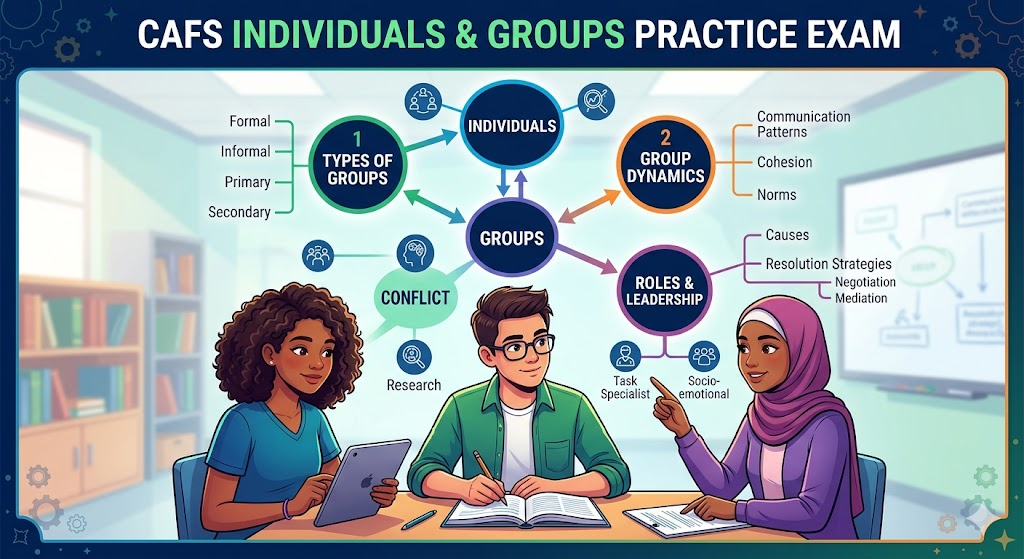
Additional Information
What the Course Entails and Exam Details
This module requires a thorough understanding of human interaction through a social scientific lens. The core content syllabus is structured around several key investigative areas. A robust practice exam should thoroughly test your comprehension of these topics.
Core Topics Covered:
Types of Groups: Differentiating between primary and secondary, formal and informal groups.
Reasons for Group Formation: Analyzing why individuals join groups, including common interest, proximity, status, security, and culture.
Roles Individuals Adopt Within Groups: Identifying specific roles that contribute to task achievement, maintain group relationships, or hinder group progress (such as the task specialist, socio-emotional leader, or distractor).
Factors Affecting Group Dynamics: Examining how self-esteem, self-confidence, age, gender, and previous experience influence individual behavior.
Observation as a Research Method: Knowing how to ethically collect, record, and analyze data on group interactions using structured and unstructured observation.
Power Bases within Groups: Defining and recognizing legitimate, reward, coercive, referent, and expert power.
Leadership Styles: Distinguishing between democratic, autocratic, laissez-faire, and transformational leadership.
Conflict: Identifying causes of conflict (incompatible goals, resource allocation) and analyzing strategies for conflict resolution (such as negotiation, agreement, or mediation).
What to Expect in the Final Exam
It is important to understand that a specialized test for "Individuals & Groups" is typically an internal school assessment administered during the Year 11 Preliminary course, rather than an external state-wide exam. However, teachers structure these tests to model final HSC exam conditions to provide authentic practice.
The format will usually mirror the Section I structure of the final CAFS HSC paper to build familiarity.
Typical Exam Structure:
Format: The exam will consist of two distinct parts.
Multiple Choice (Part A): Approximately 10–15 minutes designed to quickly test your vocabulary, conceptual definitions, and recognition of specific roles or power bases.
Short Answer Responses (Part B): Approximately 45–50 minutes of structured questions requiring you to "define," "describe," "explain," or "analyze" specific concepts. These questions require linking syllabus theory to practical examples or observation data.
Time Limit: Usually 60 minutes for a target module test.
Passing Score: There is no single universal "passing score." It is dependent on your individual school’s grading scale and its contribution to your overall Preliminary assessment rank.
How to Study and Exam Centers
Preparation for this module test relies on active recall rather than passive reading. You must be able to not only define concepts but also apply them to real-world scenarios.
Actionable Study Strategies:
Mnemonic Devices: Create mnemonics to remember lists, such as "Legit Reward Coercive Referent Expert" for power bases (e.g., "Lucy Really Can Run Fast").
Master the Verbs: Understand the "Glossary of Key Words" provided by NESA. Knowing the difference between "describe" (what does it look like?) and "analyze" (why does it work this way? what is the impact?) will dramatically improve your short answer marks.
Scenario Application: Practice taking a random group scenario (e.g., a sports team during a losing streak) and applying syllabus terminology to it, identifying the destructive roles, the leadership styles being used, and the likely power bases in play.
Practice Multiple Choice: Complete as many previous school papers or targeted revision questions as possible to train your brain on question structures.
Exam Center Location:
Since this is an internal high school assessment for the Year 11 Preliminary course, this exam is not administered by external bodies like Pearson VUE. The "exam center" is your own high school classroom or examination hall, administered by your CAFS teacher under standard school assessment rules.
Job Opportunities from the Course
While the Individuals & Groups module itself is an academic foundation rather than a vocational certification, the skills and knowledge you acquire in Community and Family Studies are essential prerequisites for many career pathways in human services and social science.
Successfully completing CAFS and building on it in your future studies can lead to specific career titles such as:
Social Worker
Community Development Officer
Counsellor (Family, Youth, or School)
Youth Worker
Human Resources (HR) Officer or Specialist
Early Childhood Educator / Teacher
Disability Support Coordinator
Aged Care Support Manager
Public Policy Analyst (specializing in social policy)
Mediator or Conflict Resolution Specialist
Frequently Asked Questions
Reviews
5.0
Based on 0 reviews
Leave a Review
No reviews yet. Be the first to review!