
Calibration Technician Practice Test
$69.00
- Buy to unlock unlimited access to all Quiz questions and Answers in this Quiz.
- After purchase you can print a PDF of the whole quiz at any point. The PDF will contain the questions and the correct answers.
About this Exam
Ready to prove your precision engineering skills?
The Calibration Technician Certification Exam validates
your expertise in metrology and ensuring the accuracy of complex measuring
instruments.
This comprehensive study guide and practice test are
designed for aspiring metrologists, existing calibration technicians seeking
professional recognition, and quality control professionals wanting to solidify
their technical foundation in measurement science.
Earning this certification demonstrates a commitment to
quality, potentially opening doors to advanced career opportunities across
various industries.
Ready to test your knowledge?
Buy Now to Access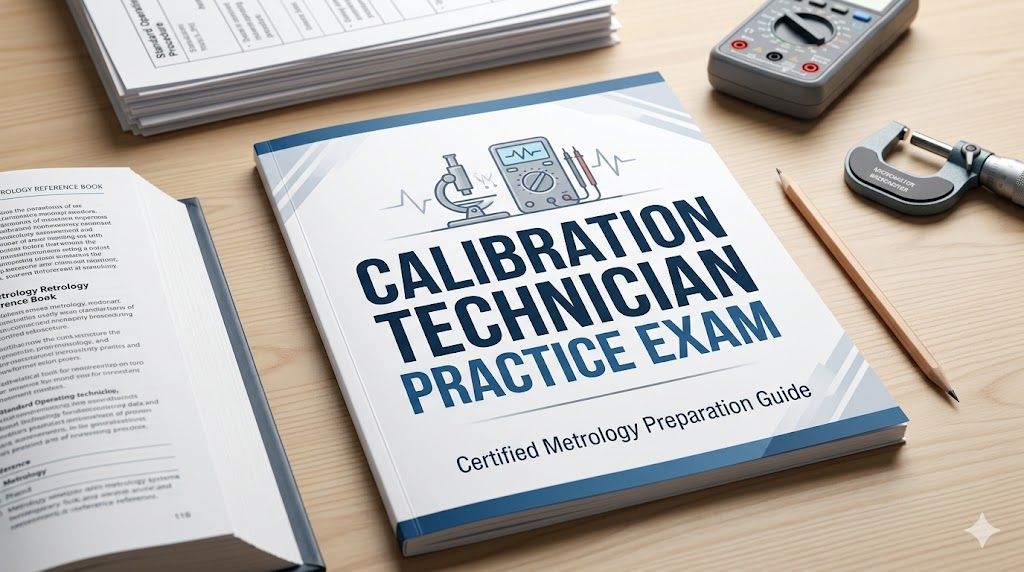
Additional Information
What the Course Entails and Exam Details
So, what does this exam cover?
While specific syllabus content can vary slightly, you can expect a rigorous evaluation across several key metrology domains:
• Metrology Principles: Grasp foundational concepts like traceability, accuracy, precision, resolution, and the international system of units (SI).
• Measurement Uncertainty: Learn how to evaluate and calculate measurement uncertainty, a critical aspect of calibration results interpretation.
• Quality Standards & Systems: Understand relevant quality management systems (like ISO 17025) and regulatory requirements impacting calibration practices.
• Calibration Procedures: Gain proficiency in developing, documenting, and executing standardized calibration procedures for diverse instruments.
• Technical Knowledge: Demonstrate understanding of various calibration types, including electrical (voltage, current, resistance), mechanical (dimensional, pressure, torque), and physical/thermal (temperature, humidity).
• Instrumentation & Equipment: Know how to select, maintain, and properly use reference standards and test equipment.
• Safety & Ethics: Apply safe working practices in calibration environments and adhere to professional ethical codes.
Beyond understanding the breadth of topics, it's crucial to be familiar with specific exam details such as the number of questions, scoring, and allowed time, which are detailed in the subsequent section.
What to Expect in the Final Exam
Preparing mentally for test day is just as vital as understanding the content.
Here’s what you can generally expect when sitting for the official Calibration Technician Certification Exam:
• Exam Format: The vast majority of these examinations are multiple-choice, designed to efficiently assess a broad spectrum of knowledge.
• Depending on the certifying body, there might rarely be some practical simulation elements, but expect standard question formats primarily.
• Number of Questions: Be prepared for around 100 to 150 questions covering all the core topics.
• Time Limit: You will typically be given a substantial block of time, often ranging from 3 to 5 hours, ensuring adequate time to carefully read and answer each question.
• Passing Score: Scoring systems vary, often using a scaled approach, but you will generally need to achieve a score equivalent to approximately 70-80% to demonstrate proficiency.
• Specific Rules: Expect a strictly proctored environment, whether you take the exam in person or online.
• Most certifying bodies follow specific procedures (no phones, ID verification, monitored breaks).
• Crucially, many professional calibration exams allow you to bring in approved reference materials (like specified textbooks or standard operating procedures), making effective indexing and familiarity with your resources a key study strategy.
How to Study and Exam Centers
Ready to conquer the Calibration Technician Practice Exam?
Your effective preparation strategy is paramount.
Here are actionable study methods:
• Deep Dive into Standards: Thoroughly familiarize yourself with critical standards such as ISO/IEC 17025 (competence of testing and calibration laboratories) and specific national standards (like ANSI/NCSL Z540 series).
• Understand their requirements and application.
• Leverage Practice Exams: Utilize high-quality practice tests repeatedly.
• Focus not just on getting questions right, but understanding why answers are correct or incorrect.
• This builds conceptual understanding and question-format familiarity.
• Active Recall & Spaced Repetition: Instead of just passive reading, actively quiz yourself.
• Cover your notes and try to recall definitions, formulas, and concepts.
• Review material at increasing intervals to enhance long-term retention.
• Build Your Index: If your chosen exam is open-book, meticulously index your allowed reference materials.
• Know exactly where to find key procedures, tables, and standards.
• This saves precious time during the test.
• Master Key Concepts & Math: Dedicate significant effort to grasping measurement uncertainty calculations, basic electrical/mechanical principles, and calibration-specific mathematics.
• Practice problems are essential here.
• Review Relevant Coursework & Materials: If you've taken metrology courses or used specific textbooks (e.g., from ASQ or ISA), systematically review that content.
Exam Centers & Registration:
Where and how you take the actual certification exam depends heavily on the issuing organization (e.g., American Society for Quality (ASQ), International Society of Automation (ISA)).
• Physical Testing Centers: Many large-scale professional certifications utilize established, global testing networks like Pearson VUE or Prometric.
• You will typically select a local test center and schedule an appointment online after registering with the certifying body.
• Online Proctoring: Increasingly common, many organizations offer online proctored exams.
• This allows you to take the test from your home or office computer, provided you have the necessary equipment (webcam, microphone) and meet specific environment requirements.
• Be sure to carefully review the rules for online proctoring beforehand.
Ensure you always check the official website of your specific certifying body (e.g., ASQ for the CCT exam) for current study guides, approved reference lists, available test centers, and registration procedures well in advance of your desired test date.
Job Opportunities from the Course
Earning your Calibration Technician certification can significantly boost your career trajectory.
While specific job titles can vary greatly by company and industry, here are common career paths and roles this credential can help unlock:
• Calibration Technician: The fundamental role, responsible for performing calibrations, troubleshooting equipment, and documenting results.
• Senior or Lead Calibration Technician: Advanced positions often involving supervisory duties, mentorship, complex calibrations, and leadership within a lab.
• Metrologist: Specialized measurement science roles, focusing on standards development, uncertainty analysis, and advanced measurement techniques.
• Quality Assurance (QA) or Quality Control (QC) Technician: Focusing on ensuring that products and processes meet quality standards, which heavily relies on accurate measuring equipment.
• Instrumentation Technician: Installing, maintaining, and calibrating various instruments and control systems, often in industrial settings.
• Calibration Coordinator or Supervisor: Managing calibration schedules, resources, personnel, and compliance within an organization or lab.
• Metrology Engineer: Applying engineering principles to solve complex measurement problems, developing new measurement systems, or improving processes.
• Calibration Business Owner: For experienced technicians, opportunities exist to start independent calibration services.
Industries ranging from aerospace and automotive to pharmaceuticals and medical devices all critically depend on precise measurements, creating robust demand for skilled and certified calibration professionals
Frequently Asked Questions
Reviews
5.0
Based on 0 reviews
Leave a Review
No reviews yet. Be the first to review!