
California Applicator License Category D Plant Agriculture Practice Test
$69.00
- Buy to unlock unlimited access to all Quiz questions and Answers in this Quiz.
- After purchase you can print a PDF of the whole quiz at any point. The PDF will contain the questions and the correct answers.
About this Exam
The California Department of Pesticide Regulation (DPR)
requires a Qualified Applicator License (QAL) or Certificate (QAC) for anyone
applying federally or state-restricted pesticides in agricultural settings. The
Category D: Plant Agriculture pest control category specifically focuses on
managing pests—including weeds, insects, and diseases—affecting agricultural
crops across the state. It is designed for agricultural pilots, farm managers,
commercial applicators, and anyone supervising pesticide applications on crops
other than ornamentals, turf, or forests. This license signifies that the
holder possesses the necessary specialized knowledge to protect California's
vital agricultural sector safely, effectively, and legally.
Ready to test your knowledge?
Buy Now to Access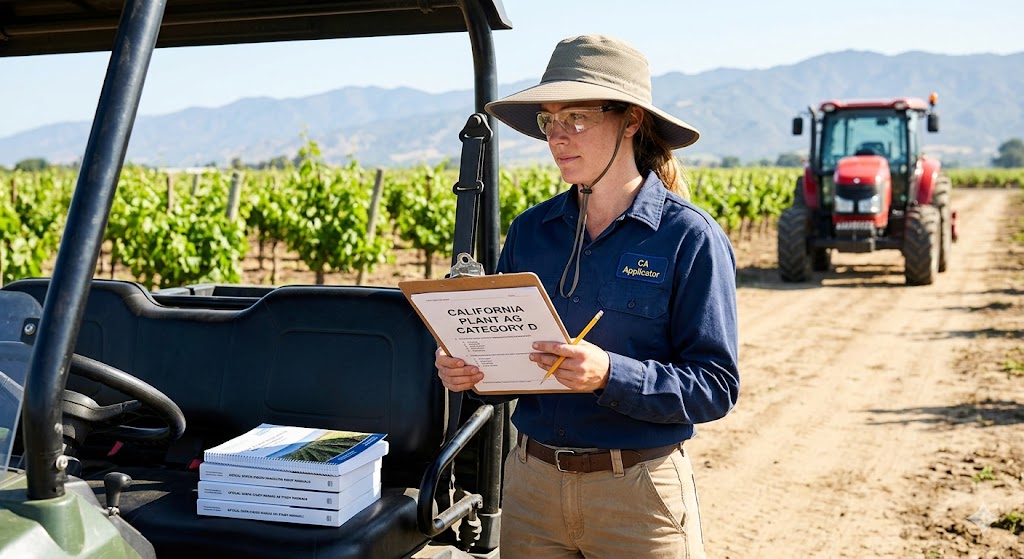
Additional Information
What the Course
Entails and Exam Details
Preparing for the Category D exam requires a deep
understanding of Integrated Pest Management (IPM) principles as they apply to
diverse California crop systems. Candidates are tested on their ability to
identify agricultural pests, understand their life cycles, and select
appropriate management strategies. The comprehensive core topics typically
include:
- Pest
Identification and Biology: Recognizing common agricultural weeds
(annuals, biennials, perennials), insects (complete vs. incomplete
metamorphosis), mites, nematodes, vertebrates, and plant pathogens in
California.
- IPM
Principles in Agriculture: Implementing strategies that combine
biological, cultural, mechanical, and chemical tools based on economic
thresholds and monitoring.
- Transgenic
Crops: Understanding how transgenic (GMO) crops integrate into an IPM plan
and affect resistance management.
- Weed
Management: Tactics for managing broadleaf, grass, and sedge weeds,
including mode-of-action selection.
- Pesticide
Formulations and Compatibility: Knowing how different formulations work,
recognizing tank mix incompatibility, and preventing application errors.
- Pesticide
Resistance Management: Strategies to delay or prevent resistance
development in insects, diseases, and weeds by rotating pesticide modes of
action.
- Application
Equipment and Techniques: Understanding proper setup, calibration, nozzle
selection, and maintenance for common agricultural sprayers.
- Pesticide
Movement and Environmental Fate: Predicting how weather, soil type, and
application methods affect pesticide runoff, leaching, and drift.
What to Expect in the Final Exam
The final assessment for your Plant Agriculture Category
D certification is a comprehensive test administered by the DPR or an approved
third-party testing agency. To earn your license, you must also pass the
separate Laws, Regulations, and Basic Principles examination. While specific
exam parameters can vary, candidates can typically expect the following for the
Category D portion:
- Format:
The exam consists of multiple-choice and true-false questions designed to
test cognitive recall and, more importantly, the practical application of
pest management knowledge. It is not an open-book exam.
- Passing
Score: You must achieve a score of 70% or higher on both the
Category D exam and the Laws & Regulations exam.
- Time
Limit: Both exams are strictly timed. Candidates should expect to be given
approximately 1 to 2 hours per exam.
- Specific
Rules: You will need to provide valid government-issued photo
identification. Calculators are usually allowed for calibration-related
math questions but may be subject to inspection. Personal items, including
cell phones, notes, and study materials, are strictly prohibited in the
testing area.
How to Study and
Exam Centers
Successful preparation requires a balanced approach to
academic study and practical understanding. Because this exam covers vast
technical material, starting early is essential.
Recommended Study Strategies:
- Utilize
DPR Suggested Materials: Thoroughly read the study manuals listed on the
California DPR’s Suggested Study Material Source List, particularly those
covering general pest control principles and specific agricultural pests.
- Focus
on Knowledge Expectations: Review the DPR’s “Exam Knowledge Expectations”
document for Category D. This document serves as the syllabus and details
the exact concepts you are expected to master.
- Practice
Active Learning: Do not just read; take notes, create flashcards for pest
identification, and practice calibration math problems by hand until they
become routine.
- Use
Practice Tests: Online practice tests are invaluable for familiarizing
yourself with the multiple-choice format, identifying your weak areas, and
managing your time effectively.
Exam Center Information: Currently, DPR examinations are
administered through PSI Services, LLC at various test centers located
throughout California. Candidates cannot schedule their exam until their
application and required fees have been received and processed by the DPR. Once
approved, you will receive an eligibility email from DPR allowing you to create
an account with PSI and select your preferred testing location and date. This
offers flexibility with sites in major hubs like Sacramento, Fresno, Los Angeles,
and San Diego.
Job Opportunities
from the Course
A valid Qualified Applicator License or Certificate with
a Category D endorsement is a valuable asset in California’s robust
agricultural economy. This certification unlocks several rewarding career
paths, including:
- Commercial
Pesticide Applicator (Agricultural): Applying restricted-use pesticides
for agricultural clients.
- Licensed
Pest Control Advisor (PCA) (Field Supervisor): PCAs often need applicator
licensing to oversee the application of their recommendations.
- Farm
Manager or Rancher: Supervising on-farm pesticide applications.
- Crop
Consultant: Providing expert advice on agricultural pest management.
- Agricultural
Pilot: Applying pesticides aerially.
- Pest
Control Dealer Designated Agent: Actively supervising the operations at a
pest control dealer location.
- County
Agricultural Inspector: Working for the government to enforce pesticide
laws and regulations.
- Agricultural
Research Technician: Working on efficacy trials for new crop protection
products.
- Industrial
Vegetation Manager (Ag-adjacent): If crops or agricultural lands intersect
with industrial sites.
Frequently Asked Questions
Reviews
5.0
Based on 0 reviews
Leave a Review
No reviews yet. Be the first to review!