
California Certified Shorthand Reporter (CSR) Professional Practice Exam
$69.00
- Buy to unlock unlimited access to all Quiz questions and Answers in this Quiz.
- After purchase you can print a PDF of the whole quiz at any point. The PDF will contain the questions and the correct answers.
About this Exam
Achieving licensure as a Certified Shorthand Reporter
(CSR) in California is a landmark moment in a court reporting career. This
certification confirms your status as a skilled professional capable of
preserving the record with unparalleled accuracy in one of the most demanding
legal environments in the country. The California CSR Professional Practice
Exam is a required, specialized written knowledge component designed to ensure
all future CSRs possess the deep understanding of ethical responsibilities, procedural
rules, and California-specific regulations necessary to operate fairly and
impartially. This exam is for students who have completed their coursework and
speed requirements and are ready to finalize their licensing process with the
Court Reporters Board of California (CRBC).
Ready to test your knowledge?
Buy Now to Access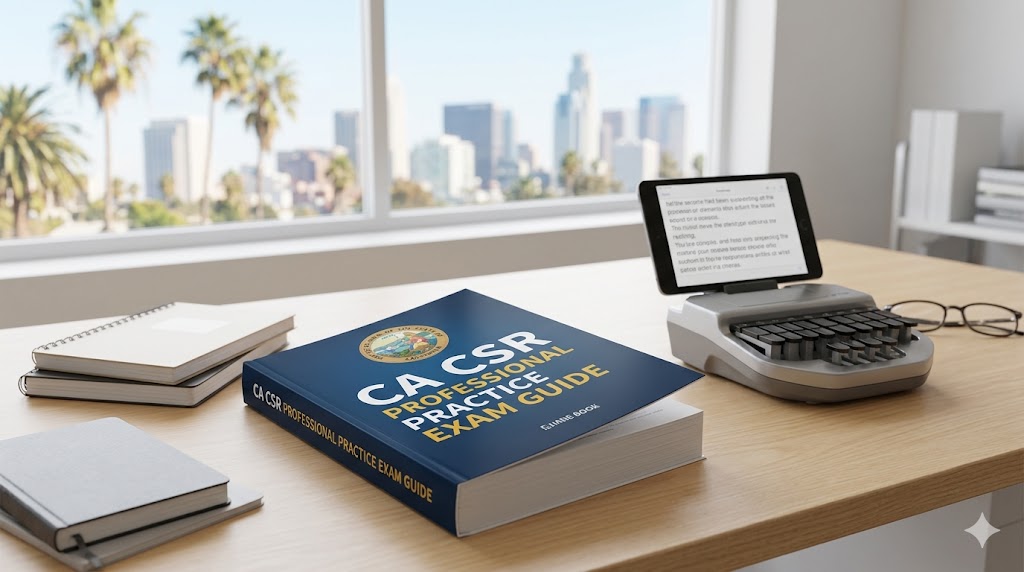
Additional Information
What the Course Entails and Exam Details
This section of the licensing process tests your academic
mastery rather than your shorthand speed. You must have comprehensive knowledge
of several critical areas defined by California regulations. Key topics
include: The Court Reporters Board of California Rules and Regulations,
including licensing requirements and disciplinary actions. The California Code
of Regulations and the Business and Professions Code (specifically sections
8000-8049) governing the court reporting profession. Ethics for court reporters,
focusing on neutrality, accuracy, confidentiality, and professional decorum.
Advanced procedural rules for both depositions (e.g., standard stipulations,
handling exhibits, oaths) and courtroom settings. Guidelines for transcript
format, delivery timelines, and certified copies as mandated by state law.
Legal terminology and basic medical terminology that a reporter must correctly
understand and render within professional practice situations.
What to Expect in the Final Exam
The final step is a rigorous written knowledge test
conducted in a secure, computer-based environment. This is a multiple-choice
examination, usually consisting of approximately 100 questions. While the exact
number may vary slightly, you are given a generous time allocation—typically
around 120 minutes—to thoughtfully complete the test. Unlike the skills
portions of the CSR licensing, this written component does not have a set
percentage score for passing. Instead, the passing grade is determined by the
Angoff criterion-referenced method, which ensures the difficulty of the
individual test form is considered. As a standardized CBT (Computer-Based
Test), you will be prohibited from bringing study materials or personal
electronics into the testing room, and you must present valid government-issued
photo identification upon arrival.
How to Study and Exam Centers
Preparation for the Professional Practice exam requires
dedicated rote study of official statutes and procedural manuals rather than
speed building. Your primary study resource must be the official publications
of the Court Reporters Board of California, specifically the "Court
Reporter’s Board Regulations and Statutes." Focus heavily on memorizing
key codes from the Business and Professions Code. Utilize official practice
tests or study guides often provided by accredited court reporting schools or
California-based professional associations (like CCRA or CalDRA). Flashcards
are invaluable for mastering legal terminology and specific code sections. When
you are eligible to take the exam, you must first apply to the Court Reporters
Board of California (CRBC). After receiving candidate eligibility confirmation,
you will then schedule your written exam directly through an authorized testing
partner, commonly a third-party testing agency like Pearson VUE, which offers
computerized testing centers conveniently located throughout California.
Job Opportunities from the Course
Earning your California CSR license unlocks some of the
most stable and prestigious career paths within the court reporting field. This
license is mandatory to work as a verbatim reporter within the state’s judicial
system. Careers stemming from this achievement include: Official Court Reporter
(for state superior courts) Freelance Deposition Reporter Realtime Deposition
Reporter Independent Contractor CSR CART (Communication Access Realtime
Translation) Provider (for the deaf and hard-of-hearing community in
educational or corporate settings) Broadcast Captioner (for live television and
webcasts) Arbitration and Hearing Reporter
Frequently Asked Questions
Reviews
5.0
Based on 0 reviews
Leave a Review
No reviews yet. Be the first to review!