
California Motorcycle Safety Program Practice Test
$69.00
- Buy to unlock unlimited access to all Quiz questions and Answers in this Quiz.
- After purchase you can print a PDF of the whole quiz at any point. The PDF will contain the questions and the correct answers.
About this Exam
The California Motorcycle Safety Program (CMSP) is the
state’s premier training initiative designed to reduce motorcycle accidents and
fatalities.
This program is not just a regulatory hurdle; it is a
life-saving foundation for new riders.
It is designed for novice riders who have never ridden a
motorcycle, as well as intermediate riders looking to formalize their skills.
Successful completion of the program’s Motorcyclist Training
Course (MTC) is mandatory for any applicant under 21 years old seeking a
California motorcycle endorsement (Type M1).
For riders 21 and older, while not legally required,
completing the course is highly recommended as it provides a critical DMV
riding skills test waiver (DL389), allowing you to skip the DMV’s physical
skills evaluation.
Ready to test your knowledge?
Buy Now to Access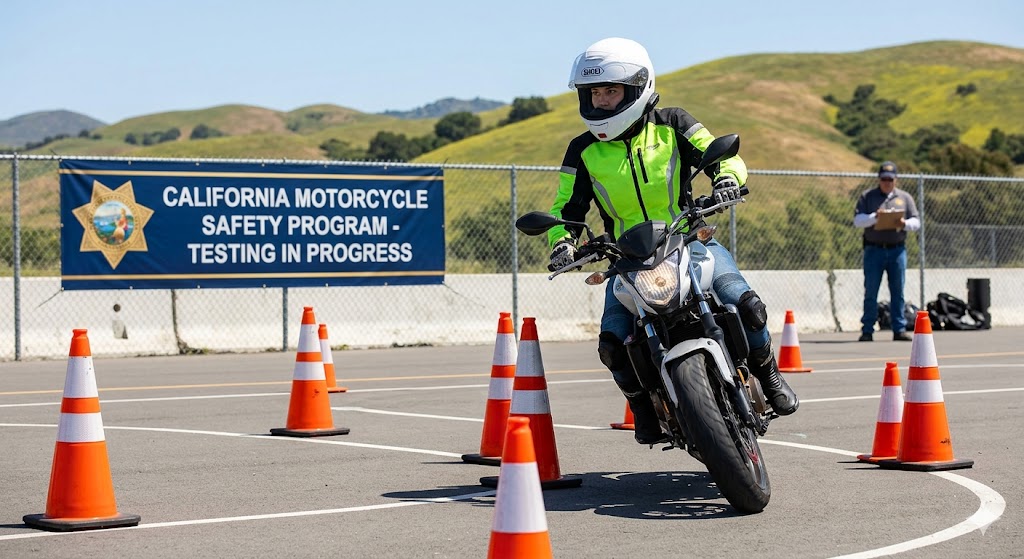
Additional Information
What the Course Entails and Exam Details
The CMSP standard Motorcyclist Training Course is typically
a comprehensive 15-hour program broken down into two distinct phases.
It combines 5 hours of intensive classroom instruction with
10 hours of hands-on, on-cycle riding practice.
You do not need to own a motorcycle to participate; training
motorcycles and helmets are provided at the testing sites.
Core syllabus topics include:
- Mental
Preparation: Managing risk, understanding fear, and developing safe
riding attitudes.
- Controls
and Mechanics: Mastery of the clutch, throttle, brakes, and gear
shifter.
- Basic
Maneuvers: Starting, stopping, low-speed balance, and turning.
- Street
Strategies: Understanding the SIPDE process (Scan, Identify, Predict,
Decide, Execute) and lane positioning.
- Advanced
Handling: Mastering cornering dynamics, swerving techniques, and
emergency braking procedures.
What to Expect in
the Final Exam
The final assessment for the CMSP course is divided into two
separate evaluations: a written knowledge test and a physical riding skills
test.
You must pass both segments to successfully complete the
course and receive your DMV skills test waiver.
The Classroom Written Test
- Format:
This is a multiple-choice exam typically consisting of 25 to 50 questions.
- Content:
Questions are derived directly from the CMSP course handbook and classroom
lectures.
- Passing
Score: Students usually need a minimum score of 80% to pass.
The Range Skills Evaluation
- Format:
This is a practical exam conducted on the closed riding range.
- Content:
You will be required to demonstrate proficiency in several specific
maneuvers taught during the 10 hours of range time.
- Key
Scenarios: Typical evaluation paths include low-speed circle turns, a
serpentine cone weave, sharp 90-turn maneuvers, dynamic cornering, and a
controlled emergency braking stop within a specific distance.
- Rules:
Points are deducted for errors such as putting a foot down during a
maneuver, stalling the engine, or failing to path correctly. Accumulating
too many points results in a failing score. A serious safety violation can
result in an immediate dismissal.
How to Study and Exam Centers
Studying for the CMSP exam begins the moment you enroll. The
course itself is designed to be the study guide.
Effective Study Strategies
- Study
the Handbook: When you register, you will receive a CMSP student
handbook. Read it cover-to-cover before your first classroom session.
- Engage
in Classroom Sessions: Take notes and ask questions. The instructors
are experts and will emphasize the information that is most likely to
appear on the written test.
- Focus
on 'The Mental Game': Many potential errors on the range test come
from lack of confidence or nervousness. Visualize yourself completing the
maneuvers successfully.
- Utilize
Bicycles: If you are a complete novice, practicing your balance on a
two-wheeled bicycle before the course can help you grasp the physics of
steering.
Finding Exam Centers
CMSP courses are offered throughout California at authorized
training sites.
They are not conducted at standard DMV offices, nor can the
course be completed online.
These authorized providers are audited and certified by the
California Highway Patrol (CHP).
To register, visit the official CMSP website
(motorcyclesafetyca.com) and use their locator tool to find a site near your
zip code.
Examples of major authorized providers include Safety
Center, Total Control Training sites, and various local colleges or motorcycle
training academies.
Job Opportunities
from the Course
While the primary goal of the CMSP course is to secure a
motorcycle endorsement safely, successful completion unlocks several direct and
related career paths.
A motorcycle license is often the first requirement for
specialized professional roles.
Potential career paths and job titles include:
- CMSP
Certified Riding Instructor: Once you gain significant riding
experience, completing the CMSP MTC is the foundational requirement to
enroll in an Instructor Preparation Course (IPC) and become a
state-certified safety instructor.
- Police
Motorcycle Officer: While a Type M1 license is required, finishing a
safety program shows a commitment to advanced skill, which is highly
viewed during the rigorous police motor unit selection process.
- Professional
Motorcycle Tour Guide: Guides for commercial motorcycle touring
companies must hold a clean license and demonstrate expert-level safety
skills to operate within fleet insurance requirements.
- Motorcycle
Sales Specialist: While not always mandatory, licensed salespeople who
have completed formal safety training have higher credibility with
customers and are often permitted to move or test-ride dealership
inventory.
- Fleet
Maintenance/Support Staff: For training centers or rental companies,
employees tasked with maintaining and transporting motorcycle fleets are
generally required to be licensed and trained to operate the vehicles
safely.
Frequently Asked Questions
Reviews
5.0
Based on 0 reviews
Leave a Review
No reviews yet. Be the first to review!