
California Phlebotomy Certification Practice Exam
$69.00
- Buy to unlock unlimited access to all Quiz questions and Answers in this Quiz.
- After purchase you can print a PDF of the whole quiz at any point. The PDF will contain the questions and the correct answers.
About this Exam
The California Pharmacy Jurisprudence Exam (CPJE) is a
critical assessment for aspiring pharmacists looking to practice in the state
of California. Designed and administered by the California State Board of
Pharmacy, this exam evaluates a candidate's mastery of federal and state laws
and regulations governing the practice of pharmacy. It is a mandatory
requirement for licensure, ensuring that every practicing pharmacist possesses
the essential legal knowledge to operate safely, ethically, and in full compliance
with the state's stringent healthcare standards. The CPJE is specifically for
individuals who have completed their pharmaceutical education and are seeking
to become registered pharmacists in California, as well as licensed pharmacists
from other states looking to transfer their license.
The California Phlebotomy Certification is a crucial
credential for healthcare professionals looking to specialize in blood draw
procedures. In California, the requirements are strict; aspiring phlebotomists
must obtain state certification (CPT I or CPT II) from the California
Department of Public Health (CDPH).
This certification validates that a phlebotomist has met
rigorous educational and practical standards. Utilizing a robust practice exam
is a designed strategy for students, medical assistants, and entry-level
healthcare workers who need to ensure they are fully prepared for the
challenging national examination required for California licensure. It helps
candidates identify knowledge gaps and build the confidence necessary to
succeed.
Ready to test your knowledge?
Buy Now to Access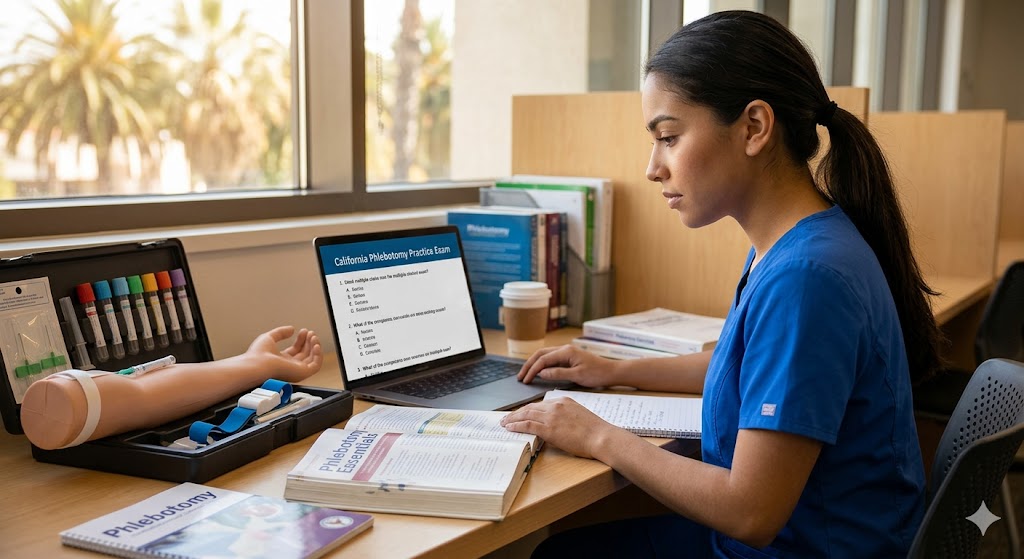
Additional Information
What the Course Entails and Exam Details
Preparing for the California certification requires a
combination of didactic training and hands-on experience. An approved training
program must cover several core domains that are reflected in the exam content.
The curriculum focuses heavily on basic and advanced
infection control, ensuring the safety of both the patient and the technician.
Candidates dive deep into medical terminology specific to the circulatory
system, human anatomy, and physiology. Understanding the structure of veins and
arteries is paramount for successful venipunctures and capillary puncutres.
Furthermore, the training details the appropriate order of
draw, specimen labeling protocols, and the management of pre-analytical errors
that can affect lab results. Professionalism, HIPAA compliance, and patient
interaction skills are also core components of the syllabus.
What to Expect in
the Final Exam
The "final exam" for California certification is
actually one of the CDPH-approved national certification exams (such as those
offered by the NHA, NCCT, or AMT). Therefore, the exact format can vary
slightly depending on the testing agency.
However, candidates can generally expect a computer-based,
multiple-choice format consisting of 100 to 120 questions. These exams must be
completed within a specific time limit, typically around 2 hours.
The passing score requirements vary by agency but generally
hover around 70% to 75%. In California, candidates must pass the written
national exam and have verified documentation of their practical skills
(successful venipunctures and skin punctures on real patients) completed during
their training program before the state license is issued.
How to Study and
Exam Centers
Effective preparation for this high-stakes exam requires
actionable study strategies. Utilizing practice exams that mimic the style and
difficulty of the national tests is one of the best ways to build testing
stamina and review core content.
Candidates should focus on active recall by using flashcards
for medical terminology and lab values. It is also essential to carefully
review the specific guidelines from the testing agency they chose (e.g., NHA’s
test plan). Focusing study efforts on weaker subject areas identified during
practice testing will yield the best results.
Regarding where and how to take the exam, these are
generally proctored tests. Candidates typically register through online portals
provided by the national certifying agencies. The exams themselves are
administered at specific physical testing centers located throughout
California, such as Pearson VUE or PSI centers, or sometimes directly within
authorized phlebotomy schools.
Job Opportunities
from the Course
Earning a phlebotomy certification in California unlocks
immediate job opportunities in a high-demand field. This credential is a legal
requirement for drawing blood in most settings across the state.
The career paths and specific job titles available upon
certification include:
- Certified
Phlebotomy Technician I (CPT I) in hospitals
- Phlebotomist
at clinical laboratories (e.g., Quest Diagnostics or LabCorp)
- Plasma
Donation Center Technician
- Blood
Bank Phlebotomist or Donor Phlebotomy Technician
- Mobile
Phlebotomist
- Laboratory
Assistant
- Medical
Assistant with Phlebotomy specialization in physician offices and urgent
care clinics.
Frequently Asked Questions
Reviews
5.0
Based on 0 reviews
Leave a Review
No reviews yet. Be the first to review!