
California Professional Fiduciary Practice Test
$69.00
- Buy to unlock unlimited access to all Quiz questions and Answers in this Quiz.
- After purchase you can print a PDF of the whole quiz at any point. The PDF will contain the questions and the correct answers.
About this Exam
Embarking on a career as a professional fiduciary in California requires a unique blend of compassion, meticulous organization, and sharp legal understanding.
This specialized practice test is specifically designed for individuals preparing for the rigorous examination required to become a licensed Professional Fiduciary in the state of California, or for those seeking the National Certified Guardian (NCG) designation which often serves as a prerequisite or benchmark.
The certification is intended for professionals who will manage the personal, financial, or legal affairs of others, including the elderly, persons with disabilities, and minors.
If you are a paralegal, accountant, care manager, or simply a dedicated individual looking to serve vulnerable populations while adhering to the highest ethical and legal standards in the Golden State, this guide and practice test are essential components of your preparation strategy.
Successfully passing the underlying licensing exam demonstrates your competence to the California Professional Fiduciaries Bureau and the public.
Ready to test your knowledge?
Buy Now to Access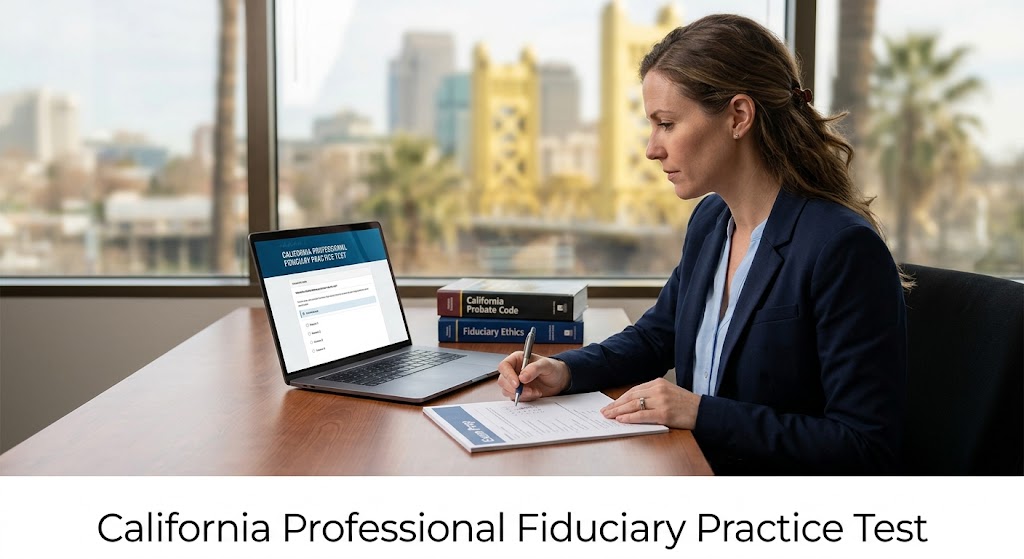
Additional Information
What the Course Entails and Exam Details
To excel on the actual licensing exam, candidates must possess a deep understanding of the core topics that form the basis of fiduciary practice.
Preparation, whether through structured coursework or independent study, covers a wide range of critical subjects.
The core of the curriculum is heavily based on the California Probate Code, which provides the legal framework for all fiduciary actions within the state.
Students must master the principles of conservatorships, understanding the differences between conservatorship of the person and conservatorship of the estate.
Crucial skills include financial management and prudent investing, ensuring that a ward or conservatee’s assets are protected and grow appropriately.
The course entails comprehensive training on ethics, focusing on standard of practice requirements, avoiding conflicts of interest, and fulfilling duty of loyalty obligations.
Tax obligations, asset inventorying, final accounting procedures, and managing the sale of real property are also covered in significant detail.
Furthermore, preparation includes understanding the National Guardianship Association (NGA) Standards of Practice and Ethical Principles, which provide a national benchmark often incorporated into state-specific testing.
What to Expect in the Final Exam
While "practice tests" can vary in length, the actual California licensing examination is a high-stakes assessment administered with strict protocols.
The final licensing exam is a closed-book, timed examination.
It typically consists of numerous multiple-choice questions designed to test your ability to recall facts and apply legal and ethical principles to complex, real-world scenarios.
A significant portion of the test is dedicated to California-specific statutes and probate code requirements, making it distinct from purely national assessments.
The time limit is strict, demanding not only accurate knowledge but also efficient time management during the test session.
To pass, candidates must achieve a minimum score set by the Professional Fiduciaries Bureau; this passing score reflects a necessary level of proficiency to practice safely.
Specific rules regarding identification, arrival time, and prohibited items (like cell phones and study aids) are strictly enforced at all testing locations to maintain the integrity of the certification.
How to Study and Exam Centers
Effective study for the Fiduciary exam requires a dedicated, structured approach combining review of theoretical concepts with practical application.
Start by obtaining the official study guidelines provided by the California Professional Fiduciaries Bureau or authorized training providers.
A comprehensive practice test is your single most valuable resource, allowing you to identify knowledge gaps, familiarize yourself with the question format, and practice pacing under timed conditions.
Utilize flashcards for key legal terms, specific California Probate Code sections, and essential mathematical formulas for accounting.
Joining a study group with peers can provide diverse perspectives on case studies and help clarify complex legal interpretations.
The official licensing exams are not taken at home; they must be taken at designated testing centers.
Currently, the Professional Fiduciaries Bureau utilizes third-party testing organizations, such as PSI Services LLC, which have physical testing locations throughout California.
Candidates must typically register for the exam online through the testing provider’s portal and schedule their specific test time and location in advance, as walk-ins are usually not permitted.
Job Opportunities from the Course
Earning licensure or a designation recognized by the California Professional Fiduciaries Bureau opens doors to several rewarding and responsible career paths in both the public and private sectors.
Potential job titles and opportunities include:
Licensed Professional Fiduciary: Operating as an independent professional or within a firm to manage conservatorships, trusts, and estates.
Professional Conservator (Person and Estate): Appointed by the court to make personal care and financial decisions for an incapacitated adult.
Private Trustee: Managing the assets held within a trust according to the trust document for the benefit of the beneficiaries.
Representative Payee: Managing Social Security or veterans' benefits for individuals incapable of doing so themselves.
Court-Appointed Guardian of the Estate: Managing financial affairs for minors who have received significant assets.
Special Needs Trust Administrator: Specialized management of trusts designed for individuals with disabilities to maintain eligibility for public benefits.
Executor/Administrator of Estates: Handling the probate process, paying debts, and distributing assets after an individual’s passing.
Frequently Asked Questions
Reviews
5.0
Based on 0 reviews
Leave a Review
No reviews yet. Be the first to review!