
California Registered Dental Assistant (RDA) Written Practice Exam
$69.00
- Buy to unlock unlimited access to all Quiz questions and Answers in this Quiz.
- After purchase you can print a PDF of the whole quiz at any point. The PDF will contain the questions and the correct answers.
About this Exam
The Registered Behavior Technician (RBT) credential is a
paramount achievement for individuals dedicated to making a positive impact on
the lives of people with behavioral challenges, particularly those with autism.
This national certification, developed by the Behavior
Analyst Certification Board (BACB), validates your knowledge and competency in
applying the principles of Applied Behavior Analysis (ABA) under the direct
supervision of a BCBA or BCaBA.
While there is no unique State of California-specific RBT
exam, candidates living in California must master the same rigorous standard of
care recognized globally.
This program is meticulously designed for paraprofessionals
working directly with clients in diverse settings such as homes, schools, and
specialized clinics.
If you have a passion for helping others achieve greater
independence, this is the foundational certification that unlocks your career
in behavioral health.
Ready to test your knowledge?
Buy Now to Access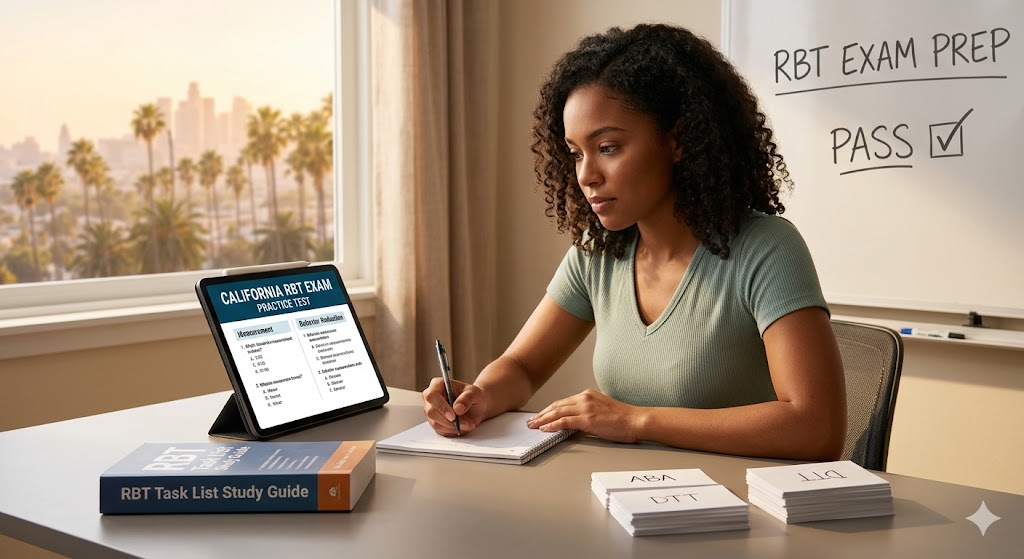
Additional Information
What the Course Entails and Exam Details
Before you are eligible to sit for the computerized final
examination, you must first complete two essential prerequisites.
The primary step is successfully finishing an approved
40-hour RBT Training Course.
This comprehensive course covers the foundational domains of
the BACB RBT Task List, ensuring you possess the theoretical knowledge required
for the role.
Core topics include measurement procedures, assistance with
functional assessments, skill acquisition techniques, behavior reduction
strategies, documentation protocols, and professional conduct standards.
After finishing your training, you will need to successfully
complete the RBT Initial Competency Assessment.
This is a critical hands-on assessment where a Board
Certified Behavior Analyst (BCBA) observes you performing specific skills,
either with a real client or through structured role-play, to verify your
mastery.
What to Expect in the Final Exam
The actual RBT Exam is a computerized, proctored test
administered globally, including at numerous physical testing centers
throughout California.
It is composed of multiple-choice questions designed to
measure your comprehension of the concepts covered in your 40-hour training.
Currently, the exam consists of approximately 85 questions,
10 of which are pilot questions that do not count towards your score.
You are allocated exactly 90 minutes to complete the
entirety of the examination.
The BACB utilizes a scaled score system rather than a fixed
raw percentage, but a score of 200 is generally required to pass.
Rest assured, standard accommodations are available for
candidates who need them, following appropriate requests through the BACB
portal.
How to Study and
Exam Centers
To ensure success on your first attempt, you must combine
dedicated study habits with realistic simulation.
We highly recommend utilizing flashcards to master
terminology, as the exam requires quick and accurate recall of definitions and
principles.
Many high-quality 40-hour training providers include
comprehensive RBT practice exams, which are invaluable for identifying your
strengths and weak areas.
Spend time meticulously reviewing the rationale for every
question you answered incorrectly.
For the scheduling process, you must utilize your BACB
account once you have been approved to take the exam.
The BACB partners exclusively with Pearson VUE, which
provides extensive physical testing center locations across all major regions
of California, including Los Angeles, San Diego, San Francisco, and Sacramento.
Be sure to arrive at your designated testing center early
with the required forms of identification.
Job Opportunities
from the Course
Earning your RBT credential significantly increases your
employability within the behavioral health sector in California.
This certification is often required by employers to provide
insurance-reimbursable services.
Successful completion unlocks several dynamic and rewarding
career paths.
Common job titles include: Registered Behavior Technician
(RBT).
Behaviour Technician.
ABA Therapist.
Behavior Interventionist.
Paraprofessional Behavior Specialist.
These roles are available across various environments, such
as public school systems, private autism centers, in-home therapy agencies, and
residential care facilities.
Frequently Asked Questions
Reviews
5.0
Based on 0 reviews
Leave a Review
No reviews yet. Be the first to review!