
Canada 6th Grade Social Studies Practice Test
$69.00
- Buy to unlock unlimited access to all Quiz questions and Answers in this Quiz.
- After purchase you can print a PDF of the whole quiz at any point. The PDF will contain the questions and the correct answers.
About this Exam
Embarking on the Canada 6th Grade Social Studies journey is
an exciting landmark for students, marking a significant step into their role
as informed future citizens. This assessment is not just a test; it is a
celebration of knowledge, designed primarily for elementary school students
across Canada nearing the completion of their sixth-grade year. The practice
exam serves as a robust tool to help students consolidate their understanding
of the nation’s history, diverse cultures, governing systems, and its place
within the global community. By engaging with this practice test, students can
identify their strengths, pinpoint areas for improvement, and build the
confidence necessary to excel in their official school or provincial
assessments. It is an essential resource for parents and educators seeking to
support young learners in mastering core social studies competencies.
Ready to test your knowledge?
Buy Now to Access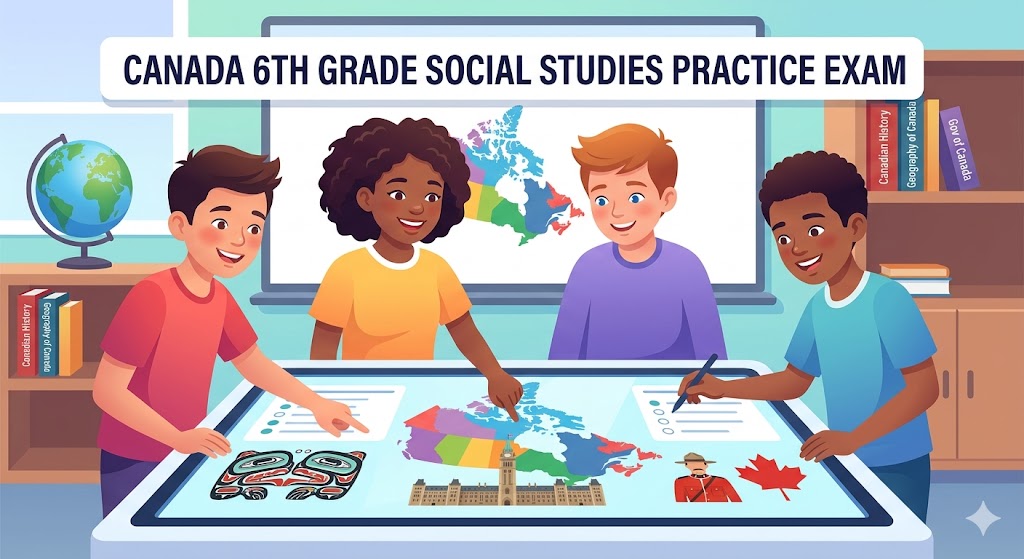
Additional Information
What the Course
Entails and Exam Details
The 6th-grade Social Studies curriculum across Canadian
provinces typically explores the rich tapestry of Canada's development from
pre-Confederation to the modern era. Students delve into key pillars of
Canadian identity, beginning with the history and enduring contributions of
First Nations, Métis, and Inuit peoples, as well as early European explorers
and settlers. The course rigorously outlines the structure and function of
Canadian government, covering federal, provincial, territorial, and municipal
levels, the role of the Monarch, and the significance of the Canadian Charter
of Rights and Freedoms. Geography skills are sharpened as students locate
provinces, capital cities, major physical regions, and natural resources on a
map. Furthermore, the curriculum emphasizes global citizenship, investigating
Canada's interactions with other nations and its involvement in international
organizations like the United Nations. The exam assesses a student's ability
not only to recall facts but also to analyze historical events, interpret maps,
and understand civic responsibilities.
What to Expect in
the Final Exam
While the exact format of the final assessment can vary by
province or specific school board, most standard 6th-grade tests rely heavily
on objective question types designed to measure a broad range of knowledge
efficiently. Students should expect a significant portion of multiple-choice
questions that require selecting the single best answer from several options.
True/false and matching questions are also common for testing definitions and
historical pairings. Depending on the specific assessment, there may be some
fill-in-the-blanks or short-answer questions that ask for a sentence or two
about a key concept. Time limits generally range between 45 to 90 minutes,
providing ample time for thoughtful completion if the student is well-prepared.
Provincial assessments (such as those previously administered in Ontario or
Alberta) have strict rules regarding standardization, but classroom-level final
exams are generally less formal, though they still require quiet concentration.
How to Study and
Exam Centers
Effective preparation for this social studies milestone
requires a blend of review and active practice. Students are encouraged to
start by thoroughly reviewing their class notes, textbooks, and any graded
assignments from the school year. Creating flashcards for key historical dates,
vocabulary terms (like "Confederation," "Charter," or
"Democracy"), and influential historical figures can be incredibly
helpful for memorization. Utilizing practice tests, like this one, is one of
the best strategies to become comfortable with the question formats and improve
time management skills. We recommend students simulate exam conditions by
taking practice tests in a quiet space without interruptions. Regarding exam
centers, these assessments are standard school-based tests. The
"center" will be the student’s normal classroom or a designated
gymnasium within their own school. For certain standardized provincial
evaluations, schools might administer the test via secure online portals
provided by the Ministry of Education.
Job Opportunities from the Course
While completing 6th Grade Social Studies does not directly
unlock a professional job market, it is the fundamental starting point for
young learners to develop critical thinking, research, and civic literacy
skills that are essential for countless successful career paths in adulthood.
Mastering these skills paves the way toward high school and university studies
that lead to rewarding professions where knowledge of history, government, and
society is crucial.
Future career foundations unlocked by these skills include:
- Lawyer
or Legal Professional
- Politician
or Public Administrator
- Historian
or Museum Curator
- Journalist
or Foreign Correspondent
- High
School Social Studies Teacher
- Librarian
or Archivist
- Urban
Planner or Geographer
- Diplomat
or International Relations Specialist
- Community
Outreach Coordinator
Non-Profit Organization Director
Frequently Asked Questions
Reviews
5.0
Based on 0 reviews
Leave a Review
No reviews yet. Be the first to review!