
Canadian Association of Rocketry (CAR) Level 1 Certification Practice Test
$69.00
- Buy to unlock unlimited access to all Quiz questions and Answers in this Quiz.
- After purchase you can print a PDF of the whole quiz at any point. The PDF will contain the questions and the correct answers.
About this Exam
Embark on your journey into the thrilling world of high-power rocketry with the Canadian Association of Rocketry (CAR) Level 1 Certification. This certification is the essential first milestone for serious rocketry enthusiasts, hobbyists, and university students across Canada who want to expand their horizons beyond standard model rocketry. Achieving Level 1 status grants you the official authority to purchase and use rocket motors in the H impulse class, opening up new possibilities for larger, more powerful, and advanced flight projects. This guide is your roadmap to mastering the foundational knowledge and proving the practical skills required to join the ranks of certified high-power rocketeers in Canada.
Ready to test your knowledge?
Buy Now to Access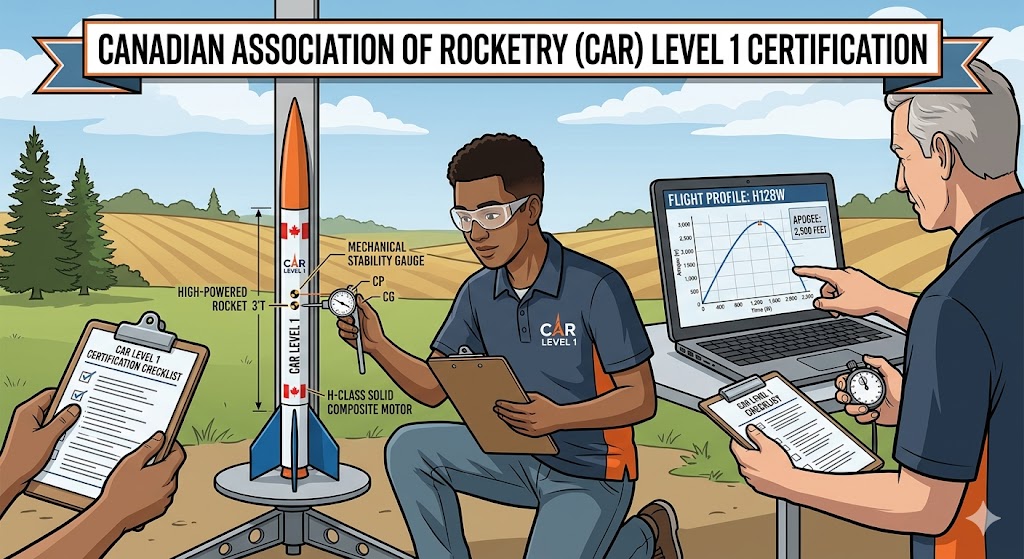
Additional Information
What the Course
Entails and Exam Details
Preparing for the CAR Level 1 Certification means
developing a core competency in both theoretical rocketry concepts and
practical, hands-on application. While it is often self-study rather than a
formal course, you must master a specific body of knowledge.
The theoretical component focuses heavily on the CAR
Safety Code, Canadian federal regulations governing rocket flights, and
fundamental physics. Key syllabus areas you must master include:
- Safety
Protocols: Detailed understanding of the CAR Safety Code, including launch
site setup, minimum safe distances, and ignition procedures.
- Rocket
Design & Stability: Comprehensive knowledge of Center of Gravity (CG)
versus Center of Pressure (CP), stability margins, and how to use
simulation software to predict flight performance.
- Propulsion:
Classification of rocket motors (total impulse, average thrust), motor
coding, safe handling of high-power composites, and the fundamentals of
solid rocket motor operation.
- Recovery
Systems: Designing reliable deployment methods for parachutes, including
motor ejection and electronic deployment concepts.
- Materials
and Construction: Selecting appropriate materials for high-power
airframes, including fiberglass, composites, and aircraft-grade plywood.
The practical component entails building a high-power
rocket that can accommodate an H-class motor, and then demonstrating a
successful flight and safe recovery at a sanctioned CAR launch.
What to Expect in the Final Exam
The CAR Level 1 certification process is not a single
sitting for a written test; rather, it is a dual assessment consisting of a
written examination and a supervised practical demonstration flight.
Part 1: The Written Examination
This exam is designed to verify your understanding of the
regulatory and safety environment of Canadian rocketry.
- Format:
The test usually consists of multiple-choice and/or true/false questions.
- Content:
Questions focus directly on the CAR Safety Code, Transport Canada
regulations (CAR 101/602), and basic stability and physics concepts.
- Time
Limit: Typically, the exam has a strict time limit (e.g., 60 minutes) and
is completed under the supervision of a CAR Prefect, RSO, or authorized
member.
- Passing
Score: A strong score, typically 70% or higher, is required to demonstrate
competence in safety and regulations.
Part 2: The Practical Flight Demonstration
Once you have passed the written exam, you must perform
your certification flight at a sanctioned CAR launch event.
- The
Build: You must design and construct your own Level 1 capable rocket. It
must be powered by an H impulse class motor during the attempt.
- The
Inspection: Before flight, your rocket will be inspected by a Range Safety
Officer (RSO) to confirm its airworthiness, stability (using your
documentation), and overall safe construction.
- The
Flight and Recovery: The rocket must launch safely, achieve a stable
ascent, and correctly deploy its recovery system (e.g., a parachute)
without damage. It must be successfully retrieved in a condition suitable
for a subsequent safe launch.
How to Study and
Exam Centers
Effective preparation for Level 1 requires combining
diligent study with practical application and mentorship.
How to Study
Master the Safety Code: This
is your primary document. Read the CAR Safety Code and relevant sections of
Transport Canada's regulations repeatedly. Memorize key distances and safety
boundaries.
Study "The
Handbook": Utilize established rocketry handbooks and online resources
that explain stability calculations, CP/CG analysis, and the properties of
materials.
Learn Simulation Software:
Download and use free software like OpenRocket to model your certification
design. Verify its stability and predict its altitude using standard H-motor
data.
Find a Mentor: Connect with
your local CAR club. Experienced rocketeers (prefects or high-level flyers) are
invaluable for reviewing your design, offering construction tips, and acting as
a designated authority to witness your flight.
Build and Fly Low Power: Gain
experience with lower-power kits. Focus on perfecting recovery deployment and
finishing techniques before moving to high-power composites.
Exam Centers
You cannot take the CAR Level 1 exam at a standard
commercial testing center like Pearson VUE. Both parts of the certification
happen exclusively through sanctioned Canadian Association of Rocketry (CAR)
club launch events and Prefects.
- Step
1: Locate your nearest CAR Chapter or Club. A directory is available on
the main Canadian Association of Rocketry website.
- Step
2: Become a member of CAR (required for certification).
- Step
3: Contact the Club Prefect or RSO to schedule your written exam.
- Step
4: Plan to attend a scheduled launch to perform your certification flight
demonstration in front of official witnesses.
Job Opportunities from the Course
While the CAR Level 1 Certification is a hobbyist
designation and not a professional license, achieving it demonstrates
foundational expertise and hands-on experience that is highly valued in the
aerospace and advanced manufacturing sectors. For students and career-changers,
it serves as crucial proof of capability. This experience unlocks pathways into
foundational roles, such as:
- Aerospace
Technician (Structural/Composite)
- Propulsion
System Assembly Technician
- STEM/Science
Educator ( especializado en Aeroespacial)
- Pyrotechnics
Handler (con certificación complementaria)
- UAV
(Drone) Test and Integration Technician
- Engineering
Technologist (Aerospace/Mechanical)
Frequently Asked Questions
Reviews
5.0
Based on 0 reviews
Leave a Review
No reviews yet. Be the first to review!