
Canadian Hospitality Law Practice Exam
$69.00
- Buy to unlock unlimited access to all Quiz questions and Answers in this Quiz.
- After purchase you can print a PDF of the whole quiz at any point. The PDF will contain the questions and the correct answers.
About this Exam
Navigating the legal landscape of
the Canadian hospitality sector is essential for mitigating risk and ensuring a
safe, compliant operation. The Canadian Hospitality Law Practice Exam is
designed as the ultimate preparatory tool for students and professionals
seeking to validate their understanding of the complex legal statutes that
govern hotels, restaurants, tourism agencies, and event venues across Canada.
Whether you are currently enrolled in a Hospitality Management program,
preparing for a professional development certification, or a business owner
looking to refresh your knowledge of provincial and federal liabilities, this
study guide and practice exam are your primary resources for academic and
professional success.
Ready to test your knowledge?
Buy Now to Access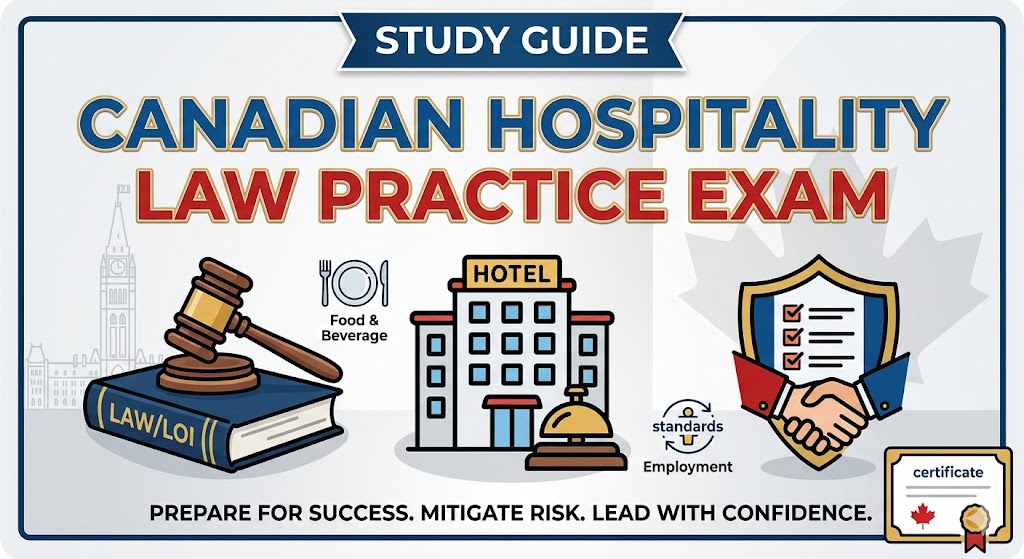
Additional Information
What the Course Entails and
Exam Details
This practice exam covers the
multi-faceted intersection of Canadian law and the daily operations of a
hospitality enterprise. The core curriculum validates competence in several
critical domains.
- Canadian
Legal Framework: An overview of the common law system, the difference
between federal and provincial jurisdiction, and the importance of
statutory law in hospitality.
- Tort
Law and Negligence: The fundamental concept of duty of care, standard
of care, and identifying liability in common hospitality scenarios such as
slip-and-fall accidents or guest injuries.
- Contract
Law: The essentials of forming valid contracts, understanding
reservations as binding agreements, cancellation policies, vendor
contracts, and employment agreements.
- Guest
Relationships: The legal definition of an "innkeeper" vs. a
"guest," rights of refusal, eviction procedures, and obligations
regarding guest property under various provincial Innkeepers Acts.
- Liquor
Liability: Key provisions of provincial liquor licensing acts,
regulations concerning the responsible service of alcohol, and the severe
implications of "over-service" liability.
- Food
Safety and Liability: Regulations governing food preparation, service,
sanitation standards, and liability related to foodborne illnesses or
allergic reactions.
- Employment
Standards: Understanding the relevant provincial Employment Standards
Acts, covering minimum wage, overtime, vacation pay, termination, and
human rights legislation regarding discrimination in the workplace.
- Property
and Risk Management: Legal considerations for property ownership,
leasing, insurance requirements, and strategies for proactive risk
mitigation.
What to Expect in the Final
Exam
While individual institutions and
certifying bodies may vary slightly, the Canadian Hospitality Law Final Exam
typically follows a rigorous, comprehensive format designed to test both
theoretical knowledge and practical application.
- Exam
Format: Most final exams are computerized and consist of a combination
of multiple-choice questions, true/false scenarios, and detailed,
short-answer case study analyses.
- Case
Studies: These critical thinking components present realistic
hospitality management dilemmas, requiring you to identify the legal
issues, cite relevant laws, and recommend legally sound management
actions.
- Passing
Score: The standardized passing requirement is usually between 60% and
70% to demonstrate safe and competent understanding of legal
responsibilities.
- Time
Limit: Expect a strict time limit, typically ranging from 90 minutes
to 3 hours, requiring efficient time management and a strong grasp of the
material.
- Permitted
Materials: The exam is generally closed-book, although some
institutions may allow a specified summary sheet or reference to specific
provincial legislative acts. Always confirm the specific rules before your
test date.
How to Study and Exam Centers
Preparation is paramount when
tackling legal subject matter. An effective study strategy integrates
consistent review with practical simulation.
Effective Study Strategies
- Master
the Terminology: Legal language can be complex. Build a glossary of
key terms such as "negligence," "duty of care,"
"vicarious liability," and "innkeeper's lien."
- Use
Practice Exams: Take our specialized Canadian Hospitality Law
Practice Exam multiple times. It is designed to simulate the
structure, difficulty level, and time constraints of the actual test.
Analyze why incorrect answers were wrong to identify your knowledge gaps.
- Analyze
Real-World Scenarios: Hospitality law revolves around scenarios. Read
relevant Canadian legal case summaries related to guest injury or
contracts and discuss them with peers to understand how courts apply the
law.
- Create
Flashcards: Use flashcards for reviewing legislative definitions,
timelines for employment standards, and provincial variations in
Innkeepers Acts.
- Focus
on Provincial Differences: While federal laws apply nationwide, many
hospitality regulations (liquor, innkeepers’ rights) are provincial.
Ensure you study the specific statutes relevant to the province where you
intend to work or take the exam.
Where and How to Take the Exam
The final exam is typically
administered by your specific learning institution or a professional certifying
body.
- Institution-Specific
Portals: If you are completing this course as part of a college or
university diploma, the exam is usually taken through the institution’s
secure online learning management system (e.g., Blackboard, D2L
Brightspace, Moodle) or on-campus in a proctored computer lab.
- Authorized
Testing Centers: Some professional certifications may require you to
take the exam at an authorized third-party testing facility, such as
Pearson VUE.
- Online
Proctoring: Increasingly, exams offer remote proctoring options,
allowing you to take the test from home while being monitored via webcam
to maintain academic integrity.
Job Opportunities from the Course
A strong understanding of
Canadian Hospitality Law is a critical asset that enhances your employability
and opens doors to leadership roles in a variety of sectors. Competence in this
area demonstrates to employers that you are prepared to manage risk effectively.
- Hotel
Manager
- Restaurant
General Manager
- Resort
Operations Manager
- Food
and Beverage Director
- Front
Office Manager
- Banquet
and Events Manager
- Director
of Human Resources (Hospitality Specialization)
- Risk
Management Coordinator
- Catering
Manager
- Club
Manager (Golf or Private Clubs)
- Casino
Operations Supervisor
- Tourism
Development Officer
- Hospitality
Business Owner/Operator
- Compliance
and Safety Officer
Frequently Asked Questions
Reviews
5.0
Based on 0 reviews
Leave a Review
No reviews yet. Be the first to review!