
Canadian Pony Club C Level Practice Exam
$69.00
- Buy to unlock unlimited access to all Quiz questions and Answers in this Quiz.
- After purchase you can print a PDF of the whole quiz at any point. The PDF will contain the questions and the correct answers.
About this Exam
The Canadian Pony Club C Level
certification represents a major milestone in a young equestrian's journey.
Designed for dedicated members who have already established a solid foundation
at the D levels, this program deepens a rider's horizontal knowledge. It is the
first stage where Pony Clubbers begin moving beyond basic pony management and
riding mechanics into more advanced aspects of horse health, training, and
competitive skill. This certification validates not just ability, but a
comprehensive understanding required for future equestrian pursuits. Candidates
are expected to demonstrate greater maturity, responsibility, and independent
thinking in all aspects of stable management and riding.
Ready to test your knowledge?
Buy Now to Access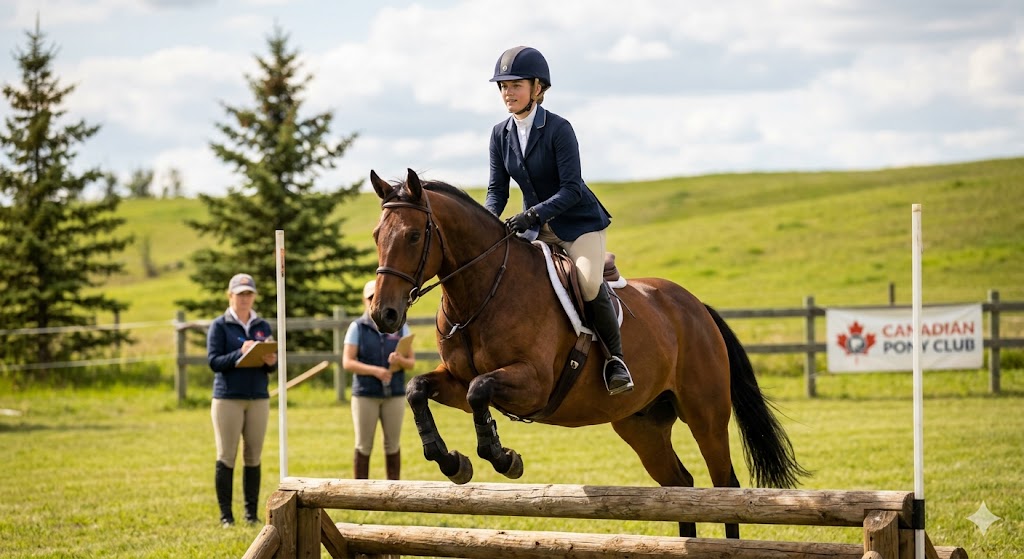
Additional Information
What the Course Entails and
Exam Details
The C Level program shifts focus
from general 'ponyship' to 'horsemanship.'
Riders will delve deeper into
complex subjects. Stable management topics now include advanced equine
nutrition, complex anatomy and physiology, the principles of shoeing and common
hoof ailments, and recognizing major, non-emergency unsoundnesses. First aid
requirements are more detailed, requiring understanding of proper treatment
techniques and when to call a veterinarian. Bandaging becomes more specific,
moving from general protection to stable and traveling support.
Riding requirements also advance
significantly. In Flatwork, riders must demonstrate understanding and
application of the Training Scale (Pyramid of Training), showcasing balance,
obedience, and developing collection. The Jumping phase demands confident,
efficient, and well-organized riding over more challenging courses, which now
include combination obstacles and a focus on correct lines and pace. For those
attempting the full C, riding in the Open (cross-country phase) is mandatory,
requiring navigation of varying terrain and obstacles appropriate for the
level.
The overall standard moves from
basic control and survival to effective riding, demonstrating the rider's
influence on the horse's shape and movement. The theoretical component often
incorporates oral examination in addition to written components, testing
practical application of knowledge rather than just memorization.
What to Expect in the Final
Exam
The C Level exam is a formal
evaluation conducted by recognized Canadian Pony Club examiners. Unlike lower
levels, the C exam is often structured as a standalone testing day, sometimes
requiring travel to a centralized location with other candidates from the
region.
The written exam requires a
deeper synthesis of knowledge than the D levels, with scenarios requiring
application, rather than just definition. It tests recall across the entire
breadth of the stable management syllabus.
The main focus of the day is the
physical examination, which is split distinctly into Riding and Stable
Management phases. Riders will demonstrate their skills in Flatwork, Stadium
Jumping, and typically Cross-Country. The Stable Management exam involves a
panel of examiners visiting candidates and their horses, questioning them on
anatomy, health checks, equipment knowledge, bandaging, and various management
scenarios, ensuring not just knowledge, but practical proficiency.
The passing standard is typically
65% for each overall phase (Riding, Stable Management, and the written test).
Candidates must achieve this minimum in all required areas to pass.
How to Study and Exam Centers
Effective studying for the C
Level requires consistent dedication and practical application. Candidates
should immerse themselves in the official Canadian Pony Club C Level Stable
Management manual.
Create detailed flashcards for
anatomy, diseases, nutrition, and shoeing concepts. The oral examination style
requires practicing explaining these concepts out loud—recruit family members
or peers to act as examiners.
Hands-on practice is essential.
If studying bandaging, bandage every horse in the barn. When studying anatomy,
physically locate the parts on a horse until it is second nature. Develop
routines for checking vital signs.
For the Riding phase, ride
consistently under the guidance of a knowledgeable coach. Practice complex
Flatwork movements and jumping lines. Review videos of your riding and analyze
your adherence to the Training Scale. Ensure your required riding equipment and
turn-out are impeccable and according to regulation.
Exam centers are generally
managed and scheduled at the Regional level within the Canadian Pony Club.
Candidates should contact their local branch District Commissioner (DC) or
Regional Chair well in advance. Examinations are organized when there are sufficient
candidates, sometimes combined with neighboring branches or during Regional
Pony Club camps. Unlike professional certifications, these are not taken via
commercial testing centers like Pearson VUE; they are organized specifically by
CPC volunteers and regions.
Job Opportunities from the
Course
Earning the Canadian Pony Club C
Level certification marks you as a knowledgeable and dedicated equestrian. It
serves as a valuable prerequisite and strong differentiator for numerous roles,
including:
- Assistant
Riding Instructor (working under a certified coach)
- Stable
Manager or Head Groom
- Vet
Assistant (especially in equine practice)
- Competitive
Groom
- Summer
Camp Riding Director
- Therapeutic
Riding Assistant
- Pathway
to higher Pony Club coaching and examining roles (e.g., B or A level)
- Direct
entry (or credits toward) accredited Equine Science or Horsemanship
college programs
Frequently Asked Questions
Reviews
5.0
Based on 0 reviews
Leave a Review
No reviews yet. Be the first to review!