
Canadian Practical Nurse Registration Examination (CPRNE) Practice Exam
$69.00
- Buy to unlock unlimited access to all Quiz questions and Answers in this Quiz.
- After purchase you can print a PDF of the whole quiz at any point. The PDF will contain the questions and the correct answers.
About this Exam
The Canadian Practical Nurse
Registration Examination (CPNRE) is a comprehensive national certification test
required for prospective practical nurses in Canada.
It is designed specifically for
graduates of approved practical nursing diploma programs who are seeking to
earn their official licensure.
Successfully passing this exam
validates your knowledge, ensures public safety, and serves as your official
gateway to becoming a Licensed Practical Nurse (LPN) or Registered Practical
Nurse (RPN) in participating Canadian provinces and territories.
By taking a CPNRE practice exam,
nursing candidates can familiarize themselves with the rigorous standards of
the profession and build the vital confidence needed for test day.
Ready to test your knowledge?
Buy Now to Access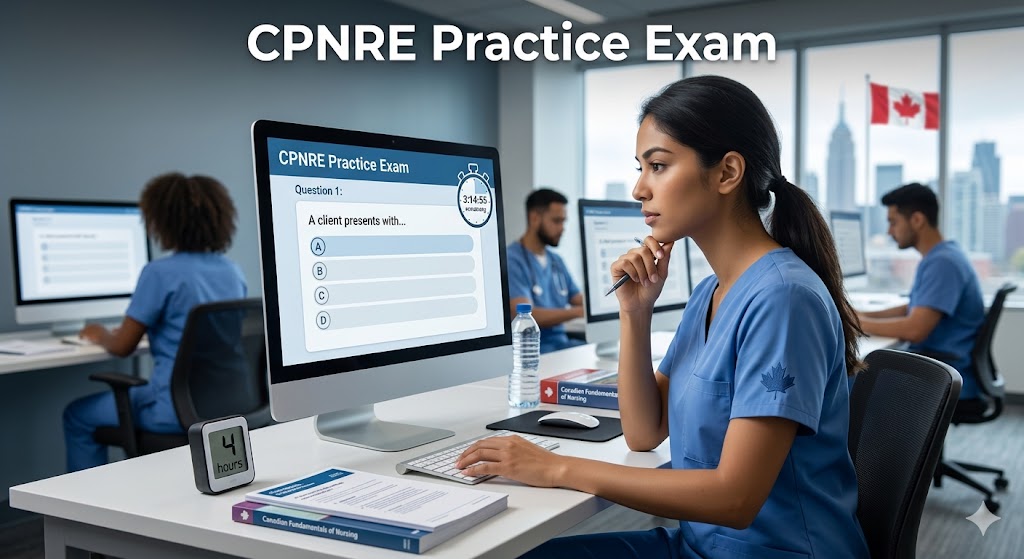
Additional Information
The Canadian Practical Nurse Registration Examination (CPNRE) is a comprehensive national certification test required for prospective practical nurses in Canada.
It is designed specifically for graduates of approved practical nursing diploma programs who are seeking to earn their official licensure.
Successfully passing this exam validates your knowledge, ensures public safety, and serves as your official gateway to becoming a Licensed Practical Nurse (LPN) or Registered Practical Nurse (RPN) in participating Canadian provinces and territories.
By taking a CPNRE practice exam, nursing candidates can familiarize themselves with the rigorous standards of the profession and build the vital confidence needed for test day.
What the Course Entails and Exam Details
Your nursing program and the subsequent CPNRE exam cover a broad spectrum of medical, ethical, and practical nursing concepts.
The core syllabus evaluates your competency in three main categories: professional, ethical, and legal practice; foundations of nursing practice; and collaborative practice.
You will be tested on critical topics such as anatomy, physiology, pharmacology, and comprehensive health assessments.
Furthermore, the exam requires you to demonstrate strong skills in nursing interventions, patient safety protocols, and therapeutic communication.
Candidates are also expected to navigate complex patient care scenarios across various demographics, including pediatric, maternity, adult, and geriatric populations.
What to Expect in the Final Exam
The final CPNRE is a computer-based, multiple-choice examination designed to test your critical thinking and clinical judgment.
Candidates can expect to answer between 165 and 170 multiple-choice questions, which include standalone queries and case-study-based scenarios.
You are typically allotted a strict time limit of four hours to complete the entire examination.
The passing score is determined by a criterion-referenced standard, meaning you are graded against an absolute standard of safe nursing practice rather than being graded on a curve against other test-takers.
Strict exam rules apply, requiring candidates to present government-issued identification, leave all personal belongings and electronics outside the testing room, and follow all instructions provided by the proctors.
How to Study and Exam Centers
Effective preparation requires a strategic blend of content review and active testing through a CPNRE practice exam.
Start by utilizing official prep guides and carefully reviewing the rationales for both correct and incorrect answers to understand the underlying clinical logic.
Forming study groups, creating flashcards for pharmacology, and taking timed, simulated practice tests will help you build stamina for the four-hour session.
The actual examination is administered via secure computer-based testing networks.
Depending on your specific provincial regulatory body, you will register and schedule your exam through dedicated testing partners like Meazure Learning (formerly Yardstick) or Pearson VUE.
Testing takes place at authorized physical test centers located across Canada, or in some specific cases, through secure online remote proctoring portals approved by your provincial college of nurses.
Job Opportunities from the Course
Earning your LPN or RPN credential unlocks a highly rewarding and in-demand career path across the healthcare sector.
Licensed Practical Nurse is the primary title you will hold in most provinces, allowing you to work in hospitals, emergency rooms, and acute care settings.
Registered Practical Nurse is the equivalent title utilized in Ontario, offering the exact same diverse clinical opportunities.
Long-Term Care Nurse roles are incredibly popular, allowing you to build lasting relationships with elderly residents in retirement homes and extended care facilities.
Clinic Nurse positions are available for those who prefer working in specialized private practices, family health teams, or outpatient surgical centers.
Home Health Nurse opportunities exist for independent professionals who wish to provide one-on-one care to patients recovering in their own residences.
Travel Nurse careers are also highly accessible, giving licensed practical nurses the freedom to accept short-term, lucrative contracts in underserved communities and remote regions across the country.
Frequently Asked Questions
Reviews
5.0
Based on 0 reviews
Leave a Review
No reviews yet. Be the first to review!