
Canadian Red Cross Emergency Medical Responder Practice Exam
$69.00
- Buy to unlock unlimited access to all Quiz questions and Answers in this Quiz.
- After purchase you can print a PDF of the whole quiz at any point. The PDF will contain the questions and the correct answers.
About this Exam
The Canadian Red Cross Emergency Medical Responder (EMR)
certification is a comprehensive program designed for professionals seeking
foundational knowledge and advanced skills in pre-hospital emergency medical
care.
This certification acts as a critical bridge between standard first aid and the professional world of paramedicine. It is the gold standard for individuals whose primary responsibility includes initial patient assessment, the provision of safe and prudent interventions, and transportation to a healthcare facility. The EMR role is vital within high-risk environments and is the initial credential for many emerging careers in emergency services
Ready to test your knowledge?
Buy Now to Access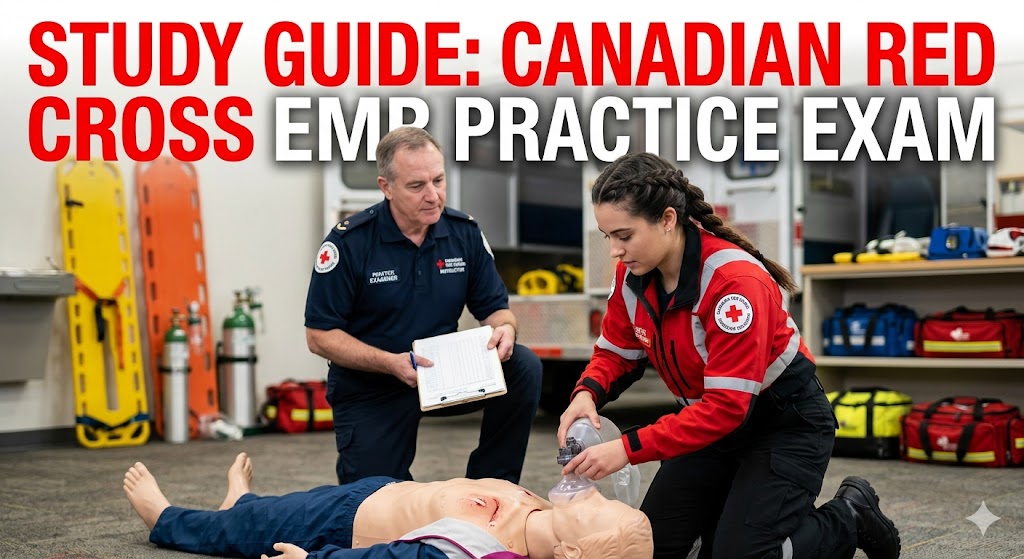
Additional Information
What the Course Entails and Exam Details
The EMR course is a rigorous program, typically involving
approximately 80 to 120 instructional hours, and is delivered by authorized
Canadian Red Cross Training Partners.
The extensive syllabus is aligned with national
occupational standards and covers a wide array of life-saving skills and
knowledge. Key topics include:
- The
Professional Responder and Responding to the Call
- Infection
Prevention and Control
- Anatomy
and Physiology
- Patient
Assessment (Scene Size-Up, Primary, and Secondary)
- Airway
Management and Respiratory Emergencies
- Circulatory
Emergencies and Basic Life Support (BLS)
- Shock
Management
- Hemorrhage
Control and Soft Tissue Trauma
- Musculoskeletal,
Head, and Spinal Injuries
- Chest,
Abdominal, and Pelvic Injuries
- Acute
and Chronic Illnesses, including Poisoning
- Environmental
Emergencies
- Pregnancy,
Labour, and Delivery
- Special
Populations
- Crisis
Intervention
- Reaching,
Lifting, and Extricating Patients
- Transportation
and Multiple-Casualty Incidents
- Pharmacology
The program emphasizes both theoretical understanding and
dynamic, hands-on scenario training, preparing you to act decisively under
pressure.
What to Expect in
the Final Exam
To achieve certification, candidates must successfully
navigate two distinct components of the final evaluation process: a written
knowledge evaluation and a practical scenario assessment.
Written Knowledge Evaluation:
- Format:
This is a closed-book, multiple-choice exam.
- Content:
It tests your understanding of all theoretical concepts covered in the
manual, from anatomy to pharmacological protocols.
- Requirement:
Candidates must achieve a minimum score of 75% to pass.
Practical Scenario Evaluation:
- Format:
Candidates are required to demonstrate proficiency in two distinct,
evaluated scenarios: one medical emergency and one traumatic injury.
- Requirement:
These are pass/fail evaluations based on standard provincial or national
competency checklists. You must correctly perform critical patient care
steps in a time-sensitive manner to succeed.
Complete attendance and participation in the training
hours are usually a mandatory prerequisite for attempting these final exams.
How to Study and
Exam Centers
Preparing for the EMR exam requires a combination of
diligent study and hands-on skill dedication.
Actionable Study Strategies:
- Master
the Text: Use the Canadian Red Cross Emergency Care for Professional
Responders reference manual as your primary guide. Read it
sequentially.
- Complete
the Workbook: If available, complete the companion workbook. It is
designed to reinforce your knowledge.
- Simulate
Scenarios: Practice is essential. Team up with classmates to practice
rapid primary and secondary assessments and specific skills (e.g.,
splinting, airway adjunct insertion) while verbalizing your thought
process.
- Use
Flashcards: Create flashcards for medical terminology, pharmacological
doses, vital sign ranges, and key assessment acronyms like SAMPLE and
OPQRST.
- Practice
with Time: For written preparation, take a practice exam to improve your
pacing.
Exam Centers: The final exams, both written and
practical, are administered directly by the Canadian Red Cross Authorized
Training Partner where you completed your EMR course. These partners manage the
scheduling, testing facility, and proctoring. You will not typically use
external centers like Pearson VUE for the core EMR certification itself;
rather, you will test at your designated school, training facility, or
authorized workplace environment.
Job Opportunities
from the Course
Earning your Canadian Red Cross EMR certification unlocks
numerous career paths in emergency medical services, security, and industrial
safety across Canada. This credential is often a baseline requirement or a
powerful asset for the following roles:
- Firefighter
- Industrial
Emergency Medical Responder (Mines, Oil & Gas)
- Remote
Site Medic
- Security
Professional
- Search
and Rescue Team Member
- Lifeguard
(Advanced level)
- Police
Officer / Law Enforcement
- Ambulance
Attendant (in specific jurisdictions)
- Ski
Patrol
- Pre-Paramedicine
Student (essential foundational course)
This certification is your first step toward a rewarding
career dedicated to helping others in times of crisis.
Frequently Asked Questions
Reviews
5.0
Based on 0 reviews
Leave a Review
No reviews yet. Be the first to review!