
CAP Wright Brothers Achievement Practice Test
$69.00
- Buy to unlock unlimited access to all Quiz questions and Answers in this Quiz.
- After purchase you can print a PDF of the whole quiz at any point. The PDF will contain the questions and the correct answers.
About this Exam
The Civil Air Patrol (CAP) Wright Brothers Achievement is a crucial milestone within the CAP Cadet Program, marking the completion of Phase I, "The Learning Phase." Named in honor of Orville and Wilbur Wright, the pioneers of powered flight, this award signifies a cadet's transition from a basic followership role to a foundational leadership position.
Designed specifically for active CAP cadets who have already completed the first three achievements of Phase I, this certification is the gateway to becoming a Cadet Non-Commissioned Officer (NCO). Passing this examination demonstrates that the cadet has mastered foundational knowledge in leadership theory and is prepared to assume the responsibilities of a Cadet Staff Sergeant, serving as a role model and mentor to newer cadets.
Ready to test your knowledge?
Buy Now to Access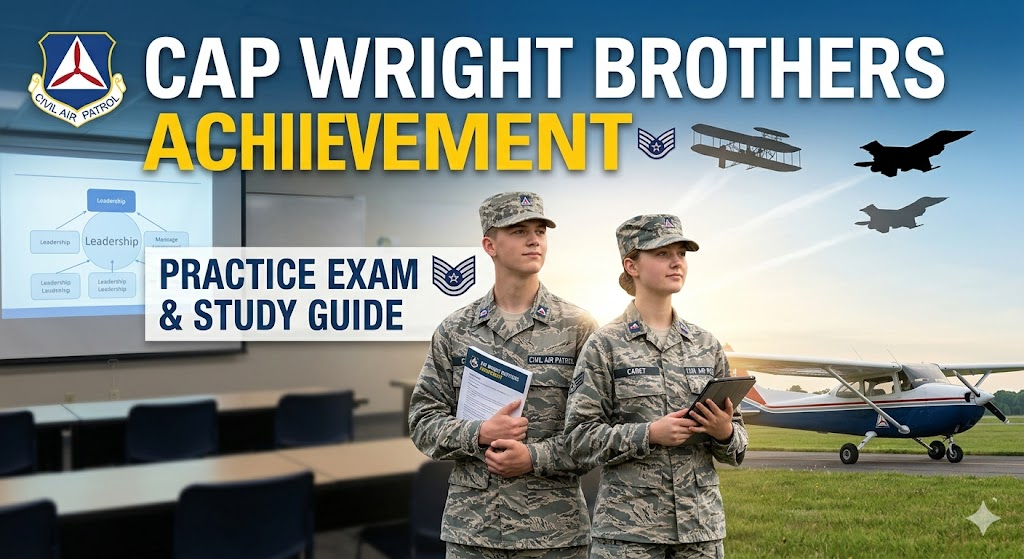
Additional Information
What the Course Entails and Exam Details
The "course" for the Wright Brothers Achievement is not a single classroom event but rather the cumulative knowledge gained throughout the first three achievements of the Cadet Program. To be eligible to take the exam, cadets must already possess satisfactory performance ratings in leadership, aerospace, physical fitness, and character development.
The syllabus for the Wright Brothers Achievement exam focuses exclusively on leadership theory and the fundamentals of drill and ceremonies. The core topics covered include the history and legacy of the Wright Brothers, the definition and essential qualities of leadership, CAP Core Values, and the practical application of drill commands as defined in Air Force Manual (AFMAN) 36-2203. Cadets are required to study "Learn to Lead," Volume 1, Chapters 1-3, which form the academic basis of the test.
What to Expect in the Final Exam
The Wright Brothers Achievement exam is a closed-book examination, distinguishing it from earlier achievement tests. It is a rigorous assessment administered in two distinct parts: a theory portion and a practical performance test. Cadets must achieve a score of 80% or higher on both portions to pass the milestone.
The theory portion consists of multiple-choice questions focusing on leadership principles, CAP history, and customs and courtesies. Cadets have a standard time limit, usually 30 minutes, to complete this section via the online CAP testing portal within eServices. The second portion is the Drill & Ceremonies Performance Test. During this practical evaluation, the cadet must demonstrate proficiency by flawlessly executing a series of drill commands, including marching movements, while acting as an element leader. This part is graded by a qualified senior member or advanced cadet NCO.
How to Study and Exam Centers
To succeed on this closed-book exam, cadets must move beyond simple reading and engage in active recall and practical application. We recommend thoroughly reviewing "Learn to Lead," Volume 1, and creating flashcards for key terms, definitions of Core Values, and leadership traits. Cadets should also practice drill movements frequently, both individually in front of a mirror and by commanding a small flight during squadron meetings, focusing on commanding presence and proper cadence.
Because the Wright Brothers Achievement is a comprehensive milestone, it requires authorized proctoring to maintain testing integrity. The exam cannot be taken at home. It must be administered at the cadet’s home squadron or at an authorized CAP activity, such as an encampment. The exam is typically accessed online through the eServices Learning Management System (LMS) under the direct supervision of an appointed Senior Member Testing Officer. Hard copy versions may also be provided by the squadron testing officer if necessary.
Job Opportunities from the Course
While passing the Wright Brothers Achievement exam does not directly translate into civilian employment, it unlocks critical advancement opportunities within the Civil Air Patrol that build an exceptional resume for future careers. The leadership, discipline, and aerospace knowledge gained are highly valued by military academies, ROTC programs, and employers in the aviation and aerospace sectors.
Specifically, obtaining the Wright Brothers Achievement unlocks the following roles and paths for a cadet:
Cadet Staff Sergeant (C/SSgt): Promotion to the first NCO rank.
Element Leader: Initial operational leadership role within a flight.
Flight Sergeant: Potential assignment to lead a larger group of cadets.
Prerequisite for National Cadet Special Activities (NCSAs): Eligibility to apply for advanced CAP training activities, including flight training and leadership academies.
Mitchell Award Track: Mandatory step toward earning the prestigious Billy Mitchell Award (Phase II milestone).
Frequently Asked Questions
Reviews
5.0
Based on 0 reviews
Leave a Review
No reviews yet. Be the first to review!