
Cardiac Surgery Certification (CSC) Practice Exam
$69.00
- Buy to unlock unlimited access to all Quiz questions and Answers in this Quiz.
- After purchase you can print a PDF of the whole quiz at any point. The PDF will contain the questions and the correct answers.
About this Exam
The Cardiac Surgery
Certification (CSC) is a prestigious subspecialty nursing credential offered by
the American Association of Critical-Care Nurses (AACN). This certification is
designed specifically for Registered Nurses (RNs) and APRNs who provide direct
care to acutely and critically ill adult patients within the initial 48 hours
following cardiac surgery. This certification validates your specialized
knowledge and clinical expertise in a high-stakes, fast-paced environment.
Earning your CSC signals to employers, patients, and colleagues that you are
committed to delivering the highest standard of care to critically ill
open-heart patients. It demonstrates a mastery of complex postoperative
monitoring, therapeutic interventions, and complication management.
Ready to test your knowledge?
Buy Now to Access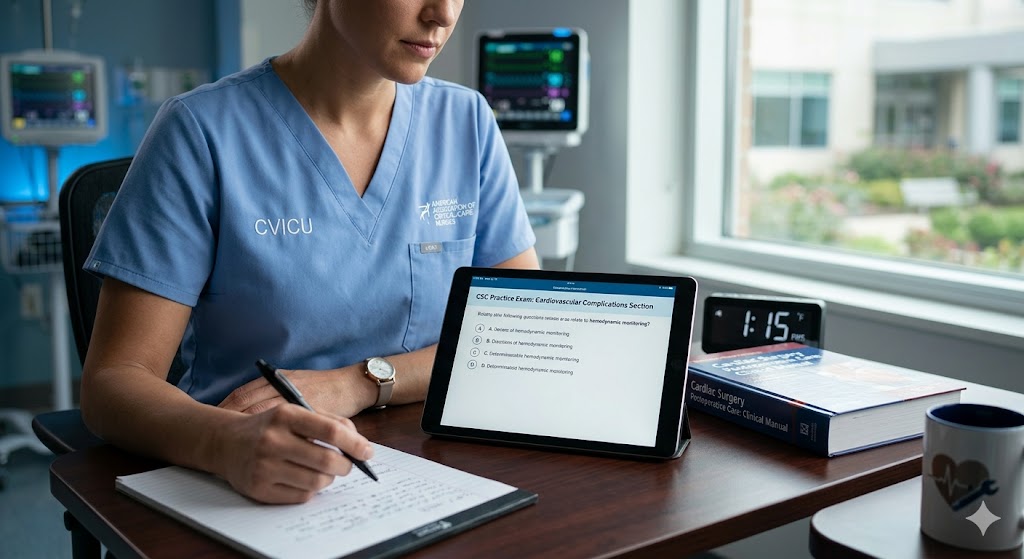
Additional Information
What the Course Entails and
Exam Details
Preparing for the CSC exam
requires a disciplined approach, as it is a testing-based credential rather
than a taught course. To be eligible, you must hold a current, unencumbered
U.S. RN or APRN license and a primary nursing specialty certification, such as
the CCRN. The CSC exam blueprint rigorously focuses on the acute care needs of
the postcardiac surgery population. A significant portion of the content
(approximately 43%) assesses your knowledge of therapeutic interventions. This
includes detailed knowledge of pharmacological management, hemodynamic
monitoring, and mechanical circulatory support devices like Intra-Aortic
Balloon Pumps (IABP) and Extracorporeal Membrane Oxygenation (ECMO). The
remaining content (approximately 33%) covers the recognition and management of
complications. This involves mastering the management of cardiovascular issues
like cardiac tamponade, respiratory failure, renal failure, and multisystem
complications. You must understand the full spectrum of patient care, from
initial recovery through the critical 48-hour postoperative window.
What to Expect in the Final Exam
You should prepare for a
professional, computer-based testing experience. The final CSC exam consists of
90 multiple-choice questions. It is important to note that only 75 of these
items are scored. The other 15 questions are unscored pretest items used by the
AACN to gather statistical data for future exam development. You will not know
which questions are unscored, so you must treat every item as crucial to your
result. The total time limit allowed for the entire examination is 2 hours.
AACN utilizes a criterion-referenced statistical method to determine the
passing score, meaning the passing threshold can vary slightly between
different versions of the test form. Candidates should aim for comprehensive
mastery across all blueprint domains rather than aiming for a specific raw
percentage. The exam is closed-book, and personal items are generally not
permitted in the testing room.
How to Study and Exam Centers
Success on the CSC exam
requires a structured and active study plan. Your first and most critical step
should be to download the official AACN Exam Blueprint and Test Plan. This
document should serve as your roadmap, directing your study time toward the highest-yield
clinical areas. It is highly recommended to utilize a recent, comprehensive
review book designed explicitly for the CSC or the CVICU environment. Perhaps
the most effective tool is a realistic CSC practice exam. These mock tests help
you become familiar with the questioning style, pace your time, and identify
knowledge gaps that require further study. Form a study group with colleagues
in your CVICU to discuss challenging clinical scenarios and share insights.
When you are ready to test, you will register through the AACN website. Upon
approval, you will receive eligibility information to schedule your specific
testing time and location. The exam is administered year-round at authorized
computer-based testing centers nationwide, often through established vendors
like PSI.
Job Opportunities from the Course
Earning your Cardiac Surgery
Certification opens doors to advanced clinical roles, recognized expertise, and
increased competitiveness for specialized positions. Many hospitals actively
prioritize or offer salary differentials for CSC-certified nurses in their
high-acuity units. This certification unlocks several rewarding career paths,
including:
- Cardiovascular
Intensive Care Unit (CVICU) Staff Nurse
- Cardiothoracic
Surgery Recovery Room Nurse
- Post-Anesthesia
Care Unit (PACU) Open-Heart Specialist
- Clinical
Nurse Educator for Cardiac Services
- CVICU
Charge Nurse or Team Lead
- Heart
Transplant and Mechanical Circulatory Support Coordinator
- Preceptor
for New CVICU Nursing Staff
- Clinical
Nurse Specialist (CNS) specializing in Adult Cardiac Surgery (with
appropriate advanced degree)
Frequently Asked Questions
Reviews
5.0
Based on 0 reviews
Leave a Review
No reviews yet. Be the first to review!