
Cardiac Testing Practice Exam
$69.00
- Buy to unlock unlimited access to all Quiz questions and Answers in this Quiz.
- After purchase you can print a PDF of the whole quiz at any point. The PDF will contain the questions and the correct answers.
About this Exam
Welcome to your essential first
step toward a rewarding career in cardiovascular healthcare. The Cardiac
Testing Technician certification is designed for entry-level healthcare
professionals who wish to specialize in the diagnostic testing of the human heart.
This includes roles commonly known as EKG Technicians or Cardiographic
Technicians. This certification validates your ability to safely and accurately
operate diagnostic equipment, record a patient’s cardiac electrical activity,
and recognize life-threatening rhythm abnormalities.
If you are a detail-oriented
individual passionate about patient care and technology, this exam is your
gateway to the medical field. It is designed for recent graduates of healthcare
training programs, as well as current allied health professionals—such as
medical assistants or phlebotomists—who want to upskill and expand their job
opportunities in cardiology clinics, hospitals, and emergency departments.
Ready to test your knowledge?
Buy Now to Access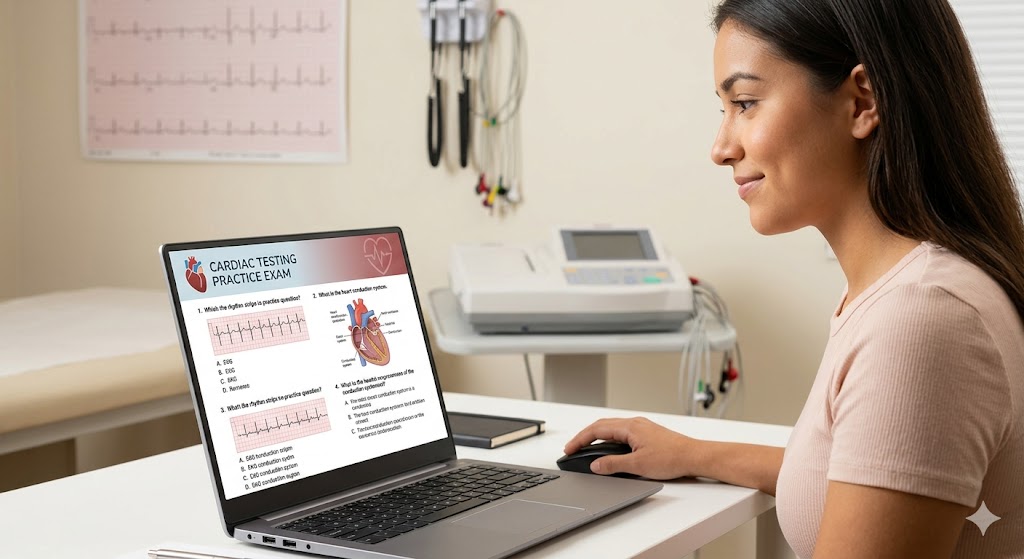
Additional Information
What the Course Entails and
Exam Details
Preparing for the Cardiac Testing
Technician exam requires a blend of theoretical knowledge and practical
clinical skills. You must master the foundational science of the heart
alongside the precise technical protocols for administering cardiac tests. The
practice exam and the official certification course cover several critical
domains that are essential for safe practice.
You will study the detailed
anatomy and physiology of the cardiovascular system, including the flow of
blood through the heart chambers and the body’s electrical conduction system. A
significant portion of your training focuses on EKG (ECG) acquisition. This
entails mastering proper 12-lead electrode placement, troubleshooting equipment
to eliminate artifact, and verifying the quality of the recording. You will
also learn the protocols for specialized procedures, including Holter
(ambulatory) monitoring and stress testing assistance.
The analytical component is
equally vital. You must be able to calculate heart rate, measure waveform
intervals, and interpret cardiac rhythms. Crucially, you will learn to
distinguish normal sinus rhythm from various arrhythmias, including heart
blocks, fibrillation, and life-threatening conditions that require immediate
emergency response. Finally, you will be trained in healthcare safety,
compliance (including HIPAA regulations), and professional patient
communication to ensure high-quality, compassionate care.
What to Expect in the Final
Exam
While specific details can vary
slightly depending on the administering credentialing body, the final
certification exam is typically a computer-based, closed-book assessment
administered in a supervised, quiet environment. You should prepare for a comprehensive
test consisting of multiple-choice questions, which may include matching,
drag-and-drop, or hot-spot questions (clicking specific areas on an image, such
as identifying a lead placement).
The time limit for the final exam
is generally two hours (120 minutes). During this time, you can expect to
answer between 100 and 130 questions. The questions are designed to assess both
your factual knowledge and your ability to apply that knowledge to practical
clinical scenarios. To earn your certification, you will need to achieve a
passing score, which is typically a scaled score that translates to roughly 70%
to 75% correct answers. You must manage your time carefully to ensure you have
enough time to review every question.
How to Study and Exam Centers
Effective study requires a
systematic approach that moves beyond mere memorization. Utilize your course
materials, textbooks, and professional study guides provided by the
credentialing body. Create flashcards dedicated solely to cardiac rhythm
strips; you must be able to identify key arrhythmias instantly. Practice
drawing the heart and its electrical system to solidify your understanding of
anatomy and physiology. Practice lead placement on a volunteer or mannequin if
possible to master the technical skills.
The most effective way to gauge
your readiness is by taking the dedicated Practice Exam. Treat practice tests
like the real day: simulate the testing environment, remove all study
materials, and time yourself strictly. This not only builds stamina but also
reveals your weak areas. Focus your remaining study time on those specific
topics before retaking the practice test. You should take regular breaks, stay
organized, and ensure you are resting well in the days leading up to the test.
When you are ready for the
official exam, registration is completed through the organization’s online
portal. The final exam is taken at authorized physical testing centers, such as
Pearson VUE, which are located nationwide. Some recognized allied health
schools or training programs may also be authorized testing centers for their
own students. Always check the official website of your chosen credentialing
organization to find the most current list of authorized locations and any
options for online proctoring that may be available.
Earning your certification as a
Cardiac Testing Technician opens the door to a specialized, high-demand sector
of the healthcare industry. This credential demonstrates your competence to
employers, distinguishing you as a dedicated professional.
Unlock your potential and explore
the following job opportunities and career paths:
- Certified
EKG Technician: The most common role, focusing on performing resting
12-lead EKGs in hospitals and clinics.
- Cardiology
Technician: A versatile role that administers a range of diagnostic
tests in dedicated cardiology offices.
- EKG
Monitor Technician: A specialized role in telemetry units, monitoring
real-time cardiac activity for multiple patients from a central station.
- Stress
Test Technician: Assisting physicians during cardiac stress tests to
monitor patient safety and data acquisition.
- Holter
Monitor / Ambulatory Monitoring Technician: Focused on setting up,
instructing patients on, and analyzing data from portable cardiac
monitors.
- Pacemaker
/ ICD Technician Assistant: Assisting in the follow-up and monitoring
of patients with implanted cardiac devices.
- Emergency
Department Cardiac Tech: Providing rapid cardiac testing to support
emergency care.
Frequently Asked Questions
Reviews
5.0
Based on 0 reviews
Leave a Review
No reviews yet. Be the first to review!