
Cardiac Vascular Nursing Certification Practice Exam
$69.00
- Buy to unlock unlimited access to all Quiz questions and Answers in this Quiz.
- After purchase you can print a PDF of the whole quiz at any point. The PDF will contain the questions and the correct answers.
About this Exam
The Cardiac Vascular Nursing
Certification is a vital credential for Registered Nurses seeking to
demonstrate their specialized knowledge in managing complex cardiovascular
conditions.
This certification, often offered
by bodies such as the American Nurses Credentialing Center (ANCC), validates
the clinical skills and expertise required to care for patients with heart and
vascular diseases.
It is designed specifically for
licensed RNs who have extensive experience working within cardiac care units,
telemetry, cath labs, or vascular clinics.
Achieving this certification
highlights a commitment to professional excellence and assures patients of a
high standard of specialized care.
Ready to test your knowledge?
Buy Now to Access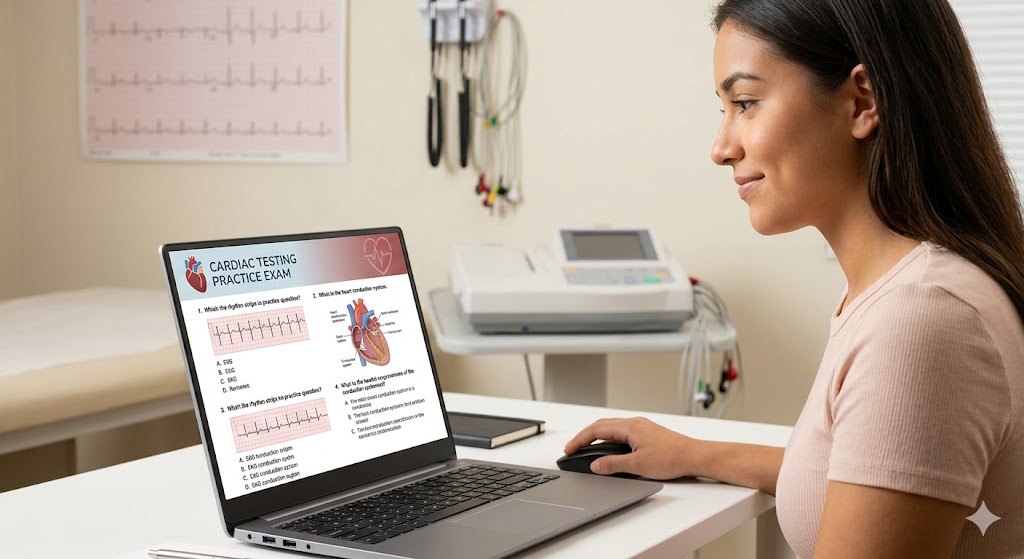
Additional Information
What the Course Entails and Exam Details
To prepare effectively,
candidates must understand the broad range of topics the material covers.
The curriculum is based on a
rigorous breakdown of cardiovascular health, focusing heavily on clinical
assessment and diagnostic methods.
Study areas include advanced
understanding of pathophysiology, such as coronary artery disease, heart
failure, and peripheral vascular disorders.
You will need to demonstrate
mastery of EKG interpretation, hemodynamic monitoring, and the management of
cardiac arrhythmias.
The coursework also emphasizes
therapeutic interventions, acute care protocols, and standard pharmacology for
cardiac patients.
Additionally, a significant
portion of the material covers patient education, secondary prevention
strategies, and ethical, legal, and professional issues in nursing practice.
What to Expect in the Final Exam
The final certification exam is a
computer-based test designed to evaluate clinical decision-making.
The exam typically consists of
150 to 175 multiple-choice questions.
Candidates are usually allotted 3
to 3.5 hours to complete the entire examination.
The passing standard is
determined by a scaled score system; for example, the ANCC often requires a
minimum scaled score of 350 to pass.
You will find a mix of
application and analysis questions, requiring you to utilize critical thinking
rather than simple recall.
Immediate preliminary scoring is
often available upon completion at the testing center.
How to Study and Exam Centers
Effective preparation requires a
combination of structured review and practice.
Start by obtaining the official
test content outline (blueprint) from the certifying body.
Utilize specialized study guides
and cardiovascular nursing textbooks to review core concepts.
Participating in dedicated review
courses can offer structured guidance and clarify difficult topics.
The most critical component of
study is taking a high-quality "Cardiac Vascular Nursing Practice
Exam."
Practice exams simulate the real
test environment, improve time management, and identify knowledge gaps.
Focus on reading the rationales
for both correct and incorrect answers during your practice sessions.
The examination is administered
year-round through authorized testing vendors, such as Prometric or Pearson
VUE.
You can schedule your test at any
of their numerous physical testing centers located globally.
Be sure to review the specific
identification requirements and rules for the testing center prior to exam day.
Job Opportunities from the Course
Obtaining this certification
validates your expertise and makes you a highly desirable candidate for
advanced nursing roles.
Earning this credential can lead
to increased salary potential and greater professional recognition.
Possessing a Cardiac Vascular
Nursing Certification unlocks numerous career paths, including:
- Cardiac
Catheterization Lab Nurse
- Telemetry
Unit Staff Nurse
- Cardiovascular
Intensive Care Unit (CVICU) Nurse
- Cardiac
Rehabilitation Specialist
- Vascular
Access Speciality Nurse
- Heart
Failure Clinic Coordinator
- Nurse
Educator (Cardiovascular Specialty)
- Cardiac
Care Unit Manager
Frequently Asked Questions
Reviews
5.0
Based on 0 reviews
Leave a Review
No reviews yet. Be the first to review!