
CASLI National Interpreter Certification (NIC) Practice Test
$69.00
- Buy to unlock unlimited access to all Quiz questions and Answers in this Quiz.
- After purchase you can print a PDF of the whole quiz at any point. The PDF will contain the questions and the correct answers.
About this Exam
The National Interpreter Certification (NIC) is the premier generalist credential for sign language interpreters in the United States. This certification is jointly managed by the Center for Assessment of Sign Language Interpreters (CASLI) and the Registry of Interpreters for the Deaf (RID). It is designed for interpreters who want to demonstrate professional competency in ethical decision-making, interpreting, and transliterating within a broad range of settings. Earning your NIC signifies that you meet the minimum standards necessary to work reliably and ethically within both the Deaf and hearing communities. A solid CASLI NIC Practice Test is the essential first step toward this career-defining milestone. It builds your confidence and identifies critical knowledge gaps before you face the actual assessments.
Ready to test your knowledge?
Buy Now to Access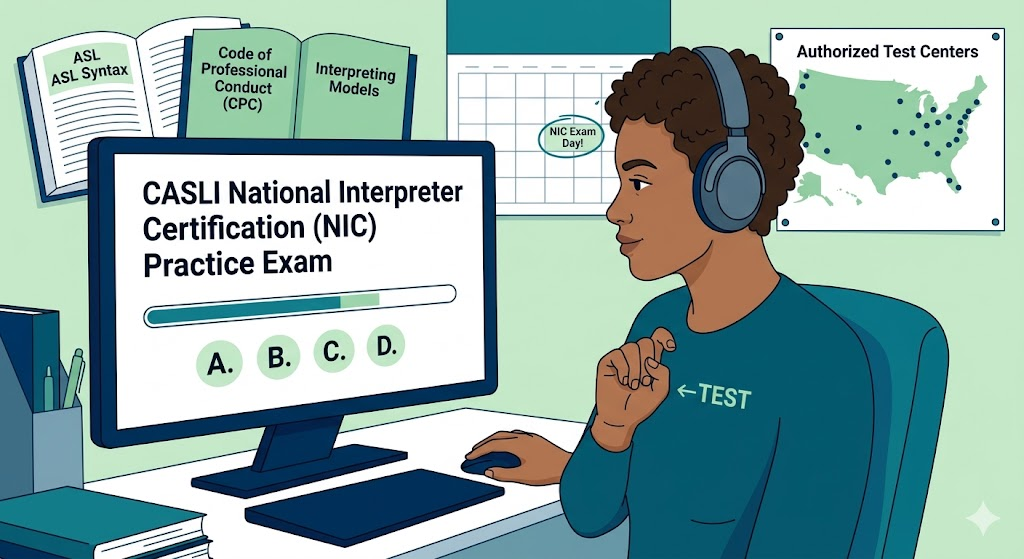
Additional Information
What the Course Entails and Exam Details
While not a unified "course," preparing for the NIC involves mastering three primary domains of expertise. The pathway requires passing two distinct examinations administered by CASLI. The first major hurdle is the CASLI Generalist Knowledge Exam. This computer-based assessment covers interpreting fundamentals, Deaf history, American Deaf culture, and interpreting models. It also heavily emphasizes the RID Code of Professional Conduct (CPC). The second major hurdle is the CASLI Generalist Performance Exam. This is a video-based exam designed to assess your practical interpreting skills. You must demonstrate proficiency in ethical decision-making through an interview portion. Furthermore, you will be tested on your ability to interpret from spoken English to ASL, ASL to spoken English, and in interactive scenarios.
What to Expect in the Final Exam
The CASLI Generalist Knowledge Exam consists of 150 multiple-choice questions. You will typically be given three hours to complete this portion at an authorized testing center. A passing score is defined as a scaled score of 500 or higher on a range from 200 to 800. Candidates receive an immediate score report upon finishing. The CASLI Generalist Performance Exam uses a set of video vignettes to simulate real-world interpreting assignments. The actual testing time is approximately one hour. You will be evaluated by a panel of trained raters against standardized rubrics. The Performance Exam is scored on a pass/fail basis. You will receive a feedback report detailing areas of strength and areas needing improvement if you do not pass.
How to Study and Exam Centers
Effective preparation must begin by taking a reputable CASLI NIC Practice Test. This allows you to pinpoint weaknesses in both theoretical understanding and practical performance. For the Knowledge Exam, study the Code of Professional Conduct (CPC) intensely. Form a study group to discuss complex ethical scenarios. For the Performance Exam, record yourself interpreting daily in diverse settings. Seek mentorship from a certified NIC interpreter to receive honest feedback on your ASL production, English voicing, and processing time. The Knowledge Exam is administered globally through Meazure Learning (formerly ScanTron) at professional testing centers. The Performance Exam requires different logistics and scheduling. Candidates must schedule this component at authorized Local Test Sites (LTS) that possess the necessary recording technology.
Job Opportunities from the Course
Achieving National Interpreter Certification (NIC) is a catalyst for your career. It opens the door to countless high-demand job opportunities in every sector of the field. Certified interpreters have access to premium assignments and often command higher pay rates.
Educational Interpreter (K-12 and Higher Education)
Video Relay Service (VRS) Interpreter
Video Remote Interpreting (VRI) Specialist
Healthcare and Medical Interpreter
Legal Interpreter (Courtroom and Attorney Settings)
Community Interpreter for Government and Social Services
Mental Health Interpreter
Freelance Business and Conference Interpreter
Theatrical and Performing Arts Interpreter
Frequently Asked Questions
Reviews
5.0
Based on 0 reviews
Leave a Review
No reviews yet. Be the first to review!