
CAST Communication Competency Practice Exam
$69.00
- Buy to unlock unlimited access to all Quiz questions and Answers in this Quiz.
- After purchase you can print a PDF of the whole quiz at any point. The PDF will contain the questions and the correct answers.
About this Exam
The CAST Communication Competency Practice Exam is a dedicated preparatory resource designed for candidates seeking roles within the utility and skilled trades sectors. The actual CAST (Construction and Skilled Trades) exam is a battery of aptitude tests developed by the Edison Electric Institute (EEI) to ensure potential employees possess the foundational cognitive skills required to succeed in demanding, safety-sensitive environments. While the comprehensive CAST measures several aptitudes, this practice guide focuses heavily on the verbal reasoning and information transfer skills essential for efficient workplace communication. It is specifically created for individuals applying for positions such as lineworkers, plant operators, technicians, and mechanics, where misunderstanding a technical manual or an oral instruction can have significant consequences. By utilizing this practice exam, candidates can familiarize themselves with the style, pace, and difficulty of the questions they will encounter during the official hiring process.
Ready to test your knowledge?
Buy Now to Access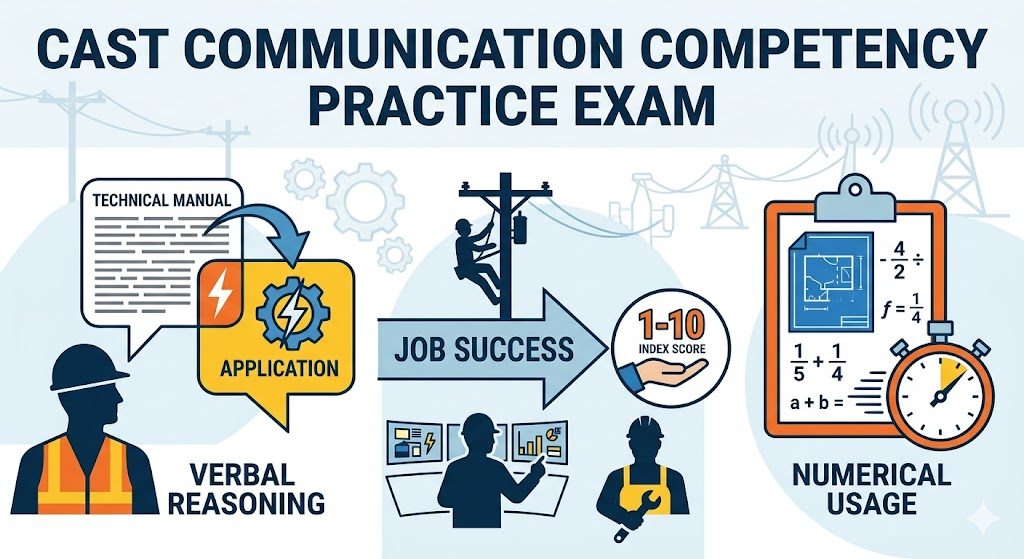
Additional Information
What the Course Entails and Exam Details
A preparatory course focusing on the communication competencies of the CAST exam centers on developing the critical reading and mathematical processing skills necessary for technical communication. The practice exam does not just test memory; it evaluates your ability to absorb new complex information and apply it quickly. The primary skills covered within this communication focus are:
Reading for Comprehension: Your ability to read and understand passage material similar to technical manuals, safety protocols, or company policies.
Mathematical Usage: Your ability to understand and use numerical relationships, including basic operations, fractions, percentages, and conversions, which are often embedded within communication about technical measurements or schedules.
Information Processing: Quickly analyzing written data or instructions to make accurate decisions or predictions, which implicitly tests divided attention and focus.
Logical Reasoning: Drawing correct conclusions from a set of provided workplace scenarios or technical descriptions.
What to Expect in the Final Exam
The official CAST exam administered by employers is a highly structured, timed event. Understanding the format is crucial for success. The full CAST typically includes four test sections, but those focusing on communication competency are characterized as follows:
Format: The exam is strictly multiple-choice. Candidates must select the single correct answer from several options.
Administration: It is classically a paper-and-pencil exam, though some companies may use computerized versions. It is always administered in a proctored environment.
Timing: Time constraints are severe. For example, the Reading Comprehension section may provide approximately 30 minutes for 32 questions, while the Mathematical Usage section is particularly fast-paced (e.g., 7 minutes for 18 questions). Managing your time is as important as knowing the material.
Scoring: CAST results are not given as a simple percentage. They are combined into a single index score ranging from 1 to 10. Individual utility companies set their own minimum index requirements based on the specific job’s requirements. A higher score always increases your competitiveness.
Rules: Generally, no calculators or outside dictionaries are permitted during the communication and math sections.
How to Study and Exam Centers
Preparing for the CAST communication competencies requires a blend of reviewing fundamental skills and mastering test-taking strategy, particularly speed management.
Effective Study Strategies:
Engage in Timed Practice: This is the most critical strategy. Use practice exams to simulate the intense time pressure of the actual test. Learn when to make an educated guess and move on rather than getting stuck on one difficult problem.
Review Fundamentals: Brush up on basic math operations, including fractions, decimals, and metric/imperial conversions. Practice reading technical articles or manuals and summarizing their key points quickly.
Use Official Resources: If your potential employer provides study materials or sample questions, focus on them first, as they are the best representation of what you will see.
Focus on Detail: The CAST tests attention to detail. In the Reading section, answers may hinge on small nuances in the text. In the Math section, small calculation errors can lead to incorrect answers provided as distractors.
Exam Centers and Logistics:
Direct Employer Administration: Unlike standardized academic tests, the official CAST is almost exclusively administered directly by the utility or construction company to which you have applied.
Scheduling: You cannot register to take the CAST on your own at a neutral testing center. Instead, the testing session is scheduled as a formal step in the employer’s hiring and selection process. The company will notify you of the physical location, date, and time.
Location: The testing usually occurs at the company's human resources facility, a designated corporate training center, or occasionally a partnered local community college.
Job Opportunities from the Course
A high score on the CAST exam, particularly the communication and verbal reasoning sections, is essential for unlocking careers in the utility sector. Employers prioritize these skills because these jobs involve complex safety documentation and high-stakes verbal coordination. Passing this exam demonstrates you are a reliable candidate for many technical paths.
Electrical Lineworker Apprentice
Power Plant Operator
Substation Technician
Utility Mechanic
Maintenance Technician
Meter Reader/Service Technician
Hydroelectric Plant Operator
Heavy Equipment Operator (within the utility sector)
Construction Trades Apprentice (e.g., Electrician, Carpenter)
Frequently Asked Questions
Reviews
5.0
Based on 0 reviews
Leave a Review
No reviews yet. Be the first to review!