
Category L Pesticide Certification Practice Test
$69.00
- Buy to unlock unlimited access to all Quiz questions and Answers in this Quiz.
- After purchase you can print a PDF of the whole quiz at any point. The PDF will contain the questions and the correct answers.
About this Exam
The Category L Pesticide
Certification is a specialist credential designed for professional pesticide
applicators seeking advanced authorization in complex or high-risk
extermination scenarios. This certification is typically required for
individuals managing public health pests, performing large-scale fumigations,
or working in sensitive environments where standard licenses do not apply. This
exam is meticulously designed to validate the highest level of competence in
applying restricted-use or complex pesticide formulations safely, legally, and
effectively. This practice test is an essential tool for ensuring you are
thoroughly prepared for this demanding examination.
Ready to test your knowledge?
Buy Now to Access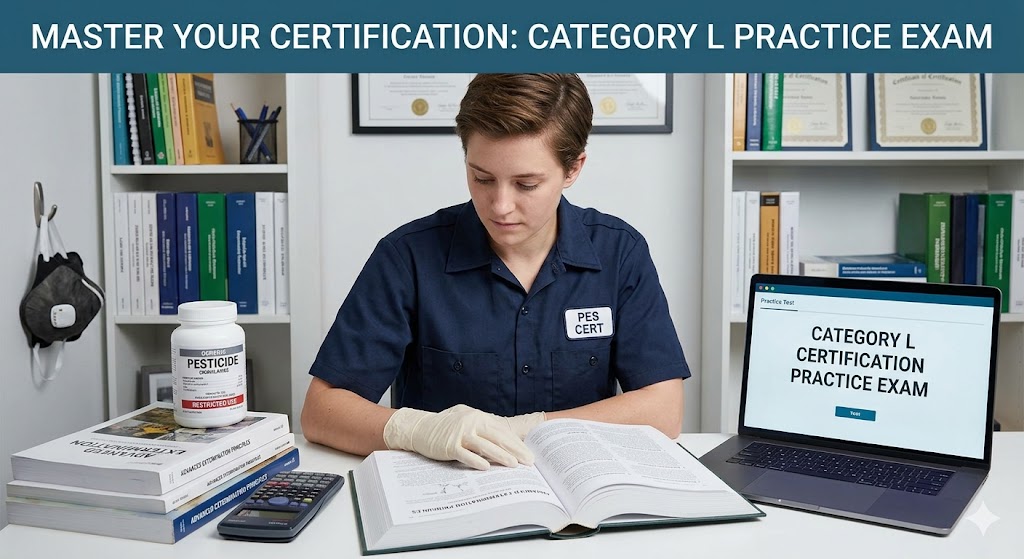
Additional Information
What the Course Entails and
Exam Details
This comprehensive course,
which the practice test simulates, focuses on the intersection of advanced
toxicology, complex mathematical calculations, and stringent regulatory
compliance. Candidates must master a dual syllabus structure. First, you will
build upon a robust understanding of core pesticide principles, including
toxicity classifications, human and environmental health risks, and standard
safety protocols. Second, the "Category L" specialization dives into
advanced application methodologies. This includes detailed study of complex
formulation handling, precision arithmetic required for varied equipment
calibration, specialized safety protocols for non-target organisms, Integrated
Pest Management (IPM) planning for sensitive zones, and navigating detailed
legal frameworks.
What to Expect in the Final Exam
While the exact structure can
vary by jurisdiction, candidates should anticipate a challenging examination,
often comprised of two distinct parts: a "Core" safety and regulatory
knowledge component and a "Category Specific" application component.
In many regions, the final exam format is entirely multiple-choice, though some
modules might be administered as closed-book tests while others, particularly
those requiring heavy arithmetic or specific regulatory lookup, might be
open-book with approved resources. A typical passing score is between 70% and
75% for each section. You should expect strict time limits, often one to two
hours per part, and rigorous proctoring protocols, whether taken in person or
through an authenticated online portal.
How to Study and Exam Centers
Preparation for the Category
L exam requires consistent, active study methods rather than passive reading.
Do not rely solely on the practice test; use it as a diagnostic tool to
identify weak areas. Focus heavily on mastering label interpretation—practice
reading, understanding, and applying directions from a wide variety of
specialist pesticide labels. Develop strong mathematical fluency, creating your
own word problems based on common application scenarios to practice dosage and
area calculations without hesitation. Your primary study resource should be the
official manuals provided by your certifying body. For testing, the process is
usually managed by the relevant provincial or state department (e.g., the
Ministry of Environment, Conservation and Parks in Ontario via OPT&C) or a
third-party administrator like Pearson VUE. Ensure you are familiar with the
specific registration procedures, which might involve online booking portals or
scheduling via an authorized technical vocational school.
Job Opportunities from the Course
A Category L Pesticide
Certification unlocks a distinct range of specialized career paths that demand
a high degree of technical expertise and safety management. Potential job
titles include:
- Specialist Structural
Exterminator
- Fumigation Technician or
Crew Lead
- Integrated Pest
Management (IPM) Coordinator
- Public Health Vector
Control Officer
- Commercial Application
Supervisor
- Agricultural or Forestry
Health Consultant
- Environmental Regulatory
Compliance Inspector
- Advanced Landscape Pest
Manager
Frequently Asked Questions
Reviews
5.0
Based on 0 reviews
Leave a Review
No reviews yet. Be the first to review!