
Cathodic Protection Tester Practice Exam
$69.00
- Buy to unlock unlimited access to all Quiz questions and Answers in this Quiz.
- After purchase you can print a PDF of the whole quiz at any point. The PDF will contain the questions and the correct answers.
About this Exam
Embark on a rewarding career
ensuring the safety and longevity of critical infrastructure with the Cathodic
Protection (CP) Tester certification. This specialized credential is the
industry-standard entry point, designed for professionals responsible for
measuring, recording, and observing the effectiveness of cathodic protection
systems. Whether you are working with underground pipelines, storage tanks, or
marine structures, this certification validates your ability to collect
essential data that prevents catastrophic corrosion. It is ideal for field
personnel, technicians, and anyone beginning their journey in the corrosion
control industry, offering a clear pathway to advanced roles.
Ready to test your knowledge?
Buy Now to Access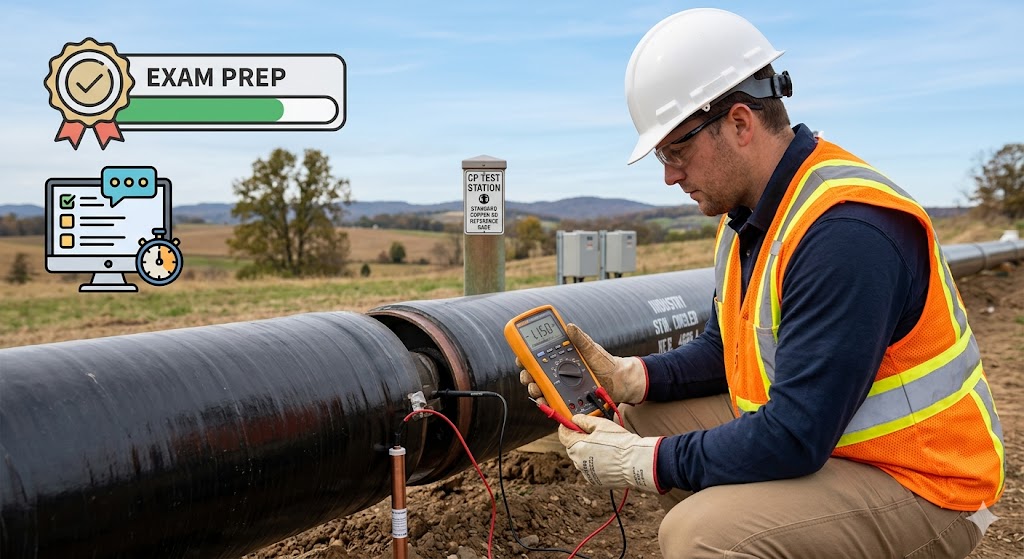
Additional Information
What the Course Entails and Exam Details
The Cathodic Protection Tester
program provides a comprehensive blend of theoretical knowledge and practical
skills. Students dive into the fundamentals of corrosion theory and the direct
current (DC) electrical laws that underpin CP systems. You will learn the
principles of both galvanic (sacrificial) and impressed current cathodic
protection and understand how half-cell reference electrodes are used for
precise measurements. The curriculum focuses heavily on field techniques,
teaching you how to properly use digital multimeters and other specialized
instruments. Key skills include conducting structure-to-soil potential surveys,
performing voltage and current measurements, and understanding how to read and
interpret rectifier data. The course also emphasizes the importance of accurate
data recording, basic safety practices related to cathodic protection work, and
key industry codes.
The corresponding certification
exam is a rigorous assessment of this knowledge base. For most, the main hurdle
is a comprehensive written exam, which is typically administered in a
computer-based format. This test ensures you can not only perform the fieldwork
but also understand the core science and safety protocols necessary to work
effectively and ethically.
What to Expect in the Final
Exam
When you arrive at the testing
center, be prepared for a standardized, closed-book computer-based exam. The
main "Theory" portion of the exam consists of approximately 81
multiple-choice questions designed to test your knowledge across five key
domains. You will be given a strict time limit of 2 and 1/2 hours to complete
all questions, making time management a crucial factor.
The question distribution
typically breaks down into the following key areas:
- Installation and Field
Measurement (40–50%): This section is the most significant part of the
exam, testing your knowledge of actual field techniques and data
collection methods.
- Fundamentals of
Corrosion (30–40%): Ensuring you understand the science of corrosion
itself.
- Equipment Management
(5–15%): Testing your ability to maintain and use CP tools properly.
- Safety (1–10%):
Assessing your understanding of personal and operational safety.
- Industry Practices
(1–10%): Validating your knowledge of common industry standards.
To obtain your certification,
you must achieve a passing score, which is determined by the certifying body
and is subject to change. Candidates are encouraged to check the latest
guidance from AMPP (formerly NACE) regarding the current score requirements. In
some cases, a practical, hands-on exam may also be required, particularly if
you are seeking certification through a specific, structured multi-day course
rather than just challenging the written exam. The results of the
computer-based exam are generally available immediately.
How to Study and Exam Centers
Effective preparation for the CP
Tester exam requires a multifaceted approach. To maximize your chances of
success, you should integrate several active study strategies:
- Utilize Official
Resources: Your first and most important resource is the official AMPP
CP 1 course material. If you have taken the official course, the student
manual, lecture notes, and field guides are foundational to the exam.
- Review the Exam
Preparation Guide (EPG): Access the official EPG provided by AMPP.
This guide outlines the exam's scope, question formats, and provides
sample questions.
- Take Practice Exams:
Leverage reputable "Cathodic Protection Tester Practice Exams."
These resources will familiarize you with the structure and tone of the
actual questions and help you identify areas where your knowledge needs
reinforcement. Look for exams that simulate the computer-based experience.
- Reinforce Practical
Skills: If you don’t have regular field experience, watch
instructional videos showing proper use of multimeters, half-cells, and
specific measurement types like "on/off" potentials.
- Focus on Key Topics:
Dedicate extra study time to the heavily weighted areas like field
measurement techniques and fundamental corrosion science. Ensure you have
memorized common safety procedures and standard values.
You must schedule your final
exam in advance through an authorized testing partner. AMPP primarily partners
with Pearson VUE, which provides access to a massive global network of secure,
computer-based testing centers. When you are eligible to test, you can create
an account on the Pearson VUE website to find a convenient testing location,
date, and time. Ensure you arrive early on exam day and bring the required
forms of valid identification as specified in your appointment confirmation.
Job Opportunities from the
Course
A Cathodic Protection Tester
certification serves as a powerful differentiator in the job market, unlocking
numerous specialized career paths within the large and growing corrosion
control industry. It is highly valued by engineering firms, energy companies,
utility providers, and specialized corrosion control contractors. Upon
certification, you will be qualified to pursue various essential roles,
including:
- Cathodic Protection Tester
- Corrosion Technician
- Field Service Technician
- Asset Integrity Inspector
- CP Specialist (often a
later career progression)
- Pipeline Integrity
Technician
- Infrastructure Inspector
Frequently Asked Questions
Reviews
5.0
Based on 0 reviews
Leave a Review
No reviews yet. Be the first to review!