
Cavalry Scout General Knowledge Practice Test
$69.00
- Buy to unlock unlimited access to all Quiz questions and Answers in this Quiz.
- After purchase you can print a PDF of the whole quiz at any point. The PDF will contain the questions and the correct answers.
About this Exam
The United States Army Cavalry
Scout (MOS 19D) is a critical role responsible for reconnaissance and security
on the battlefield, acting as the eyes and ears of the commander.
This position is designed for
individuals who possess a strong sense of duty, initiative, and the ability to
operate independently or in small teams, often ahead of main friendly forces.
As a crucial step in preparing
for this demanding MOS, this general knowledge study guide helps prospective
and current soldiers master the foundational academic components required for
success.
This practice exam environment
is tailored for soldiers undergoing One Station Unit Training (OSUT), those
preparing for promotional boards, or veterans seeking to brush up on core 19D
competencies.
Mastery of this material is a
hallmark of an elite Scout, proving your commitment to competence and
battlefield survival.
Ready to test your knowledge?
Buy Now to Access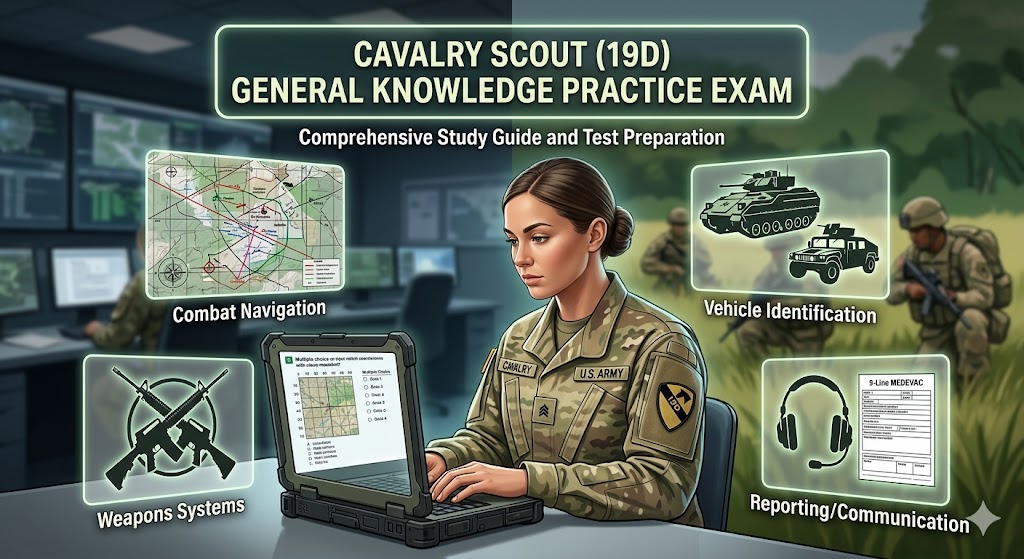
Additional Information
What the Course Entails and
Exam Details
This comprehensive practice
guide covers the essential knowledge base required of every 19D soldier.
The exam syllabus is structured
around four primary pillars of Cavalry Scout operations: Reconnaissance and
Security, Weapons and Gunner Skills, Combat Navigation, and
Communication/Reporting Procedures.
In the Reconnaissance pillar,
you will be tested on the Fundamentals of Reconnaissance, Fundamentals of
Security, different types of patrol operations, and principles of observation.
The Weapons section requires you
to identify and understand the maintenance and operations of individual and
crew-served weapons systems, such as the M4 Carbine, M240 Machine Gun, M2 .50
Caliber Machine Gun, and the MK19 Grenade Launcher.
Combat Navigation tests require
mastery of military map reading, understanding grid coordinates, calculating
azimuths, and identifying terrain features.
Lastly, the Communication pillar
focuses on reporting formats essential for battlefield intelligence, including
the SALUTE report, SALT report, 9-Line MEDEVAC requests, and Call for Fire
procedures.
What to Expect in the Final
Exam
While actual OSUT phase tests
and official promotional exams vary in scope, this General Knowledge Practice
Test is designed to simulate the academic rigors of a standard military written
exam.
The exam consists entirely of
100 multiple-choice questions, which must be completed within a strict 2-hour
time limit.
This format forces you to
develop speed and confidence when identifying critical tactical information
under pressure.
To demonstrate mastery, this
practice exam sets a high bar, requiring a passing score of 80% or higher.
The questions utilize realistic
scenarios and images to test not just rote memorization, but also your tactical
application of the general knowledge.
This is a closed-book, timed
evaluation, simulating the supervised and high-stakes environment of an
official military testing facility.
How to Study and Exam Centers
Effective study for this test
requires a dedicated approach that combines memory recall with practical
application.
Your primary sources of
information should be current Army Field Manuals (FMs), including FM 3-20.96
(Reconnaissance and Cavalry Squadron) and FM 3-21.8 (The Infantry Rifle Platoon
and Squad), as well as Soldier Training Publications (STPs) for MOS 19D.
Create comprehensive flashcards
for vehicle identification, reporting formats (the SALUTE acronym must be
second nature), and medical 9-line requirements.
Spend hours performing "dry
runs" of map reading and land navigation, practicing grid-to-magnetic
azimuth conversions on real military maps.
Utilize our provided digital
practice test portal to identify your weak areas and track your scoring trends,
treating every attempt as if it were the official test day.
The practice test is hosted on
our secure educational portal, allowing you to study anytime from a digital
device.
Please note that this is a practice
guide; the final official written and practical exams for certification or
promotion occur at authorized US Army military testing centers, often located
on major installations or within the OSUT training environment at Fort Moore
(formerly Benning).
Job Opportunities from the Course
Mastery of Cavalry Scout general
knowledge unlocks multiple pathways for career advancement within and beyond
the military structure.
Success on this and associated
MOS evaluations proves your technical competence and readiness for leadership
responsibility.
Your immediate career
opportunities are focused within the Army structure, but your disciplined
training translates significantly to the civilian sector.
Military Career Pathways (MOS
19D)
- Cavalry Scout (Crewmember
or Dismounted)
- Reconnaissance Team Leader
- Scout Section Leader
- Cavalry Platoon Sergeant
- Armor/Cavalry Senior
Advisor
Civilian Career Opportunities
(Translational Skills)
- Law Enforcement Officer
(State/Federal/Local)
- Tactical Team Member (SWAT)
- Emergency Management
Specialist
- Private Security Contractor
(High-Threat Protection)
- Logistics and Mapping
Analyst
- Telecommunications and
Radio Operator
Frequently Asked Questions
Reviews
5.0
Based on 0 reviews
Leave a Review
No reviews yet. Be the first to review!